Acids, bases and pH: definitions, calculations and buffer solutions
Arrhenius, Brønsted and Lewis definitions, the pH scale, strong and weak acids with numerical examples, titrations and buffers with the Henderson-Hasselbalch equation.
Acids and bases are everywhere: in lemons, in car batteries, in blood, in the solutions used to etch printed circuit boards. This lesson explains the definitions, the pH scale, the difference between strong and weak acids and how buffer solutions work.
The definitions
- Arrhenius: an acid releases H+ ions in water, a base releases OH−. Simple, but limited to aqueous solutions.
- Brønsted-Lowry: an acid donates a proton, a base accepts one. Every acid has its conjugate base: in HCl + H2O → H3O+ + Cl−, Cl− is the conjugate base of HCl. It explains why ammonia is a base even though it contains no OH−: NH3 + H2O ⇌ NH4+ + OH−.
- Lewis: an acid accepts an electron pair, a base donates one. It is the most general definition.
Self-ionisation of water and pH
Even pure water contains a few ions: 2 H2O ⇌ H3O+ + OH−, with Kw = [H3O+][OH−] = 1.0·10−14 at 25 °C. To avoid working with powers of ten we use pH:
pH = −log10[H3O+], pOH = −log10[OH−], pH + pOH = 14
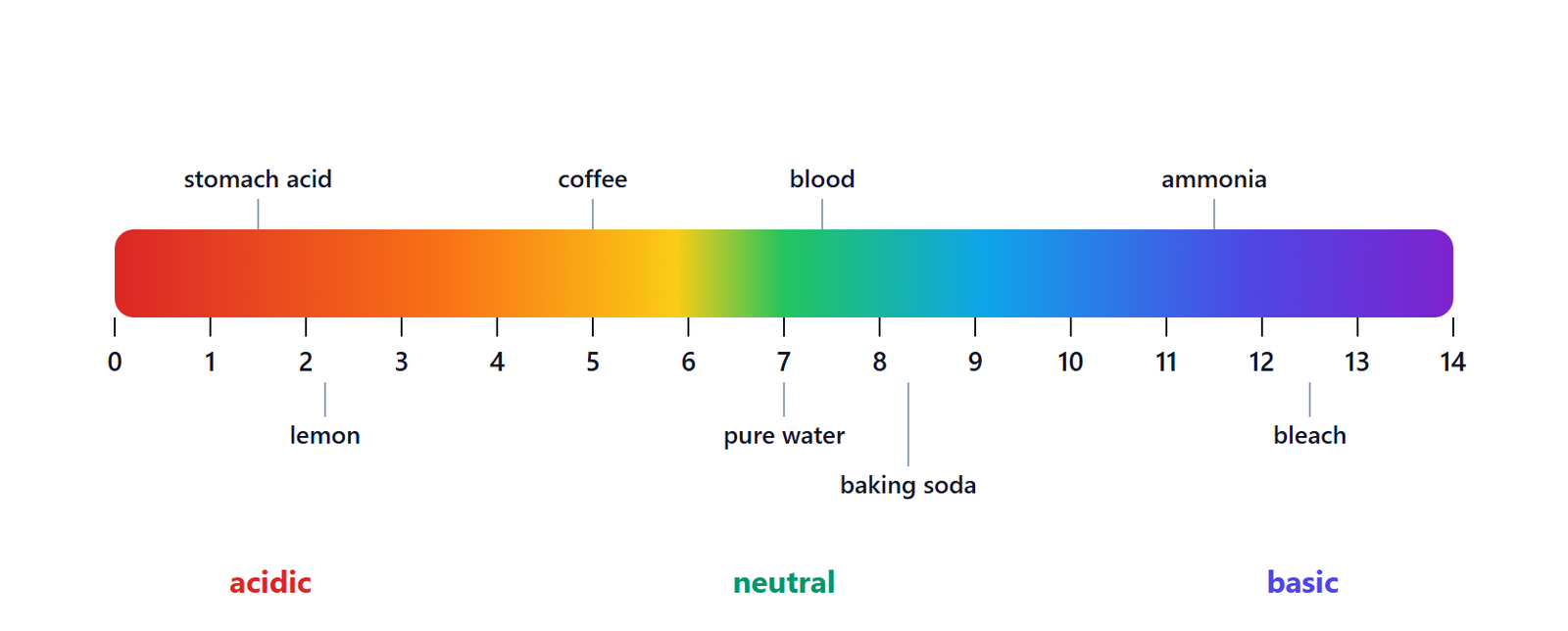
The scale is logarithmic: lemon juice at pH 2 is ten thousand times more acidic than coffee at pH 6. pH 7 is neutral only at 25 °C, because Kw changes with temperature.
Strong acids and bases
They dissociate completely: HCl, HNO3, H2SO4 (first dissociation), NaOH, KOH. The calculation is direct. 0.010 M HCl has [H3O+] = 0.010 and pH = 2. 0.0010 M NaOH has pOH = 3 and therefore pH = 11.
Weak acids and bases
They dissociate only partly, with a constant Ka (or Kb). For a weak acid HA at concentration C, if the dissociation is small the approximation [H3O+] ≈ √(Ka · C) holds.
Example. 0.10 M acetic acid, Ka = 1.8·10−5: [H3O+] ≈ √(1.8·10−6) = 1.34·10−3 M, pH ≈ 2.87. Only 1.3% of the molecules dissociate, so the approximation is justified. For a conjugate pair Ka · Kb = Kw: the stronger the acid, the weaker its conjugate base.
Neutralisation and titration
Acid and base react to form a salt and water. In a titration a base of known concentration is added until all the acid is neutralised (the equivalence point), shown by an indicator that changes colour or by a pH meter. At the equivalence point nacid = nbase (for monoprotic acids and bases): 25.0 mL of HCl neutralised by 20.0 mL of 0.100 M NaOH has a concentration of 0.100 · 20.0 / 25.0 = 0.080 M.
Buffer solutions
A mixture of a weak acid and its conjugate base (for example acetic acid and sodium acetate) resists changes in pH: the acid neutralises added bases, the conjugate base neutralises added acids. The pH is given by the Henderson-Hasselbalch equation:
pH = pKa + log ([A−] / [HA])
With equal amounts of acid and conjugate base the pH equals pKa: 4.74 for the acetate buffer. Blood is buffered by the carbonic acid/bicarbonate pair around pH 7.4.
pH is measured with a glass electrode: the membrane develops a small voltage, about 59 mV per pH unit at 25 °C, which a voltmeter with a very high input impedance turns into a reading. A pH meter is, at heart, an electrometer amplifier.