Electrochemistry: cells, standard potentials, electrolysis and batteries
The Daniell cell, anode and cathode, standard reduction potentials, the Nernst equation, electrolysis with Faraday's laws, battery types and galvanic corrosion.
Electrochemistry is where chemistry and electronics meet: a redox reaction can produce a current (cells and batteries), and a current can drive a reaction that would not happen on its own (electrolysis, electroplating, battery charging). This lesson starts from the Daniell cell and ends with lithium batteries and corrosion.
The Daniell cell
If you dip a zinc strip into copper sulphate solution, copper deposits on the zinc and the solution loses its colour: zinc hands its electrons straight to copper, and the energy is wasted as heat. If the two half-reactions are separated into two vessels, connected by an external wire and a salt bridge, the electrons are forced through the wire: you get a current.
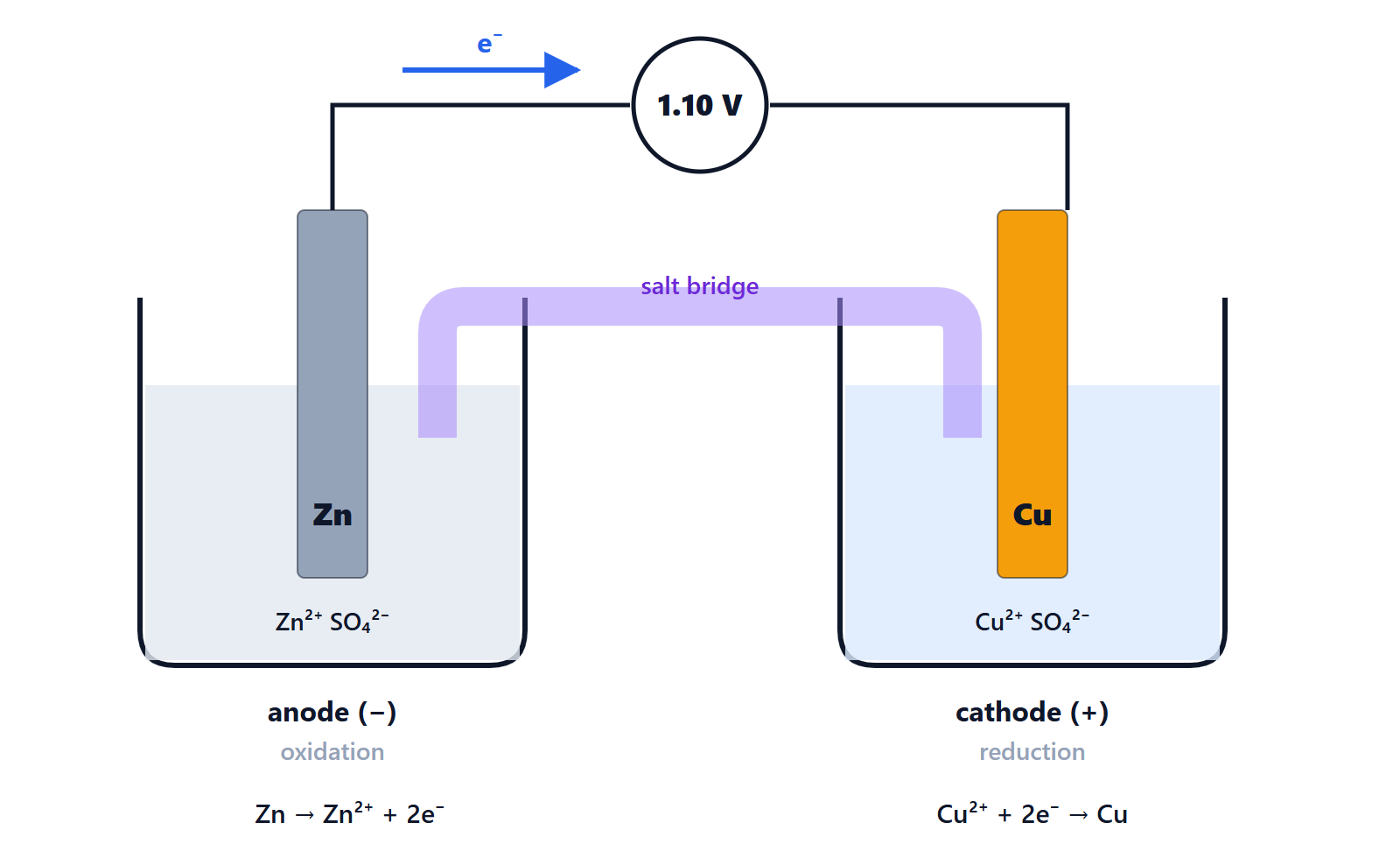
- Anode (negative terminal): oxidation, Zn → Zn2+ + 2e−.
- Cathode (positive terminal): reduction, Cu2+ + 2e− → Cu.
- Salt bridge: a KNO3 or KCl solution that closes the circuit through ion motion and keeps both solutions neutral.
A way to remember it: “an ox and a red cat”, oxidation at the anode, reduction at the cathode. In a galvanic cell the anode is the negative terminal; in electrolysis the signs swap, but the anode is always where oxidation happens.
Standard reduction potentials
Each half-reaction has a standard potential E°, measured against the standard hydrogen electrode (0 V by definition). The higher E°, the more the species tends to be reduced.
| Half-reaction | E° (V) |
|---|---|
| Li+ + e− → Li | −3.04 |
| Zn2+ + 2e− → Zn | −0.76 |
| Fe2+ + 2e− → Fe | −0.44 |
| 2H+ + 2e− → H2 | 0.00 |
| Cu2+ + 2e− → Cu | +0.34 |
| Ag+ + e− → Ag | +0.80 |
| O2 + 4H+ + 4e− → 2H2O | +1.23 |
The cell’s electromotive force is E°cell = E°cathode − E°anode: for the Daniell cell 0.34 − (−0.76) = 1.10 V. The link with thermodynamics is ΔG° = −n·F·E°: with n = 2 and F = 96,485 C/mol you get ΔG° ≈ −212 kJ/mol, a clearly spontaneous reaction.
The Nernst equation
Outside standard conditions the voltage depends on concentrations:
E = E° − (0.0592 / n) · log Q (at 25 °C)
As the cell discharges, products build up, Q grows and the voltage falls, down to zero at equilibrium: a flat battery is a reaction that has reached equilibrium. The same equation explains the glass electrode of a pH meter, which produces about 59 mV per pH unit.
Electrolysis and Faraday’s laws
Applying a voltage larger than the electromotive force drives the reaction in its non-spontaneous direction: this is electrolysis, used to produce aluminium and chlorine, for electroplating and for charging batteries. The amount of substance transformed is proportional to the charge: n = Q / (z·F), with Q = I·t.
Example. How much copper is deposited by 2.00 A for 30 minutes? Q = 2.00 · 1800 = 3600 C; n = 3600 / (2 · 96,485) = 0.0187 mol; mass = 0.0187 · 63.55 = 1.19 g. It is the calculation behind copper plating of printed circuit boards.
Batteries
| Type | Cell voltage | Rechargeable | Typical use |
|---|---|---|---|
| Alkaline Zn-MnO2 | 1.5 V | no | remote controls, toys |
| Lead-acid | 2.0 V | yes | cars, UPS units |
| NiMH | 1.2 V | yes | rechargeable AA cells |
| Lithium-ion | 3.6-3.7 V | yes | phones, laptops, electric cars |
| Lithium iron phosphate (LFP) | 3.2 V | yes | energy storage, electric cars |
Lithium-ion batteries exploit lithium’s very negative potential: during discharge Li+ ions move from the graphite of the anode to the metal oxide of the cathode, while the electrons go round the external circuit. Capacity is measured in ampere-hours: a 3000 mAh cell at 3.7 V stores about 11 Wh.
Corrosion
Rust is an unintended cell: iron is oxidised in one area (the anode) and oxygen is reduced in another (the cathode), with moisture acting as the electrolyte. When two different metals touch in the presence of moisture, the one with the lower potential corrodes faster: this is galvanic corrosion, the reason why aluminium and copper connectors must be paired with care. Iron is protected by galvanising or by sacrificial anodes of zinc or magnesium, which are consumed in its place.