Physical quantities, units and vectors
The SI, dimensional analysis with the pendulum example, significant figures, vector components, addition, dot and cross products with a worked example.
Physics describes the world with numbers, but a number alone is not enough: “3” means nothing, “3 metres” means something, and “3 metres north” means even more. This first lesson sets up the tools needed for the whole course: quantities and units, dimensional analysis, vectors and their operations.
Physical quantities and the SI
A physical quantity is a property that can be measured: length, mass, time, temperature. The result of a measurement is always a number followed by a unit. The International System of Units (SI) starts from seven base quantities; all the others (velocity, force, energy, charge) are built by combining them.
| Quantity | SI unit | Symbol |
|---|---|---|
| length | metre | m |
| mass | kilogram | kg |
| time | second | s |
| electric current | ampere | A |
| temperature | kelvin | K |
| amount of substance | mole | mol |
| luminous intensity | candela | cd |
Since 2019 every SI unit is defined by fixing the exact value of a constant of nature: the second from a transition frequency of caesium, the metre from the speed of light ( m/s), the kilogram from Planck’s constant, the ampere from the electron charge.
The derived units we will use most are the newton ( ), the joule (
 ), the watt (
 ) and the pascal (
 ).
Dimensional analysis
Every physical equation must be homogeneous: both sides must have the same dimensions. It is the fastest check there is for catching a mistake in a calculation. We write [L], [M], [T] for the dimensions of length, mass and time.
Example. The period of a simple pendulum might depend on the length  , the mass
 and
 . Write
 and match the dimensions:

For mass  , for length
 , for time
 . So
 ,
 and
 . Dimensional analysis does not give the constant
 (we will see it is
 ), but it tells us straight away that the period does not depend on the mass and that four times the length gives twice the period.
Significant figures and uncertainty
A measurement without its uncertainty is incomplete:  m. In calculations the result cannot be more precise than the data: if you time something to a hundredth of a second, there is no point in writing the speed with six decimals. Rule of thumb: in products and quotients keep as many significant figures as the least precise input has.
Scalars and vectors
Mass, time, temperature and energy are scalars: a number with its unit is enough. Displacement, velocity, acceleration and force are vectors: they need a magnitude, a direction and a sense. We write  (or bold) and the magnitude
 or simply
 .
In a Cartesian frame each vector can be split along the axes using the unit vectors  , which have length 1 and point along the axes:

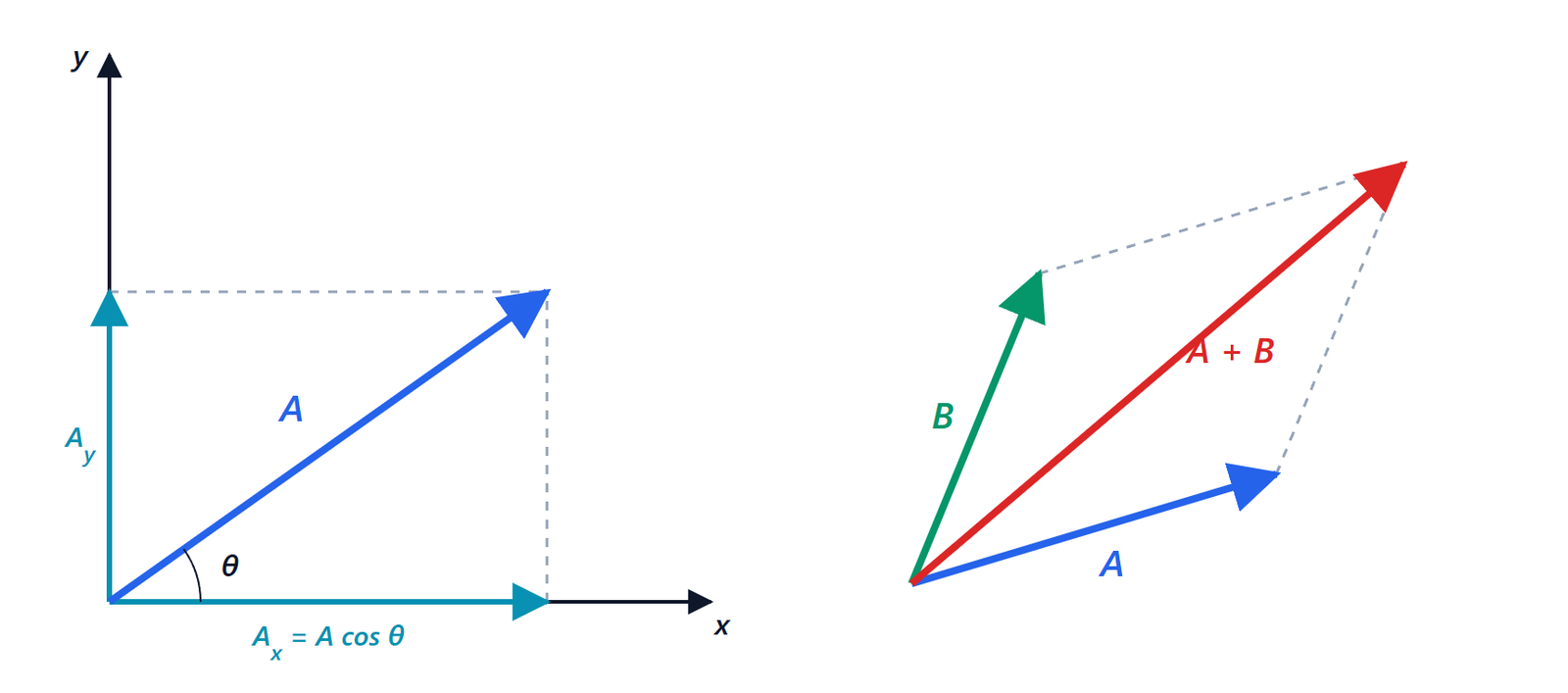
 and
 of a vector in the plane. Right: the sum
 is the diagonal of the parallelogram built on the two vectors.
In the plane, if  is the angle with the
 axis:

Be careful with the last formula:  returns an angle between
 and
 , so when
 you have to add
 . The atan2 function of calculators and programming languages does this for you.
Sum and difference
Geometrically, the sum is found with the parallelogram rule, or by placing the tail of the second vector on the tip of the first. With components it is even simpler: add component by component.

The difference  is the sum of and the opposite of
 . Multiplying a vector by a scalar multiplies its magnitude by
 and, if
 , reverses its sense.
Example. A boat moves east at 4 m/s on a river whose current flows north at 3 m/s. Its velocity relative to the bank is  m/s, with magnitude
 m/s, at an angle
 from east.
Dot product
The dot (scalar) product of two vectors is a number:

where  is the angle between them. It is largest when they are parallel, zero when they are perpendicular, negative when the angle is obtuse. In physics it appears in the work of a force,
 , and in power,
 .
Proof: the dot product in components
The unit vectors of the axes are perpendicular to each other and have length 1, so  and
 . Expanding the product with the distributive property, of the nine terms only those with equal unit vectors survive:

This formula gives the angle between two vectors known by their components: 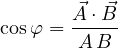 . With
 you get Pythagoras’ theorem in three dimensions,
 .
Cross product
The cross (vector) product  is a vector:
- magnitude
 , the area of the parallelogram built on the two vectors;
- direction perpendicular to the plane of and ;
- sense given by the right-hand rule: index finger along , middle finger along , the thumb points along
 .
It is not commutative:  . The product of a vector with itself is zero. In components it is computed with a determinant:

We will use it for the torque of a force,  , for angular momentum and, in Physics 2, for the Lorentz force
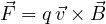 , the working principle of every electric motor.
Worked example
Given  and
 , find ,
 , the angle between the vectors and
 .
- Sum:
 .
- Dot product:
 .
- Magnitudes:
 ,
 ;
 , so
 .
- Cross product:
 .
Quick check: the cross product must be perpendicular to :  . Correct.