Thermodynamics in depth: kinetic theory, Kelvin and Clausius, Carnot's theorem, Otto and Diesel cycles
Pressure and temperature from molecular motion, equipartition and specific heats, equivalence of the statements of the second law, Carnot's theorem, efficiency of the Otto and Diesel cycles, entropy in mixing and free expansion, table of processes.
This page goes deeper into the lessons on the first and second laws of thermodynamics. It derives the pressure of a gas from the motion of its molecules and the microscopic meaning of temperature, explains specific heats with the equipartition of energy, proves the equivalence of the Kelvin and Clausius statements and Carnot’s theorem, computes the efficiency of the Otto and Diesel cycles of combustion engines, and shows with two examples that the entropy of the universe increases in real processes. At the end is the table to remember of ideal-gas processes.
Pressure from molecular motion
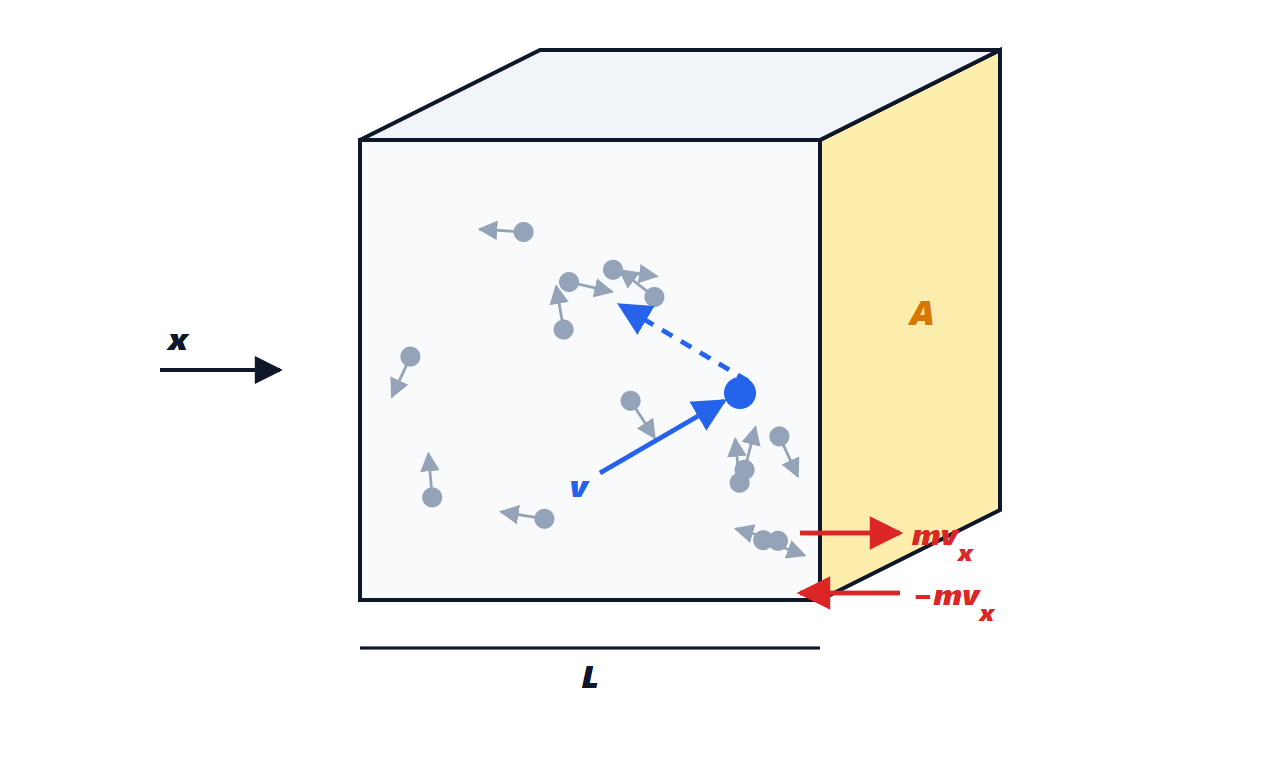
Theorem. A gas of  molecules of mass
 in a volume
 exerts on the walls the pressure

where  is the mean of the square of the speed.
Proof. Take a cubic container of side  and a wall of area
 perpendicular to the
 axis. A molecule with component
 hits the wall elastically: its momentum along goes from
 to
 , and the wall receives the impulse
 . The molecule returns to the same wall after travelling
 back and forth, i.e. every
 seconds. The average force it exerts is impulse over time:
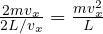 .
Summing over all molecules:  , and
 . The directions are equivalent, so
 . ∎
The meaning of temperature. Comparing with the equation of state  (with
 J/K):
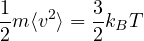
Absolute temperature measures the mean translational kinetic energy of the molecules. The root-mean-square speed is  : for nitrogen at 300 K about 517 m/s, for hydrogen 1930 m/s.
Equipartition and specific heats
The previous result says that each translational direction carries on average  . The equipartition theorem (from statistical mechanics) generalises this: every quadratic term in the energy of a molecule (a degree of freedom) has on average .
- Monatomic gas: only 3 translations.
 ,
 ,
 ,
 .
- Diatomic gas at room temperature: 3 translations and 2 rotations (rotation about the molecular axis does not count).
 ,
 ,
 . This is the value for air.
- At high temperatures (above about 1000 K for
 ) vibrations “unfreeze”, with two quadratic terms (kinetic and elastic):
 tends to
 .
Why vibrations are “frozen” at room temperature is explained by quantum mechanics: vibrational energy can only grow in jumps, and if the jump is much larger than  collisions cannot excite it. It is one of the first cracks in classical physics, noticed by Maxwell as early as 1860.
Kelvin and Clausius say the same thing
Kelvin-Planck statement: there is no cyclic machine that converts into work all the heat taken from a single reservoir. Clausius statement: there is no cyclic machine whose only effect is to transfer heat from a cold body to a hot one.
Theorem. The two statements are equivalent: if one is false, so is the other.
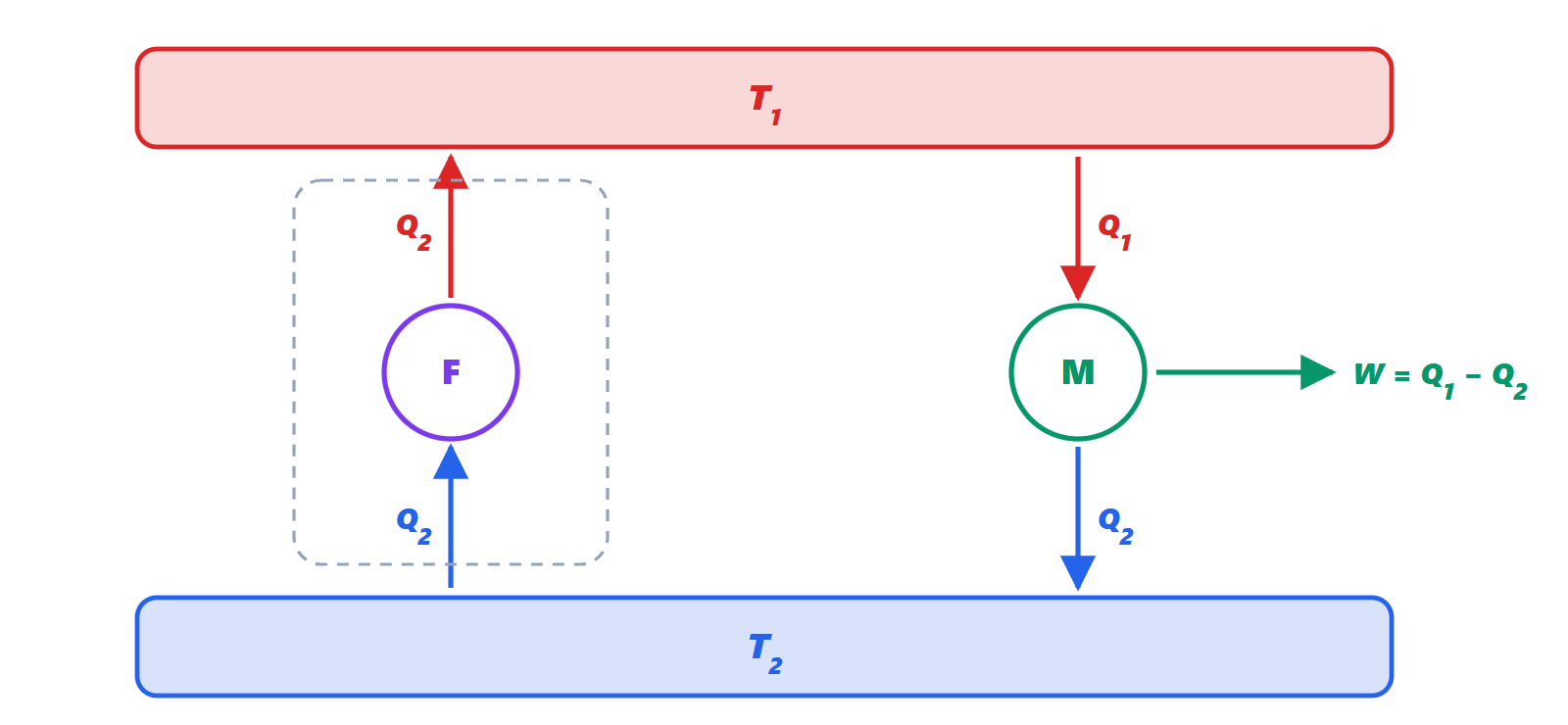
Proof. *If Clausius is false, Kelvin is false.* Suppose a refrigerator F exists that, without work, carries heat  from the cold reservoir
 to the hot one
 . Couple F with an ordinary heat engine M that takes
 from , produces
 and gives exactly to . Overall the cold reservoir does not change (it receives and gives ), the hot reservoir gives
 , and the work is obtained: a machine that turns entirely into work the heat of a single reservoir. Kelvin is violated.
*If Kelvin is false, Clausius is false.* Suppose a machine exists that turns into work  all the heat
 taken from . Use to run an ordinary refrigerator that takes from and gives
 to . Overall the hot reservoir receives
 , the cold one gives , and there is no external work: Clausius is violated. ∎
Carnot’s theorem
Theorem. No engine working between two reservoirs  has an efficiency greater than a reversible engine between the same reservoirs; all reversible engines between and have the same efficiency,
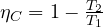 .
Proof. Let X be an engine with efficiency  , where R is reversible. Adjust the two engines so that they produce the same work : X takes
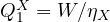 from , R would take
 . Run R in reverse, as a refrigerator, driven by the work of X: R gives
 to and takes
 from . Overall no work is produced, the hot reservoir receives
 and the cold one gives the same amount: heat from cold to hot with no other effect, against Clausius. So
 .
If X is also reversible, swapping the roles gives  : the efficiencies are equal. It is then enough to compute it for the Carnot cycle of the ideal gas, as in the lesson. ∎
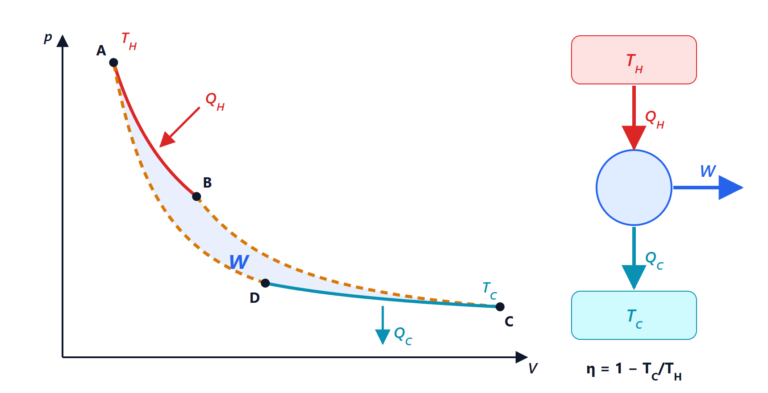
The Carnot efficiency depends neither on the substance nor on the machine, only on the temperatures: it is a limit of nature, not of technology. A power plant with steam at 840 K and a condenser at 300 K cannot exceed 64 %; real ones reach about 45 %.

Engine cycles: Otto and Diesel
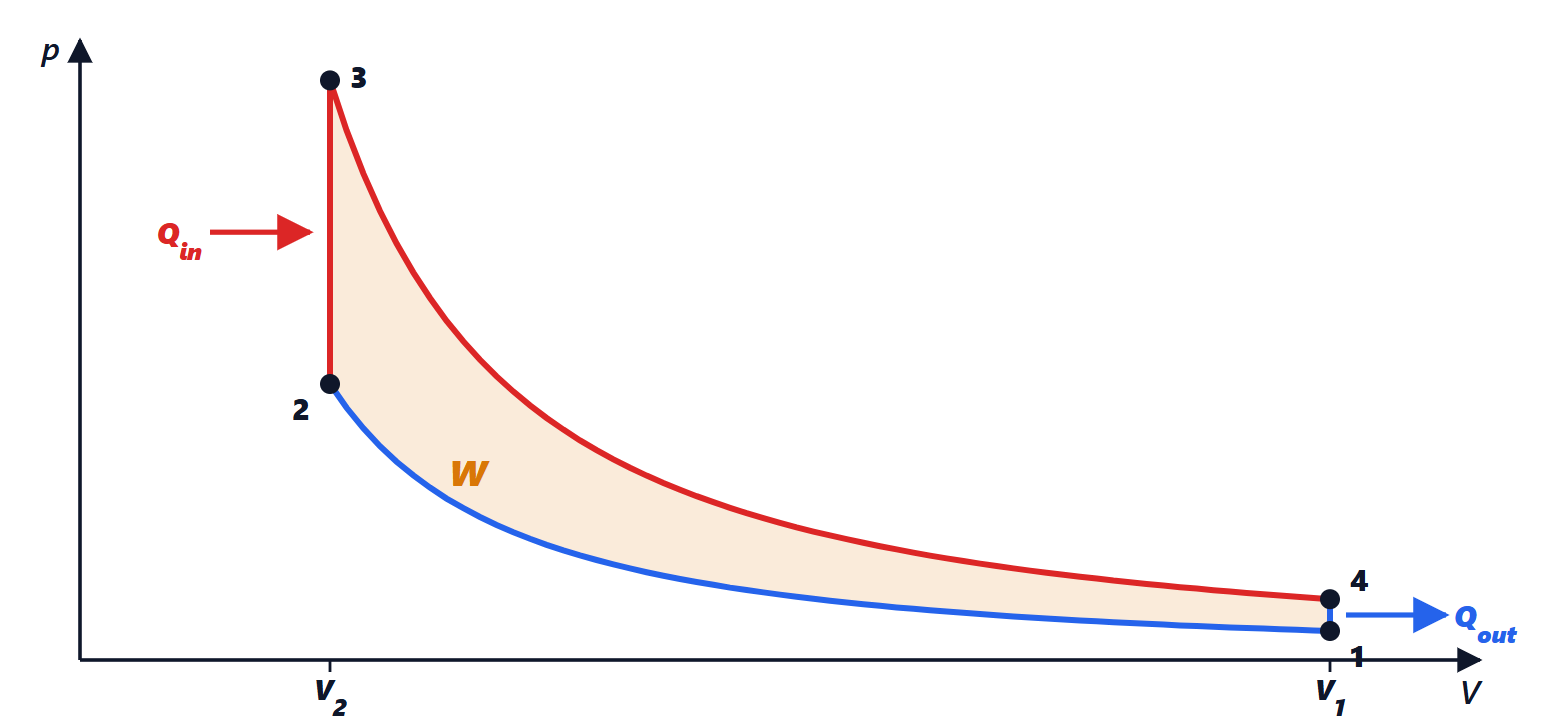
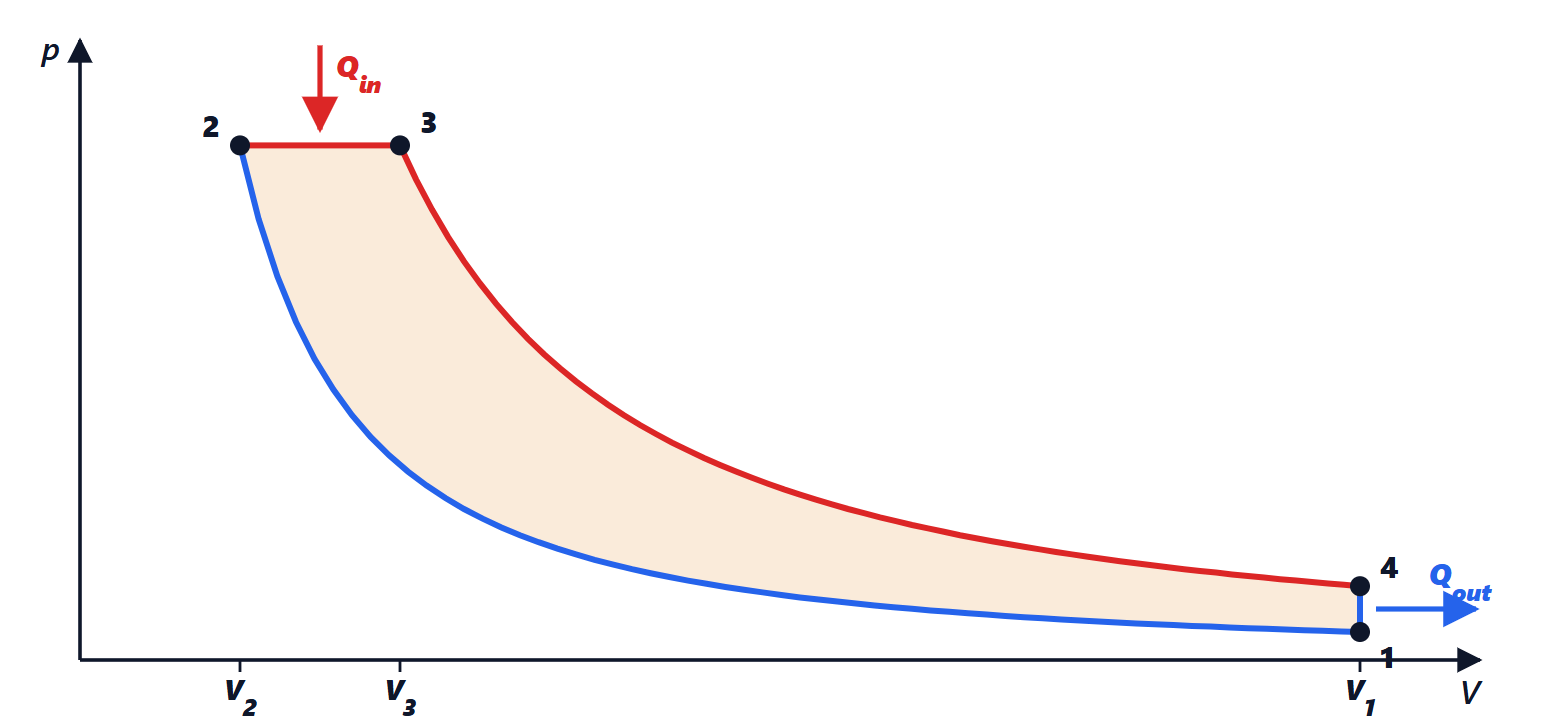
The Otto cycle idealises the petrol engine: adiabatic compression 1→2, instantaneous combustion at constant volume 2→3, adiabatic expansion 3→4, exhaust at constant volume 4→1. The parameter is the compression ratio  .
Theorem. The efficiency of the ideal Otto cycle is  .
Proof. Heat enters only in the isochoric 2→3,  , and leaves only in the isochoric 4→1,
 . On the adiabats
 is constant, and the volume ratios are the same:
 and
 . So
 and

∎
With  and ,
 %. Increasing
 increases the efficiency, but beyond about 10-12 the mixture ignites by itself before the spark (detonation, “engine knock”).
The Diesel cycle differs in that combustion happens at constant pressure (2→3), because the diesel fuel is injected and burns while the piston moves down. With the compression ratio and the cut-off ratio  , the same reasoning (with
 ) gives

For the same the Diesel is less efficient than the Otto (the second factor is greater than 1), but by compressing only air it can use  –
 without detonation, and in the end it is more efficient.
The entropy of the universe increases: two examples
Mixing hot and cold water. Two equal masses of water, at and , reach  . Heat flows irreversibly, but to compute the entropy one imagines a reversible heating between the same initial and final states:
 , so

because the arithmetic mean is always greater than the geometric mean (unless  ). The cold body gains more entropy than the hot one loses, because it receives the same heat at a lower temperature.
Free expansion. An isolated ideal gas expands into a vacuum from to  when a valve is opened. There is no work (the vacuum exerts no pressure) and no heat (isolated):
 , and for the ideal gas the temperature does not change. Yet the process is irreversible: the gas does not go back by itself into the starting half. The entropy is computed along a reversible isotherm between the same states:
 , although no heat has flowed. Entropy is not just “heat over temperature”: it measures the number of accessible microscopic states, which is multiplied by
 when the volume doubles.

Table to remember
Reversible processes of  moles of ideal gas, with molar and
 :
| Process | Law | (done by the gas) | |  |  |
|---|---|---|---|---|---|
| isochoric | constant | 0 |  | |  |
| isobaric |  constant |  |  | |  |
| isothermal |  constant |  |  | 0 |  |
| adiabatic |  constant |  | 0 | | 0 |
Other formulas to keep at hand:  (Mayer);
 ; on the adiabat and
 are also constant;
 between any two states; efficiency
 ; coefficients of performance
 and
 ;
 J/(mol·K)
 L·atm/(mol·K).
Exercises on processes, cycles, engines and entropy, from basic to exam level, are on the exercise page linked at the top.