Fluid mechanics: hydrostatic pressure, Pascal, Archimedes and Bernoulli
Density and pressure, hydrostatic pressure, Pascal's principle, buoyancy and floating, the continuity equation, Bernoulli's equation and its applications, viscosity.
Liquids and gases have no shape of their own: they flow. To describe them we do not follow individual pieces, we use quantities defined point by point such as density, pressure and velocity. In this lesson we look at fluid statics (Stevin’s law, Pascal’s and Archimedes’ principles) and at the dynamics of ideal fluids (continuity and Bernoulli), with proofs that use only Newton’s laws and energy conservation.
Density and pressure
Density is mass per unit volume,  : water is about 1000 kg/m³, air at sea level 1.2 kg/m³, mercury 13,600 kg/m³.
Pressure is the perpendicular force per unit area,  , measured in pascals (Pa = N/m²). Atmospheric pressure at sea level is about 101,325 Pa, that is 1 atm or 1.013 bar. In a fluid at rest the pressure at a point is the same in every direction.
Stevin’s law (hydrostatic pressure)
Proof
Inside a liquid at rest of density  , consider a small vertical cylinder of cross-section
 and height
 . The vertical forces on it are the pressure on the top face,
 downwards, the pressure on the bottom face,
 upwards, and the weight of the liquid,
 . Sideways forces cancel by symmetry. In equilibrium:

Pressure grows linearly with depth and does not depend on the shape of the container. In water it rises by about 1 atm every 10 m: at a depth of 10 m a diver feels twice the pressure at the surface.
Torricelli’s barometer. A tube full of mercury turned upside down in a dish drops to a height such that  : about 760 mm. Hence the unit mmHg, still used for blood pressure.
Pascal’s principle
A change in pressure applied to an enclosed fluid is transmitted unchanged to every point of the fluid. The hydraulic press uses it: a small piston of area  pushed with force
 creates a pressure
 that also acts on the large piston of area
 , with force

With an area ratio of 100 you lift a car with the force needed to lift a suitcase. No energy is gained: the small piston must travel a hundred times further. It is the principle of hydraulic brakes and jacks.
Archimedes’ principle
A body immersed in a fluid receives an upward push equal to the weight of the fluid it displaces:

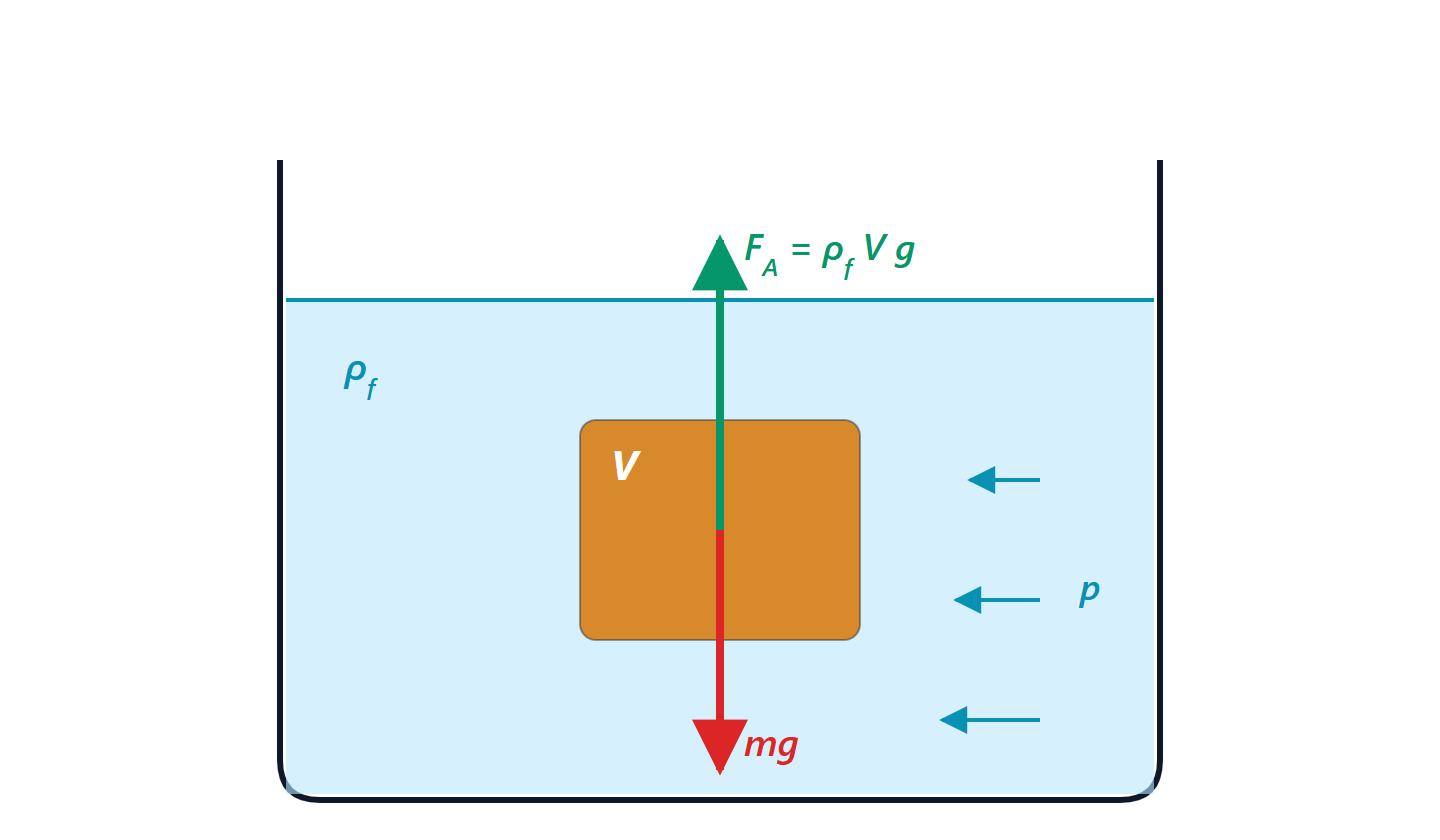
 feels its weight
 and the buoyant force
 . Buoyancy arises because the liquid’s pressure (light blue arrows) grows with depth.
Proof
Take a box-shaped body with horizontal faces of area and height , immersed in a fluid of density  . The forces on the side faces cancel in pairs. On the top face, at depth
 , pressure pushes down with
 ; on the bottom face, at depth
 , it pushes up with
 . By Stevin’s law the difference is

For a body of any shape, argue like this: if fluid were in its place, it would be in equilibrium, so the push of the surrounding pressures is exactly the weight of that fluid. The pressures do not change if the body takes the fluid’s place.
Floating. A body floats if its average density is less than the fluid’s. At equilibrium the submerged part  satisfies
 , that is
 . Ice (917 kg/m³) in sea water (1025 kg/m³) has about 89% of its volume under water: the famous tip of the iceberg. A steel ship floats because its average density, air in the hull included, is less than water’s.
Moving fluids: the continuity equation
Consider an incompressible fluid flowing steadily through a pipe of varying cross-section. In a time  a volume
 passes through section ; the same volume must leave through section , because the fluid neither piles up nor compresses:

The product  is the flow rate (m³/s). Where the pipe narrows, the fluid speeds up: it is what you do when you squeeze the end of a garden hose with your thumb.
Bernoulli’s equation
For an ideal fluid (incompressible and without viscosity) in steady flow, along a streamline

Proof
Follow a portion of fluid that, in a time , moves from one part of the pipe (section , pressure  , speed
 , height
 ) to another (,
 ,
 ,
 ). The net effect is that a small volume
 of mass
 moves from the first position to the second.
The fluid behind pushes with  over a distance
 , the fluid ahead resists with
 over
 . The work of the pressure forces is
 . By the work-energy theorem, writing the work of gravity as a change in potential energy:

Dividing by  and collecting the terms with index 1 and 2 gives Bernoulli’s equation. It is energy conservation per unit volume.
Consequences
- Torricelli’s theorem. From a hole at depth below the free surface of an open tank, the liquid comes out at
 , the same speed as a stone dropped from that height: the pressure is atmospheric both at the top and at the outlet.
- Venturi effect. In a horizontal constriction the speed rises, so the pressure falls. Measuring the pressure difference between two sections gives the flow rate: it is the principle of Venturi meters and of the carburettor.
- Lift. A wing is shaped so that air flows faster over it than under it: the pressure difference produces an upward force. The full explanation also needs how the wing deflects air downwards, but Bernoulli gives the right order of magnitude.
Limits of the ideal model: viscosity
Real fluids have internal friction, viscosity  . In a pipe of radius
 and length
 in laminar flow, the flow rate follows Poiseuille’s law,
 : halving the radius cuts the flow by sixteen times. That is why a narrowed artery is so dangerous, and why liquid cooling in computers uses tubes that are not too thin. At higher speeds the flow turns turbulent, and the Reynolds number
 says when: in a pipe, above roughly 2000 to 4000.