Foundations: bearing capacity and settlement
Shallow and deep foundations, Terzaghi's formula, 2:1 spreading proved, oedometric settlement proved with an example, consolidation, differential settlement and the Tower of Pisa.
All loads end up in the ground, which is the weakest and most variable material of the construction. Foundations distribute the loads so that the ground neither fails nor settles too much. In this lesson we look at foundation types, bearing capacity, stress spreading in the soil with the 2:1 method proved, oedometric settlement with its proof and an example, and differential settlement.
Foundation types
- Shallow foundations: pad footings under individual columns, strip footings under several columns, rafts covering the whole plan. They are used when the upper soil layers are strong enough.
- Deep foundations: piles, which carry the load to strong deep layers by end bearing, or transmit it along the shaft by skin friction.
The choice depends on site investigations: boreholes, in-situ tests and laboratory tests on samples, which give the stratigraphy and mechanical parameters of the soil.
Bearing capacity
If the pressure under a foundation is too high, the soil fails: a slip surface forms and the foundation sinks while rotating. The ultimate load is calculated with Terzaghi’s three-term formula, later extended by other authors:

whose three terms represent the contribution of cohesion  , of the soil above the founding level (depth
 , unit weight
 ) and of the weight of the soil below the foundation (width
 ); the coefficients
 depend on the soil’s friction angle and grow very rapidly with it. The design pressure must stay below
 divided by a safety factor. Founding deeper increases bearing capacity, and widening the foundation reduces the pressure.
Stress spreading
The load of a foundation spreads in the soil over larger and larger areas with depth, and the additional stress decreases. Boussinesq’s elastic theory gives the exact distribution for an elastic half-space; for quick calculations the 2:1 method is used.

Theorem (2:1 method). If the load of a rectangular foundation  spreads with a slope of 2 vertical to 1 horizontal on each side, the average additional stress at depth
 below the founding level is
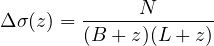
Proof. With the 2:1 slope, at depth each side of the footprint has widened by  on each side, i.e. by in total: the spreading area is
 . The total load is conserved (vertical equilibrium of a block of soil, neglecting its weight, which is counted separately), and the average stress is the load divided by the area. ∎
Settlement
Soil compressed under a foundation is confined laterally by the neighbouring soil: it deforms almost only vertically. Its behaviour is measured with the oedometer test, in which a sample enclosed in a rigid ring is loaded vertically; the ratio of stress to strain is the oedometric modulus  .
Theorem. A layer of thickness  , with oedometric modulus , subjected to a uniform increase in vertical stress
 , settles by
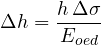
Proof. With lateral strain prevented, the vertical strain is  by definition of the oedometric modulus, uniform in the layer; the shortening is the strain times the thickness. ∎
If the stress varies with depth, the soil is divided into layers and the settlements are added.
Example. A 2 m by 2 m footing carries 800 kN: contact pressure 200 kPa. Below there is a 4 m clay layer with  MPa. At mid-layer,
 m, the additional stress is
 kPa. The settlement is about
 m, i.e. 20 mm. In clays settlement is not immediate: water must leave the pores, and consolidation can last months or years.
Differential settlement
A structure tolerates uniform settlement well, even of a few centimetres; it is differential settlements, different from one support to another, that crack it, because they impose relative displacements that an indeterminate structure cannot follow without stresses (Structural Mechanics lesson on the elastic line). They are limited through angular distortion (the relative settlement divided by the distance between columns), which usually must stay below 1/500 so as not to damage infill walls. The remedies are stiffer foundations that spread loads (strip footings, rafts), piles carrying the loads to stiffer layers, or joints separating parts of the building founded on different soils. The Leaning Tower of Pisa is the most famous example of differential settlement, and also of how it can be corrected: between 1990 and 2001 it was straightened by about 40 cm by extracting soil from under the side opposite the lean.