Steel connections: bolts and welds
Bolt classes and shear resistance with an example, a bolt group under moment proved with an example, fillet welds with an example, pinned and rigid joints.
A steel structure is made of pieces, and the connections joining them are often the critical point: many collapses started at a joint, not a beam. Connections are made with bolts or welds. In this lesson we look at bolts and their shear resistance with an example, the distribution of forces in a bolt group subjected to a moment with its proof and an example, fillet welds with an example, and the classification of joints.
Bolts
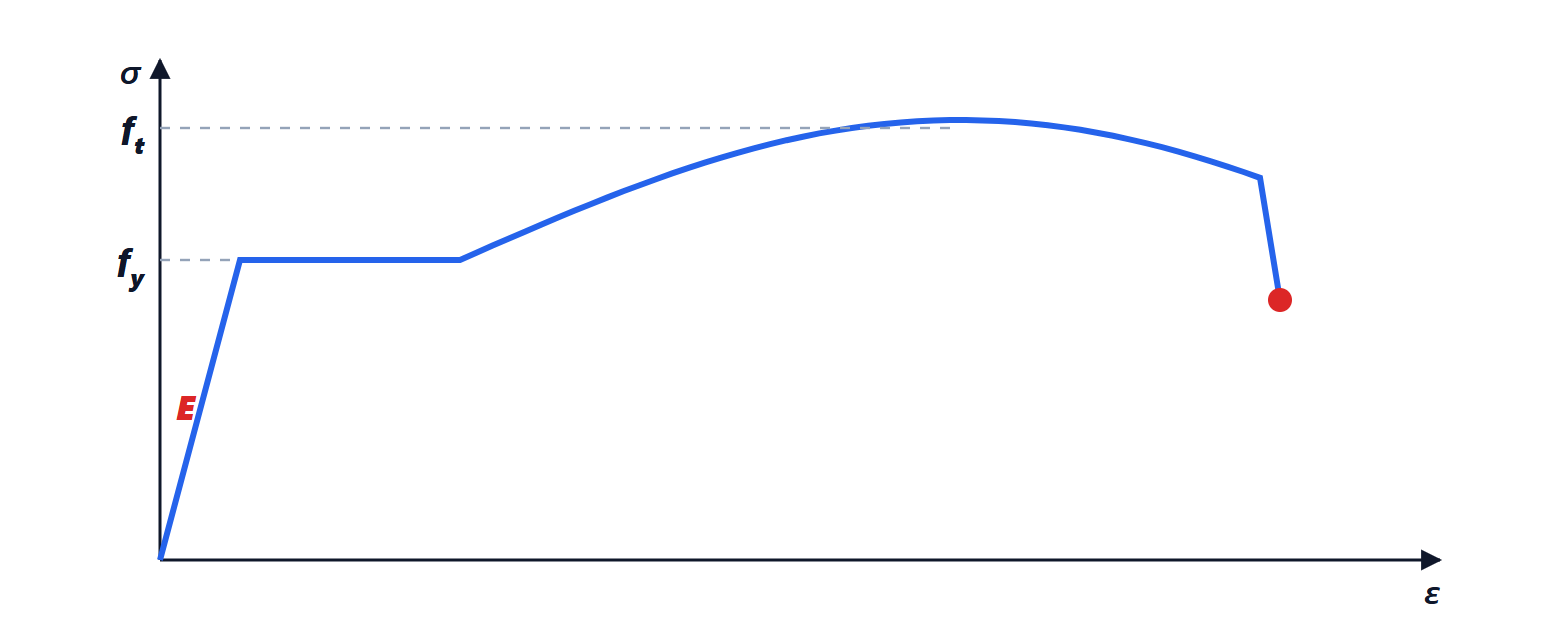
A bolt is designated by its diameter and class: for example M16 class 8.8, where 8 indicates a tensile strength of 800 MPa and the second number the ratio between yield and ultimate (0.8, hence 640 MPa). In shear connections, the plates tend to slide over each other and the bolt shank resists. The shear resistance of a shear plane through the threaded part is
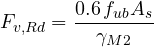
with  the tensile stress area of the thread and
 . Example. M16 8.8:
 mm²,
 kN. Bearing is also checked, i.e. crushing of the plate against the shank, which depends on the thickness and edge distances, as well as the resistance of the plates with holes. In slip-resistant connections, with high-strength bolts tightened with a controlled torque, the plates are clamped so tightly that they transmit the force by friction, without slip: they are used when the connection must not move, for example under repeated loads.
Bolt group subjected to a moment
A bracket bolted to a column, with an eccentric load, loads the bolt group with a force and a moment. The force is shared equally among the bolts; the moment as follows.

Theorem. If the plate rotates rigidly about the centroid of the group, a moment  produces on bolt
 , at distance
 from the centroid, a force perpendicular to the radius of magnitude

Proof. In a rigid rotation through a small angle  , bolt moves by
 perpendicular to the radius. With elastic behaviour the force is proportional to the displacement:
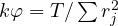
 , always perpendicular to the radius. The moment of all the forces about the centroid must equal :
 , so
 and
 . ∎
The bolts furthest away are the most heavily loaded: to resist moments the group should be spread out, just as in bending material should be placed far from the neutral axis.
Example. Four bolts at the corners of a 100 mm square:  mm for all,
 mm². With
 kNm:
 kN per bolt, to which the share of the direct force is added vectorially. With M16 8.8 bolts (60 kN) the connection is verified.
Welds
Welding joins pieces by melting the base metal with a filler metal. The most common in structures are fillet welds, of triangular section, whose design dimension is the throat thickness  , the height of the triangle (about 0.7 times the leg). The resistance is computed on the throat area
 , with the simplified method of the codes:
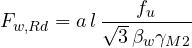
with  the ultimate strength of the base material and
 a correlation factor (0.85 for S275). Example. S275 (
 MPa), 5 mm throat, 200 mm length:
 kN. Shop welds are reliable; site welds are harder to control, which is why the preference is to weld in the shop and bolt on site. Welds must be inspected (visually, with dye penetrants, ultrasound or radiography) and are sensitive to fatigue under repeated loads.
Joints
Beam-column joints are classified by stiffness and strength:
- pinned: they transmit shear but practically no moment (for example an angle cleat bolted to the beam web); the structure must be braced;
- rigid: they transmit moment with negligible rotation (extended end plates, welded flanges); they allow unbraced frames;
- semi-rigid: an intermediate case, to be modelled with its rotational stiffness.
The structural model must match how the joints are actually built: a joint designed as a pin that in reality transmits moment, or vice versa, changes the distribution of internal forces (Structural Mechanics lesson on the elastic line).