Elasticity, Hooke's law and strength criteria
Strains, Young's modulus and Poisson's ratio, G = E/(2(1+ν)) proved, the stress-strain curve of steel, Tresca and von Mises criteria with an example.
A loaded material deforms; as long as the stress stays below a limit, removing the load restores it: this is elastic behaviour. Beyond it, the material deforms permanently and finally breaks. In this lesson we look at strains, Hooke’s law with Young’s modulus and Poisson’s ratio, the proof of the relation between shear modulus and Young’s modulus with an example, the stress-strain curve of steel, and strength criteria for combined stress states with an example.
Strains
Strain measures the change of shape: normal strain  is the relative elongation of a segment, shear strain
 the change of the angle, initially a right angle, between two segments. Like stresses, strains at a point form a symmetric tensor. They are very small numbers: a structural steel at yield elongates by about 0.1 %.
Hooke’s law
For a linear elastic isotropic material, in simple tension:

where  is Young’s modulus and
 Poisson’s ratio: a bar in tension lengthens and thins. Typical values: steel
 GPa,
 ; aluminium 70 GPa, 0.33; concrete 30 GPa, 0.2; wood along the grain about 11 GPa. For a general stress state the strains add by superposition:

with  the shear modulus.
Theorem. For an isotropic material
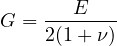
Proof. Consider a state of pure shear:  ,
 . Mohr’s circle (lesson on stress) has its centre at the origin and radius
 : the principal stresses, at 45°, are
 and
 . Along direction 1 Hooke’s law gives
 . But the same deformation, seen in the
 ,
 axes, is a shear strain; Mohr’s circle for strains, analogous to the one for stresses with
 in place of , gives for pure shear
 . So
 , and
 . ∎
Example. Steel:  GPa. An isotropic material therefore has two independent elastic constants, not three.
The stress-strain curve
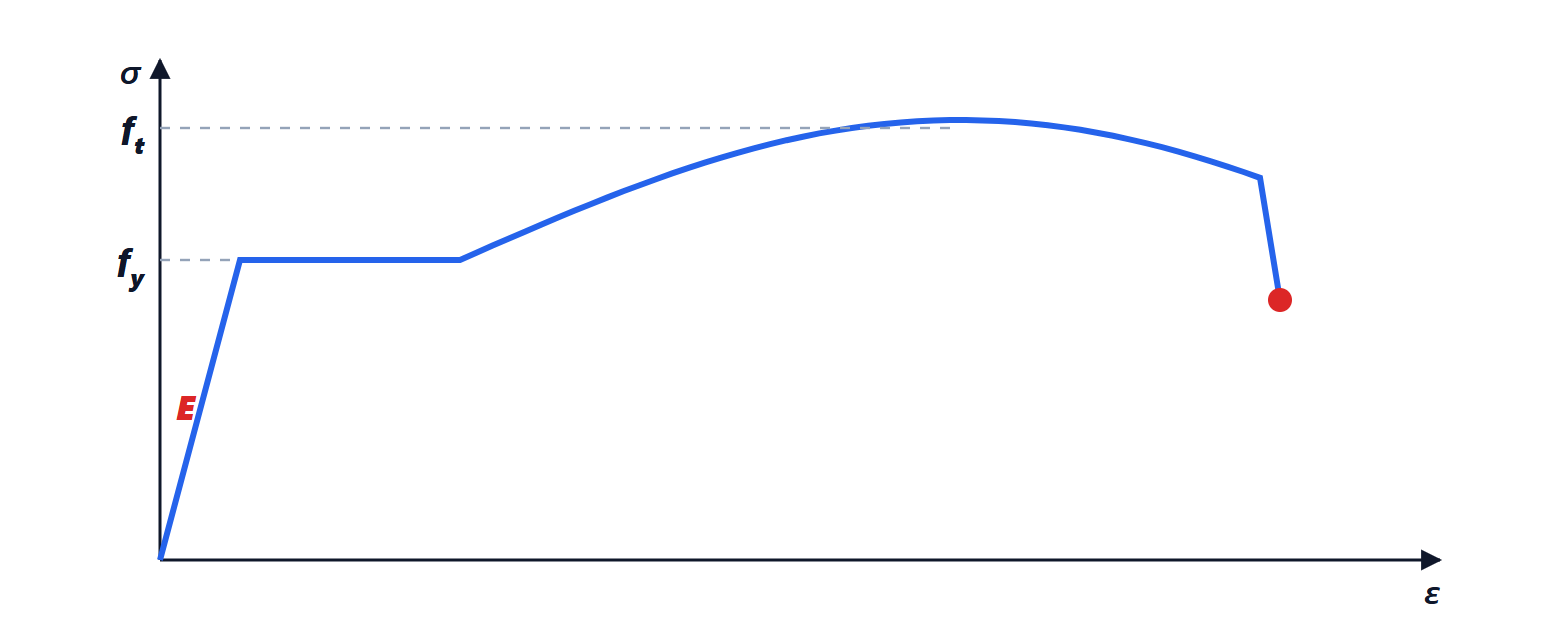
The tensile test of a mild steel shows a linear elastic segment, yielding at  (235, 275 or 355 MPa for steels S235, S275, S355), a long plastic segment in which the material elongates at almost constant stress, strain hardening up to the strength
 , and fracture after elongations of 20 % or more. This ductility is precious: a steel structure deforms visibly before collapsing, giving warning and redistributing loads (Building Techniques lesson on steel). Brittle materials (glass, cast iron, concrete in tension, ceramics, the silicon of chips) instead break without warning, just beyond the elastic range.
Strength criteria
The tensile test gives a single number; in a real structure the stress state is combined. A strength criterion defines an equivalent stress to be compared with that of the uniaxial test. For ductile materials:
- Tresca (maximum shear stress):
 ;
- von Mises (distortion energy):
 .
In a beam, with a normal stress  and a shear stress , the von Mises criterion reduces to
 , Tresca’s to
 .
Example. At a point of an S235 steel beam,  MPa and
 MPa. Von Mises:
 MPa < 235 MPa, verified; Tresca, more conservative:
 MPa. For brittle materials criteria on the maximum principal tensile stress are used.