The elastic line, deflections and indeterminate structures
The elastic line equation, deflection 5qL⁴/384EI proved with an example, deflection limits, the force method and the 3qL/8 reaction of a propped cantilever proved.
A beam must be strong, but also stiff enough: a floor that deflects too much cracks floors and walls, a shelf that bounces is annoying, a robot arm that bends misplaces its tool. In this lesson we look at the elastic line equation, the proof of the deflection of a simply supported beam under uniform load and a check example, and the method for solving statically indeterminate structures with compatibility conditions, with the proof of the reaction of a propped cantilever.
The elastic line equation
From Navier’s formula (lesson on bending) the curvature of the beam axis is proportional to the moment:  . For small displacements the curvature is approximately the second derivative of the vertical displacement
 , and with
 positive downwards:
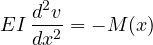
Integrating twice and imposing the conditions at the supports (zero displacement at supports, also zero rotation at fixed ends) gives the deflected shape. The product  is the flexural stiffness.
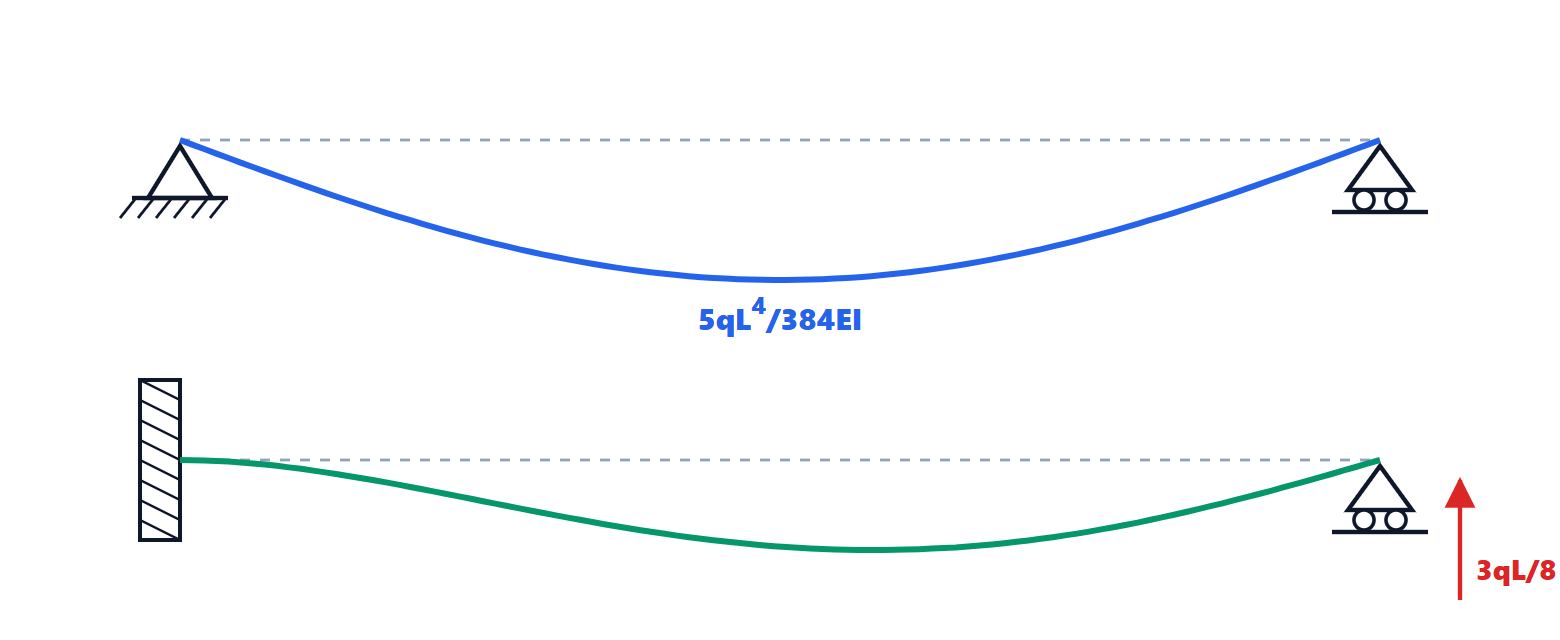
Deflection of the simply supported beam
Theorem. A simply supported beam of span  under uniform load
 has a midspan deflection

Proof. The moment is  (lesson on internal forces), with positive downwards. Integrating
 twice:

The conditions  and
 give
 and
 . So
 . At
 :
 . ∎
Example. The 6 m beam with 10 kN/m, made with an IPE 300 steel section ( cm⁴,
 GPa):
 mm, i.e. about
 . Codes usually require deflections below
 (24 mm) for floors and
 –
 where there are brittle partitions: verified. Deflection grows with the fourth power of the span: at 12 m, with the same section and load, it would be 16 times larger.
Statically indeterminate structures
In a statically indeterminate structure (lesson on statics) the equilibrium equations are not enough. The force method removes the redundant constraints, replacing them with the unknown reactions, and requires the structure, made determinate, to deform compatibly with the removed constraints. By linearity superposition holds.
Theorem. A beam fixed at one end and simply supported at the other, under uniform load , has at the support the reaction

and at the fixed end the moment  .
Proof. Remove the support: a cantilever remains. The load produces at the free end a deflection  ; an upward force
 at the end produces a lift
 (both obtained by integrating the cantilever’s elastic line, with zero displacement and rotation at the fixed end). The support requires zero displacement:
 , so
 . By equilibrium, at the fixed end the reaction is
 and the moment
 . ∎
The result does not depend on  and
 , because the beam has constant stiffness; in general, in indeterminate structures internal forces depend on the relative stiffnesses of the members: a stiffer member attracts more load. For complex structures (building frames, trusses with many bars) the method generalises into the displacement method, in which the unknowns are the displacements of the joints: it is the basis of the finite element method, with which almost every structure is analysed today.