Shear and torsion
Jourawski's formula, maximum shear 1.5 V/A in a rectangle proved, torsion of circular shafts proved with an example, hollow shafts, thin open and closed sections.
Besides the moment, a beam carries shear, and shafts, cantilevers with eccentric loads and springs carry torsion. Both produce shear stresses. In this lesson we look at Jourawski’s formula for shear with the proof of the maximum value in a rectangular section, torsion of circular shafts with its proof and an example, and the behaviour of thin open and closed sections.
Shear: Jourawski’s formula
Shear is not distributed uniformly over the section. Jourawski derived it from the equilibrium of a portion of beam cut horizontally: the change of moment along the beam produces, above a chord, a thrust that must be balanced by shear stresses on the chord itself. The result is
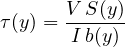
where  is the first moment, about the neutral axis, of the part of the section beyond the chord at level
 , and
 is the width of the chord.
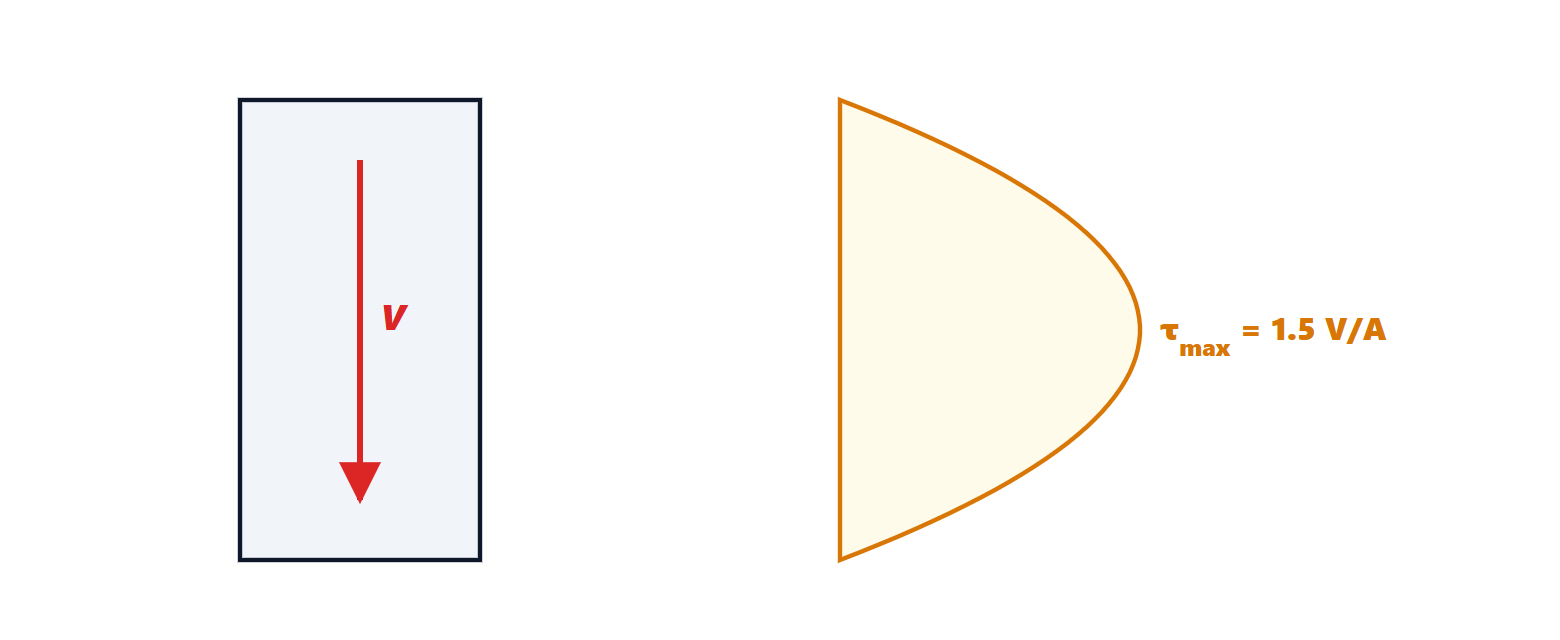
Theorem. In a rectangular section  the shear stress has a parabolic profile, zero at the edges, and the maximum, at the neutral axis, is
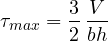
Proof. The part of the section beyond level has area  and centroid at distance
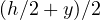 from the neutral axis, so
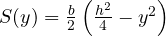 . With
 and
 :

a parabola vanishing at  , with maximum at
 :
 . ∎
The shear maximum is at the neutral axis, where the bending stress is zero; at the edges the opposite happens. This is why the two checks are usually made at different points, and only in I sections, at the web-flange junction, is it worth combining them with a strength criterion (lesson on elasticity). In I sections shear is carried almost entirely by the web, with a stress roughly equal to  divided by the web area.
Torsion of circular shafts
A transmission shaft, a motor shaft, a screw being tightened are subjected to a torque  .
Theorem. In a solid circular shaft of diameter  , the shear stress grows linearly from the centre to the edge:
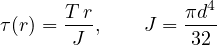
and the angle of twist per unit length is  .
Proof. By symmetry circular sections remain plane and rotate rigidly relative to each other. If two sections a distance  apart rotate by
 , a fibre at radius
 undergoes a shear strain
 , and by Hooke’s law
 : linear in the radius. The moment of the stresses must equal the applied one:
 , where
 is the polar moment of inertia. So
 and
 . For the circle, in polar coordinates,
 . ∎
Example. A 40 mm shaft transmits 1 kNm:  mm⁴, and at the edge
 MPa. The material at the centre works little: a hollow shaft with the same outer diameter and half the inner diameter weighs 25 % less and loses only 6 % of its torsional stiffness, because depends on the fourth power of the radius. Car drive shafts are tubes for this reason.
Thin open and closed sections
For non-circular sections the theory is more complex, and one practical conclusion is important. A thin closed section (a tube, a box) has very high torsional stiffness: shear stresses circulate around the contour with a constant flow, and is proportional to the square of the enclosed area. An open section of the same material (a channel, a tube slit lengthwise) is hundreds of times more flexible in torsion. An intact cardboard tube resists torsion well; slit along a generatrix, it twists with one finger. This is why frames, fuselages and bridge box girders are designed as closed sections.