Kinematics: straight-line, projectile and circular motion
Position, velocity and acceleration as derivatives, the laws of uniformly accelerated motion, a projectile's path, range and maximum height, centripetal acceleration and relative motion.
Kinematics describes motion without asking what causes it: where a body is, how fast it goes, how its velocity changes. The tools are the vectors of the previous lesson and the derivatives of Analysis 1. In this lesson we derive the laws of straight-line motion, projectile motion and circular motion, which we will then use throughout dynamics.
Position, velocity, acceleration
The motion of a point is described by the position vector  as a function of time. Velocity is its derivative, acceleration is the derivative of velocity:

The average velocity over an interval  is
 : the slope of the chord on the position-time graph, while the instantaneous velocity is the slope of the tangent. The instantaneous velocity is always tangent to the path.
Going the other way uses integrals: knowing the acceleration and the initial conditions, you rebuild velocity and position.

Uniform straight-line motion
If the velocity is constant,  and the position grows linearly:
 . On the
 graph this is a straight line of slope
 .
Uniformly accelerated motion
Proof of the three laws
With constant acceleration  , integrating once gives the velocity and integrating again gives the position:


Taking  from the first and substituting into the second removes time:

This last one is very handy when time does not matter. Example: a car at 100 km/h (27.8 m/s) brakes at 7 m/s². The braking distance is  m. At 130 km/h it becomes about 93 m: the distance grows with the square of the speed.
An important case is free fall: near the Earth’s surface every body, without air, accelerates downwards at  m/s², whatever its mass.
Projectile motion
A body launched with velocity  at an angle
 above the horizontal, ignoring air, has constant acceleration
 . The key idea is that the two motions are independent: horizontally the motion is uniform, vertically it is uniformly accelerated.
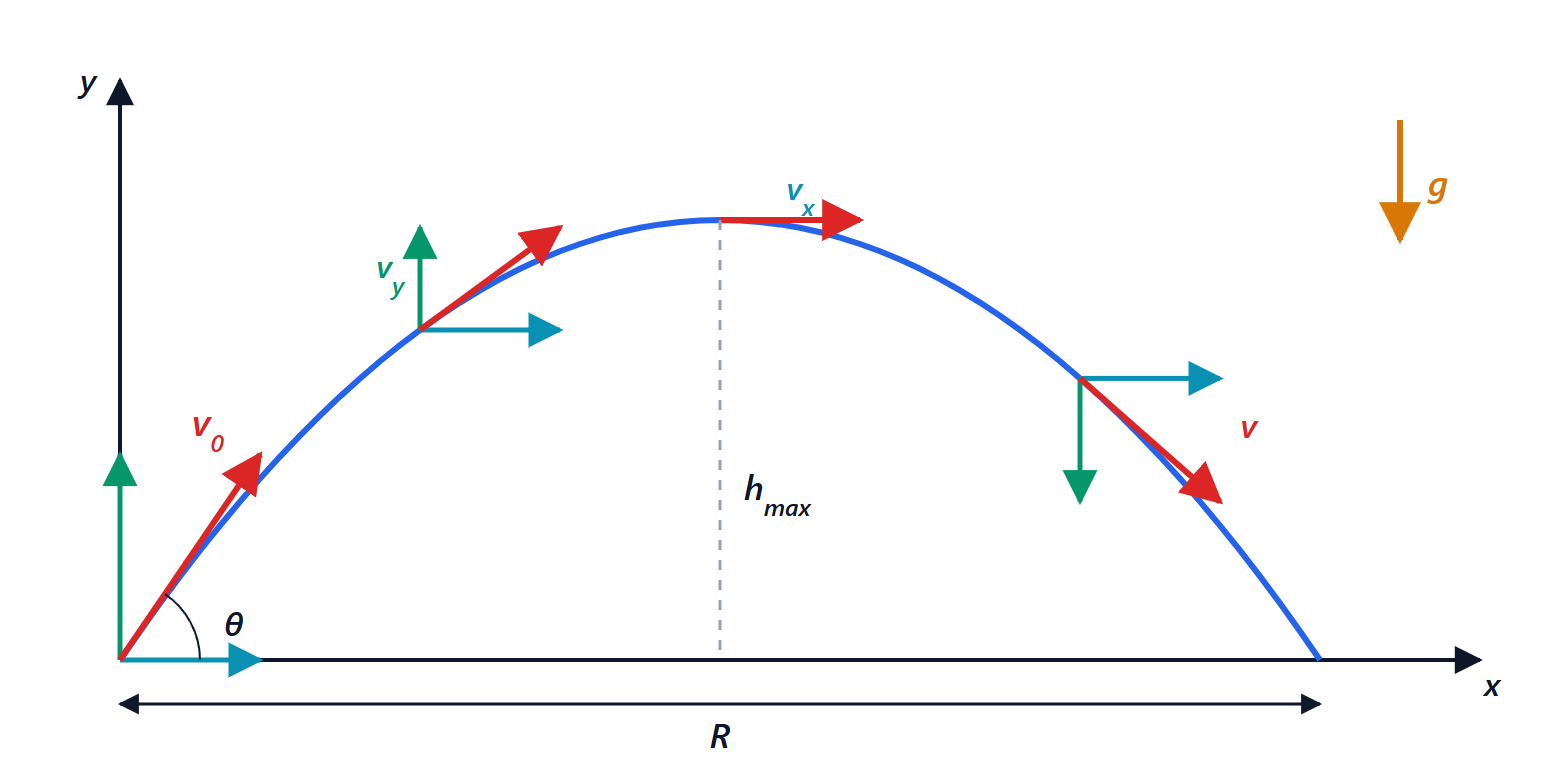
 (light blue) stays constant; the vertical component
 (green) decreases, is zero at the top and then reverses. The velocity (red) is always tangent to the path.

Proof: the path is a parabola
From the first equation  . Substituting into the second:

This is a downward-opening parabola through the origin.
Range and maximum height
The projectile lands when  , that is at
 or
 . The range is the horizontal distance covered in that time:

Since  is at most 1, at
 , that is the angle of maximum range. Complementary angles (30° and 60°) give the same range. The maximum height is reached when
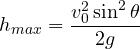
 ; using
 vertically:
Example. A ball kicked at 20 m/s at 35°:  m,
 m. In reality air shortens the range, and by a lot for a light ball.
Circular motion
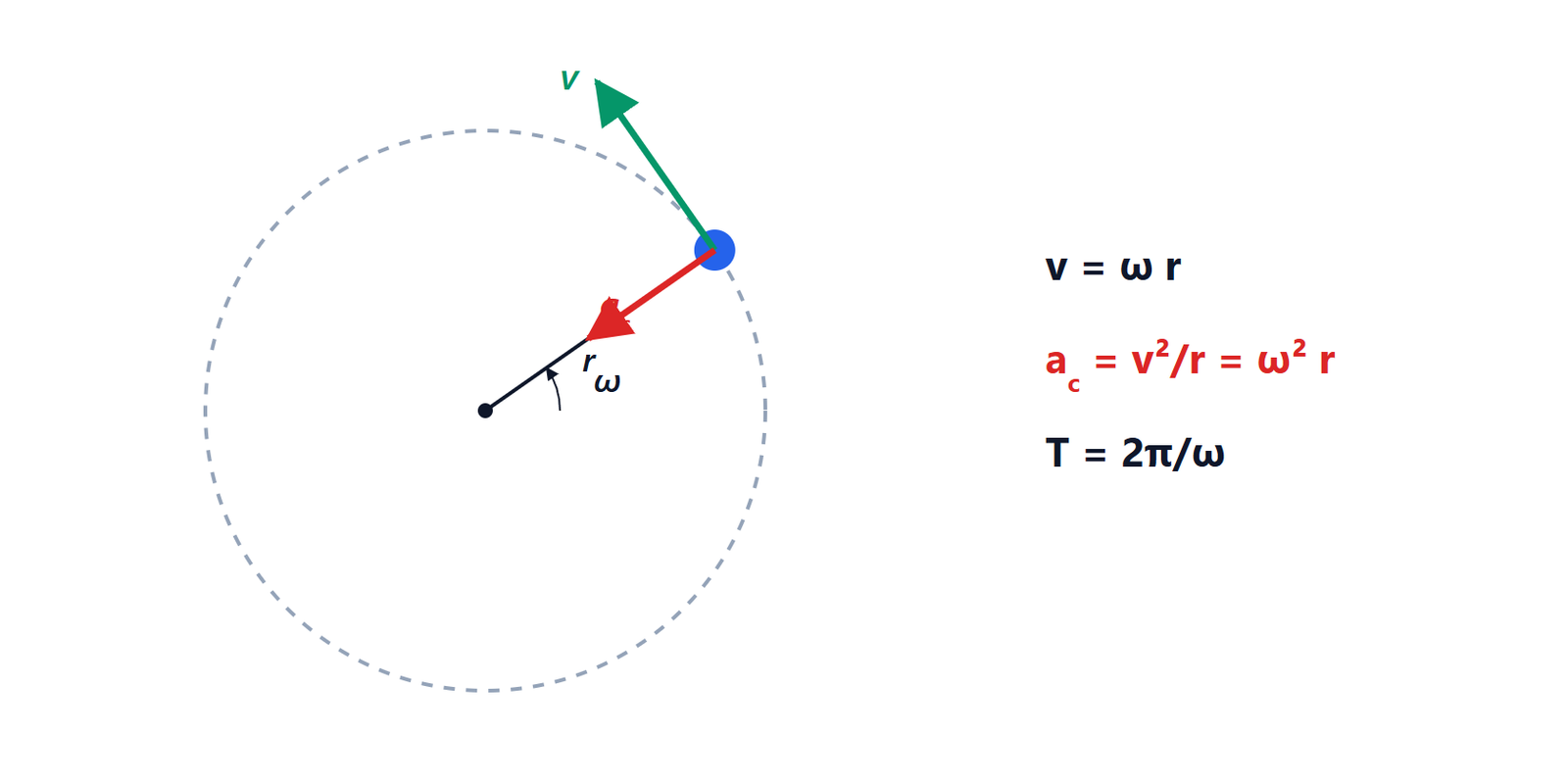
A point moving on a circle of radius  is described by the angle
 . The angular velocity is
 (rad/s) and the speed along the circle is
 . If
 is constant the motion is uniform circular, with period
 and frequency
 .
Proof: centripetal acceleration
Even if the speed is constant, the direction of the velocity changes, so there is an acceleration. Write the position with  :

Differentiating once:

which has magnitude  and is perpendicular to
 (the dot product is zero). Differentiating again:

The acceleration is opposite to the position vector, so it points to the centre, and its magnitude is
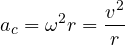
If the speed also changes, a tangential acceleration  adds to the centripetal one, where
 is the angular acceleration.
Example. A 7200 rpm hard disk:  rad/s. A point 4 cm from the centre has
 m/s and a centripetal acceleration of about
 m/s², more than two thousand times
 .
Relative motion
Velocity depends on who measures it. If one frame moves relative to another with constant velocity  , the velocities measured in the two frames are linked by the Galilean transformation:

A passenger walking at 1.5 m/s towards the front of a train travelling at 30 m/s moves at 31.5 m/s relative to the tracks. Accelerations, on the other hand, are the same in both frames, because is constant: this is why Newton’s laws hold equally in every inertial frame. The rule works well at speeds small compared with light; beyond that you need relativity.
Summary
| Motion | Laws |
|---|---|
| uniform straight-line |  |
| uniformly accelerated |  ,  ,  |
| projectile |  ,  |
| uniform circular | ,  , |