Derivatives: definition, table and differentiation rules
Difference quotient and tangent line, corners and cusps, derivatives of elementary functions, differentiation rules with examples, the differential and common mistakes.
The derivative measures how fast a function changes. Geometrically it is the slope of the tangent line to the graph, physically it is a rate: current is the derivative of charge, the voltage across an inductor is proportional to the derivative of the current.
Definition
 is differentiable at
 if the limit of the difference quotient exists and is finite:

The quotient is the slope of the line through two points of the graph; in the limit it becomes the slope of the tangent, whose equation is  .
Differentiable implies continuous, but not the other way round.  is continuous at 0 but has right derivative
 and left derivative
 : a corner.
 at 0 has a vertical tangent (infinite derivative),
 has a cusp.
Derivatives of elementary functions
 |  | | |
|---|---|---|---|
 |  |  |  |
 | |  |  |
 |  |  |  |
 |  |  |  |
 |  |  | |
|  |  |  |
Each one follows from the definition and a standard limit. For instance  .
Differentiation rules
- Linearity:
 .
- Product:
 (proof in the in-depth article).
- Quotient:
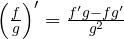 .
- Composite function (chain rule):
 .
- Inverse function: if
 ,
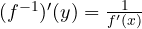 . This gives
 .
Examples.
 ;
 ;
 ;
 : when the variable is both in the base and in the exponent, switch to the exponential.
Higher derivatives and the differential
Differentiating repeatedly gives  ,
 ,
 . The second derivative measures how the slope changes (in physics it is acceleration) and decides the concavity of the graph. The differential
 is the change along the tangent: for small increments
 . It is the linear approximation used to estimate errors: if
 and the voltage has a 1% relative error,
 also gets about 1% error from
 .
Common mistakes
- Forgetting the inner derivative in the chain rule:
 , not
 .
- Using the power rule for exponentials:
 , not
 .
- Differentiating as if it were
 : the derivative is
 for
 and does not exist at 0.
In circuits
The constitutive relations of components are derivatives:  for a capacitor,
 for an inductor. With a voltage
 across a capacitor, the current is
 : leading by 90° and proportional to frequency. That is why a capacitor “blocks” DC and lets high frequencies through.