The theorems of Fermat, Rolle, Lagrange and Cauchy, and l'Hôpital's rule
Stationary points, Rolle's theorem, the mean value theorem and its consequences for monotonicity, Cauchy's theorem, l'Hôpital's rule with examples and when not to use it.
The theorems of Fermat, Rolle, Lagrange and Cauchy link the derivative to the global behaviour of a function: monotonicity, maxima and minima, estimates. L’Hôpital’s rule, which follows from them, is the most used tool for indeterminate forms.
Fermat: stationary points
If  has a local maximum or minimum at an interior point
 and is differentiable there, then
 . The converse is false:
 has zero derivative at 0 but neither a maximum nor a minimum there. That is why the candidates for extrema of a function on an interval are three kinds of points: those with
 , those where is not differentiable, and the endpoints of the interval.
Rolle
If is continuous on  , differentiable on
 and
 , there is
 with
 . Proof: by the extreme value theorem has a maximum and a minimum on ; if both are at the endpoints the function is constant, otherwise one of them is interior and by Fermat the derivative vanishes there.
Lagrange (mean value theorem)
If is continuous on and differentiable on , there is with
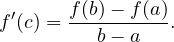
Somewhere the tangent is parallel to the chord. In terms of speed: if you cover 90 km in one hour, at least at one moment the speedometer showed exactly 90 km/h. The proof applies Rolle to  minus the line of the chord.
Consequences used all the time:
- if on an interval, is constant there (which is why antiderivatives differ by a constant);
- if
 on an interval, is strictly increasing; if
 , decreasing;
- estimates:
 , because
 .
Cauchy
It extends Lagrange to two functions: with the same hypotheses on and  , and
 , there is
 with
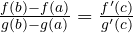 . It is the step needed to prove l’Hôpital’s rule.
L’Hôpital’s rule
If and  both tend to 0 (or both to
 ) as
 , are differentiable near with , and the limit of
 exists, then
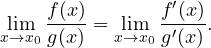
It also holds for  .
 (applied three times);
 ;
 : it is
 , rewrite it as
 and get
 .
When not to use it
- When there is no indeterminate form:
 as
 is
 ; differentiating would give 1, which is wrong.
- When the limit of
 does not exist nothing can be concluded:
 as
 tends to 1, but
 has no limit.
- To prove the standard limits: you would need to know the derivatives already, and they are derived from those very limits.
- When the derivatives get messy: equivalences or Taylor expansions often reach the result in one line.


