Integrals in depth: fundamental theorem, integration methods proved and tables
Fundamental theorem of calculus proved, parts and substitution derived, cyclic integrals, Wallis formula, rational functions in every case, universal substitution, substitutions for roots, tables of basic and standard integrals, choosing the method.
This page goes deeper into the lessons on indefinite and definite integrals. It proves the fundamental theorem of calculus and the integration rules, works out the method for rational functions in every case, derives the substitutions for trigonometric and irrational functions and the recurrence formula for powers of sine. At the end are the tables to remember: basic integrals, standard integrals and the “recipe” for choosing the method.
The fundamental theorem of calculus
Theorem. Let  be continuous on
 and let
 be the integral function. Then
 is differentiable and
 for every
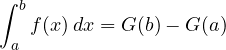
 . Consequently, if
 is any antiderivative of :
Proof. For  , by additivity of the integral,

By the mean value theorem for integrals (lesson) there is  between and
 with
 . So the difference quotient equals
 . As
 ,
 , and by continuity of ,
 . Hence .
For the second part: and are antiderivatives of the same function on an interval, so they differ by a constant (the derivative of  is zero, and a function with zero derivative on an interval is constant, a consequence of the mean value theorem).
 ; with
 ,
 . Then
 . ∎
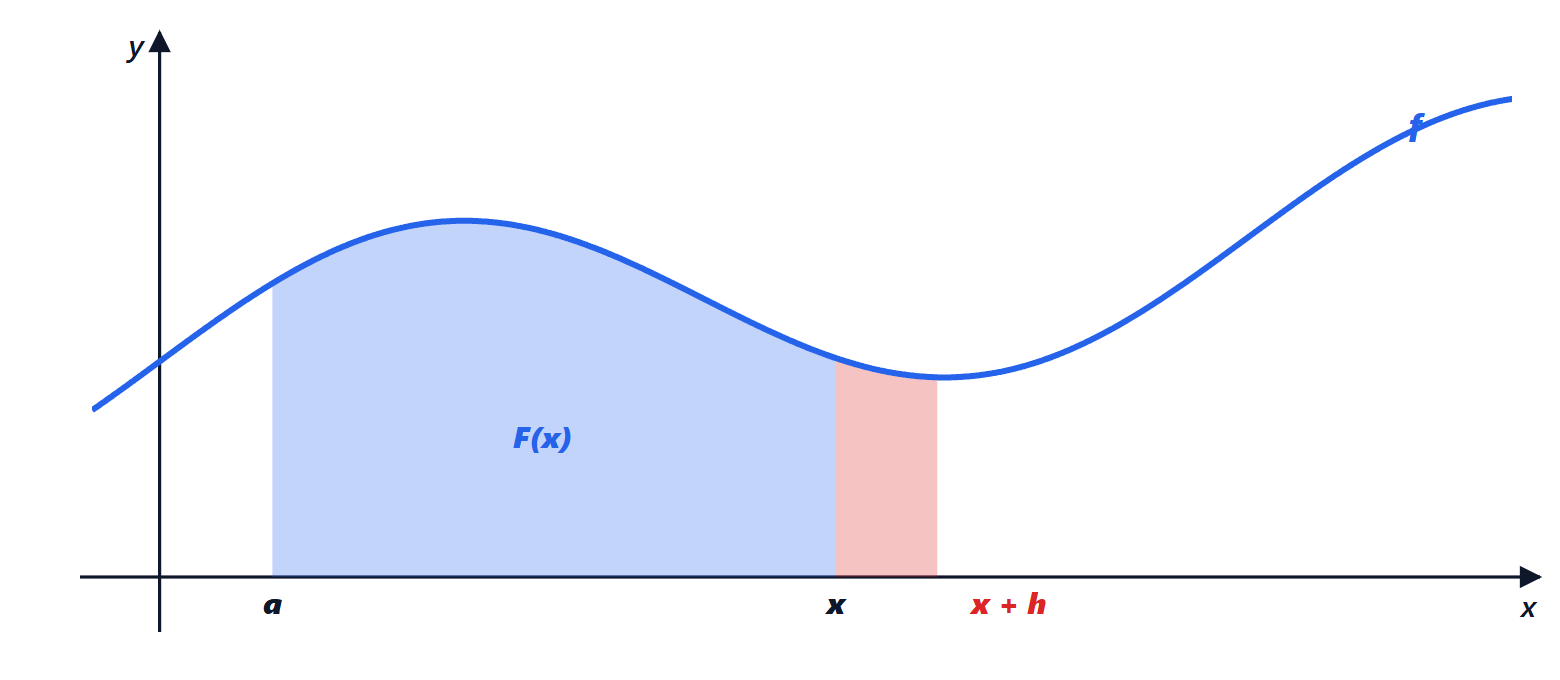
This is the theorem that links two apparently different problems, area and tangent. It has two consequences that are used often: every continuous function has an antiderivative (even if it cannot be written with elementary functions, like  ), and the derivative of
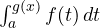 is
 , by the chain rule.
The integration rules, derived
By parts. From the product rule  , integrating both sides:

Choose as the factor that simplifies when differentiated (polynomials, logarithms, inverse trigonometric functions) and as  the one you can integrate (exponentials, sine, cosine). The trick for
 and
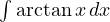 is to take
 .
Cyclic integrals. For 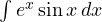 , integration by parts applied twice brings back the original integral with the opposite sign:
 , and so
 . One solves an equation in the unknown
 .
By substitution. From the chain rule, if  then
 . So, with
 :

In a definite integral the limits change and there is no need to go back to the variable . The practical rule “ ” is just a mnemonic way of writing this formula.
Recurrence formula for powers of sine. With  , by parts with
 and
 , and then
 :

with  and
 . For example
 . These are the Wallis integrals; the same holds for cosine.
Rational functions, case by case
To integrate  , with
 and
 polynomials, proceed as follows.
1. Degree. If the degree of is greater than or equal to that of , divide:  , with the degree of
 less than that of . The quotient
 is a polynomial and is integrated straight away.
2. Factorisation. Factor into first-degree factors  and irreducible second-degree factors
 with
 . Every real polynomial factors this way (a consequence of the fundamental theorem of algebra).
3. Partial fractions.  is written as a sum of terms
 ,
 , … for first-degree factors (one for each power up to the multiplicity) and
 for second-degree ones. The constants are found with the identity principle for polynomials, or faster by substituting the roots.
4. Integrating the fractions.  ;
 for
 . For the second-degree term, make the derivative of the denominator appear in the numerator:

The first piece gives  . For the second, complete the square:
Theorem. If  , with
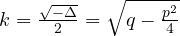 :

Proof.  . With
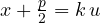 ,
 :
 . ∎
If  the denominator has two real roots and one goes back to first-degree fractions; if
 it is a perfect square,
 , and the integral of
 is
 .
Trigonometric functions: the universal substitution
Theorem. With  , for
 :

Proof. With the double-angle formulas and dividing by  :
 ; dividing numerator and denominator by
 gives
 . In the same way
 . Finally
 , so
 . ∎
Every rational function of  and
 thus becomes a rational function of
 . It always works but often leads to long calculations: first try the shortcuts, i.e.
 if the rest contains
 , and the formulas
 and
 for even powers.
Roots: trigonometric and hyperbolic substitutions
For  set
 , and the root becomes
 . For
 set
 , and the root becomes
 (because
 ). For
 ,
 .
Example: the area of the circle. With  ,
 :

Between 0 and 1 it gives  , a quarter of the circle of radius 1. The two terms have a precise geometric meaning, shown in the figure.

Tables to remember
Basic integrals (the constant  is understood)
 |  |
|---|---|
 ,  |  |
 |  |
 ,  | ,  |
| , |  , |
 ,  |  ,  |
 |  |
 |  |
 ,  | , |
Composite forms (with  differentiable):
 ;
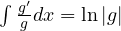 ;
 ;
 . Recognising them at a glance avoids many substitutions.
Standard integrals ( )
| |
|---|---|
 |  |
|  |
|  |
 | 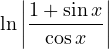 |
 ,  |  ,  |
 |  |
 |  |
 |  |
 | 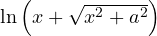 |
|  |
 | 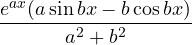 |
Which method to use
| If the integrand is… | Method |
|---|---|
a composite form  | substitution  |
| polynomial times exponential, sine or cosine | by parts, differentiating the polynomial |
| polynomial times logarithm or arctangent | by parts, differentiating the logarithm or arctangent |
| exponential times sine or cosine | by parts twice, cyclic integral |
| rational function | division and partial fractions |
| rational in and | shortcuts, otherwise |
with ,  | , , |
with  |  |
Exercises from basic to exam level, with areas, volumes and integral functions, are on the exercise page linked at the top.