Solved thermodynamics exercises: processes, cycles, engines and entropy
Fourteen exercises with solutions and figures: ideal gas, calorimetry, isotherm, isobar, adiabat, Carnot, heat pump, entropy, rectangular cycle, Otto and Diesel cycles, lost work, free expansion, kinetic theory.
Thermodynamics exercises of the kind set in Physics 1 and Engineering Thermodynamics courses, in three levels: basic, with the ideal gas, calorimetry and simple processes; intermediate, with adiabats, Carnot engines, heat pumps, entropy and a complete cycle; exam, with the Otto and Diesel cycles, entropy in irreversible processes and kinetic theory. The result is given straight away; the full solution, with the figure, opens with a click. The proofs and the table of processes are in the in-depth study linked at the top.
Data:  J/(mol·K); water
 J/(kg·K), latent heat of fusion of ice
 kJ/kg; monatomic gas
 , diatomic (air)
 ,
 .
Basic level
Exercise 1. The equation of state
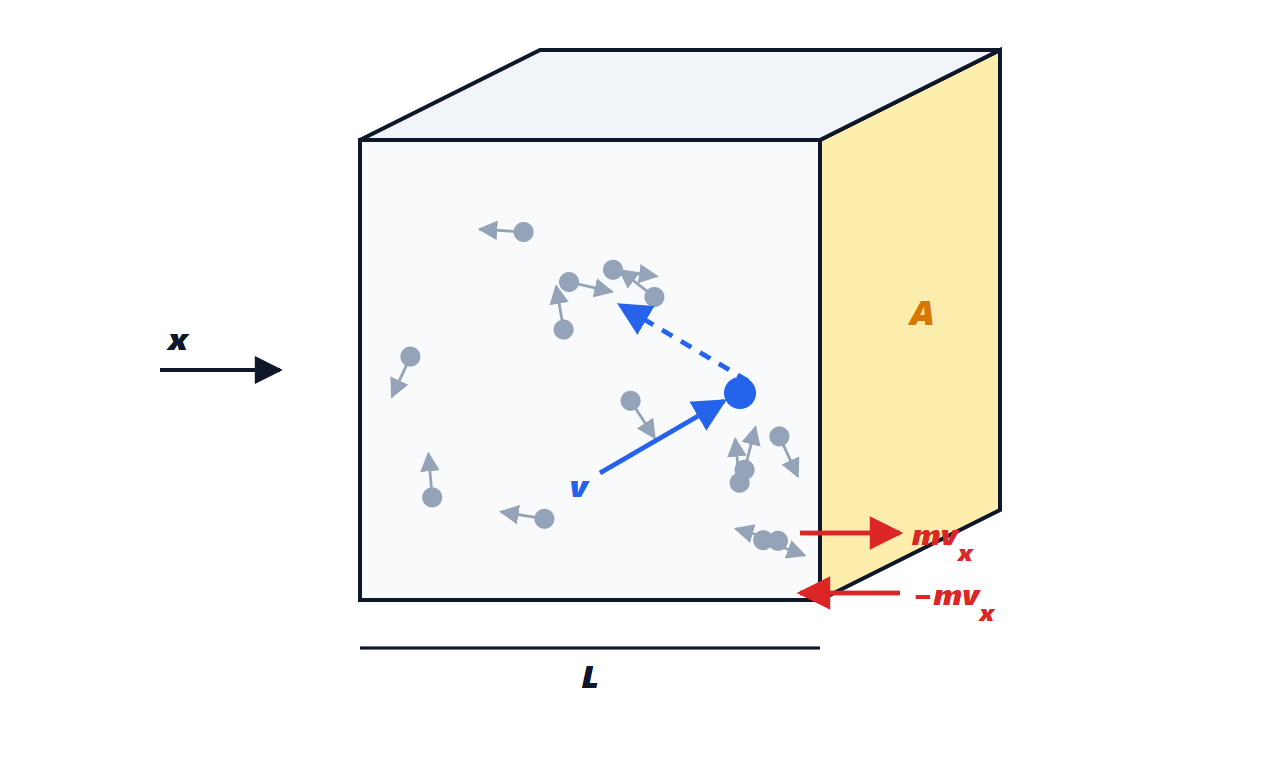
2.0 mol of ideal gas at 300 K occupy 10 L. What is the pressure?
Result:  Pa, about 4.9 atm.
Solution
 Pa. The volume must be in m³ (10 L = 0.010 m³): this is the most common mistake.
In atmospheres,  atm. Alternatively, with
 L·atm/(mol·K) and the volume in litres:
 atm.
Exercise 2. Mixing hot and cold water
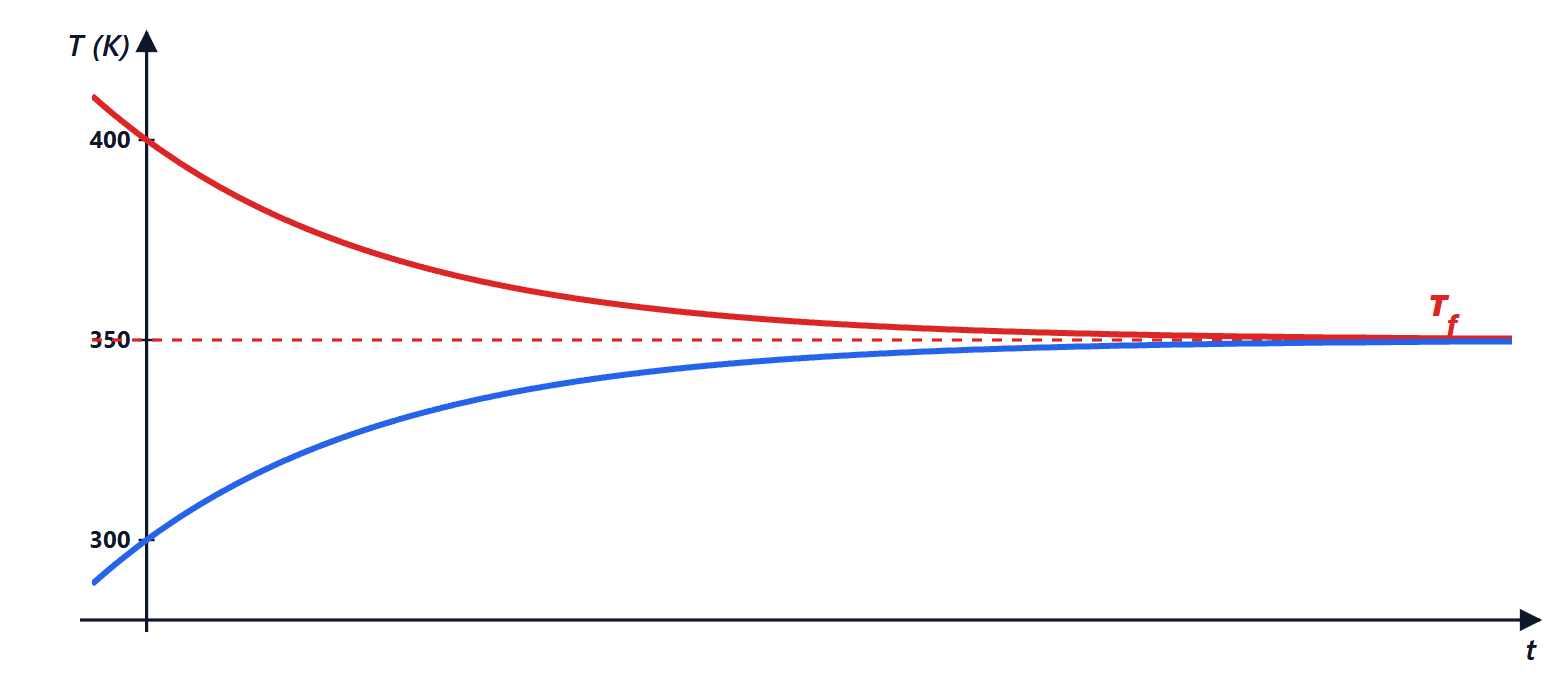
200 g of water at 80 °C are mixed with 300 g at 20 °C, in an insulated container. Find the final temperature and the total entropy change.
Result: 44 °C;  J/K.
Solution
The heat given by the hot water equals that received by the cold water:  , so
 °C.
Entropy, with temperatures in kelvin ( K): hot water
 J/K; cold water
 J/K. Total
 J/K: positive, as it must be in an irreversible process.
Exercise 3. Isothermal expansion
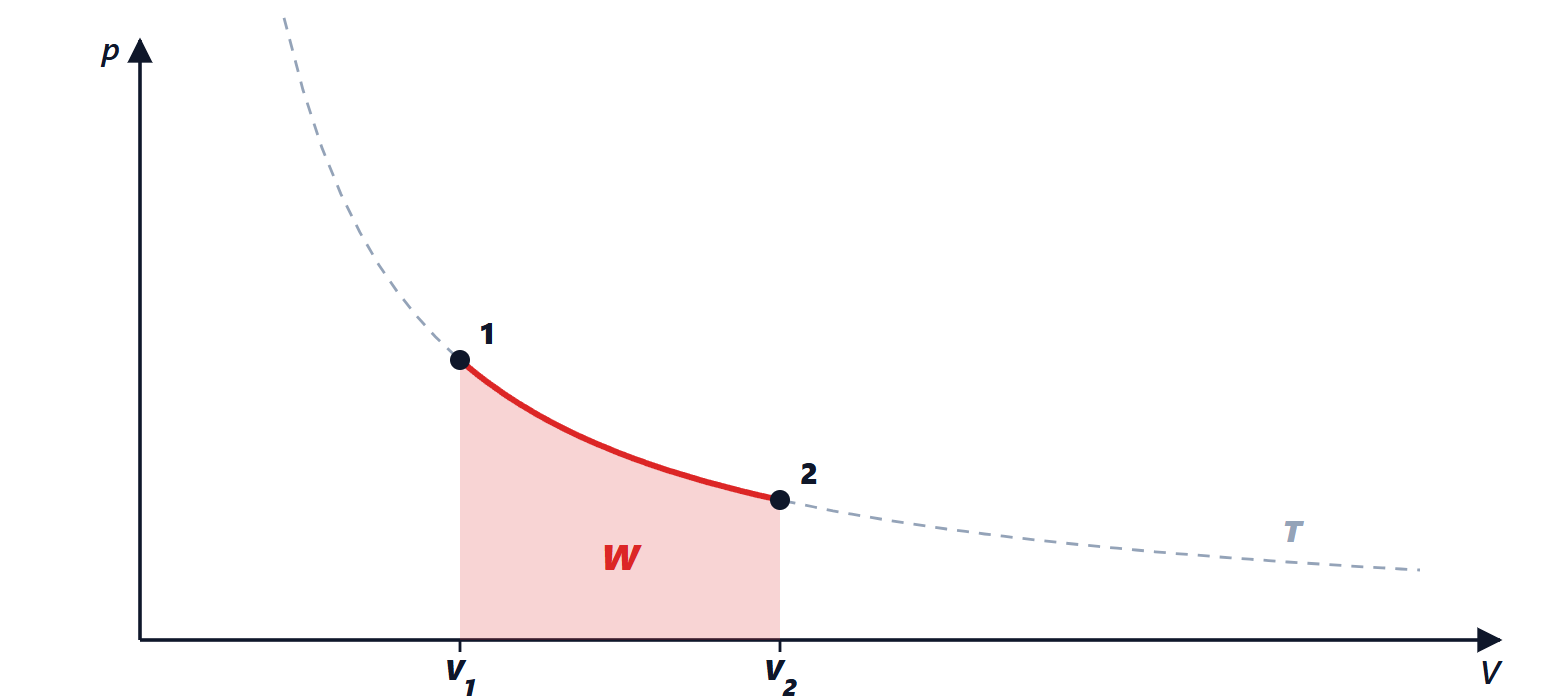
1.0 mol of ideal gas expands reversibly at 300 K from 10 L to 20 L. Find the work, heat, change in internal energy and change in entropy.
Result:  kJ;
 ;
 J/K.
Solution
In the isotherm (the internal energy of an ideal gas depends only on  ), so
 .
 J.
 J/K. The gas took in heat and gave it all back as work: this does not violate Kelvin, because the process is not a cycle (the gas has changed, it occupies twice the volume).
Exercise 4. Heating at constant pressure
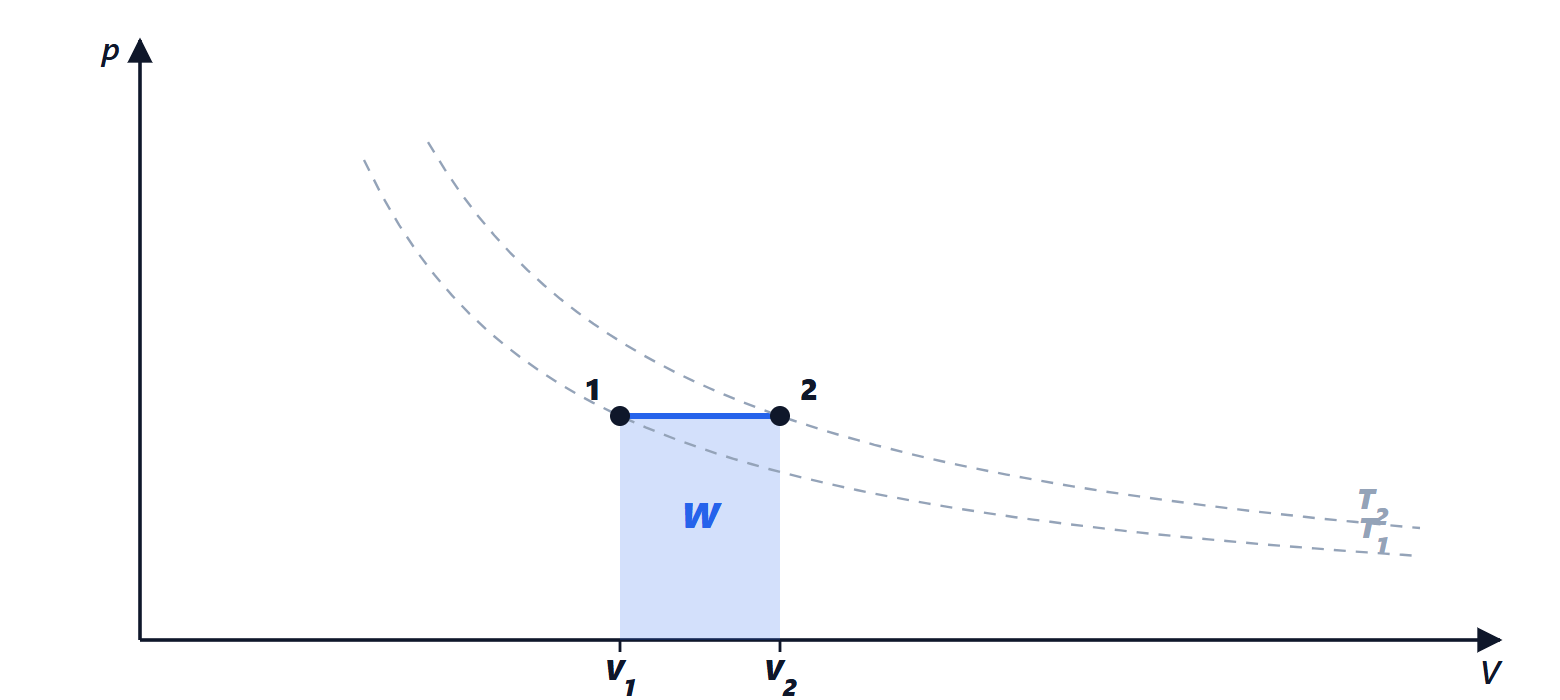
2.0 mol of monatomic gas are heated at constant pressure from 300 K to 400 K. Find the heat, the work and the change in internal energy.
Result:  kJ;
 kJ;
 kJ.
Solution
 J.
 J.
 J. Check with the first law:
 J. 40 % of the heat goes into work and 60 % into internal energy, ratio
 .
Intermediate level
Exercise 5. Adiabatic compression of air
Air at 1.0 atm and 300 K is compressed adiabatically and reversibly to one tenth of its volume. Find the final temperature and pressure and the work done on the gas per mole.
Result:  K;
 atm; 9.4 kJ/mol.
Solution
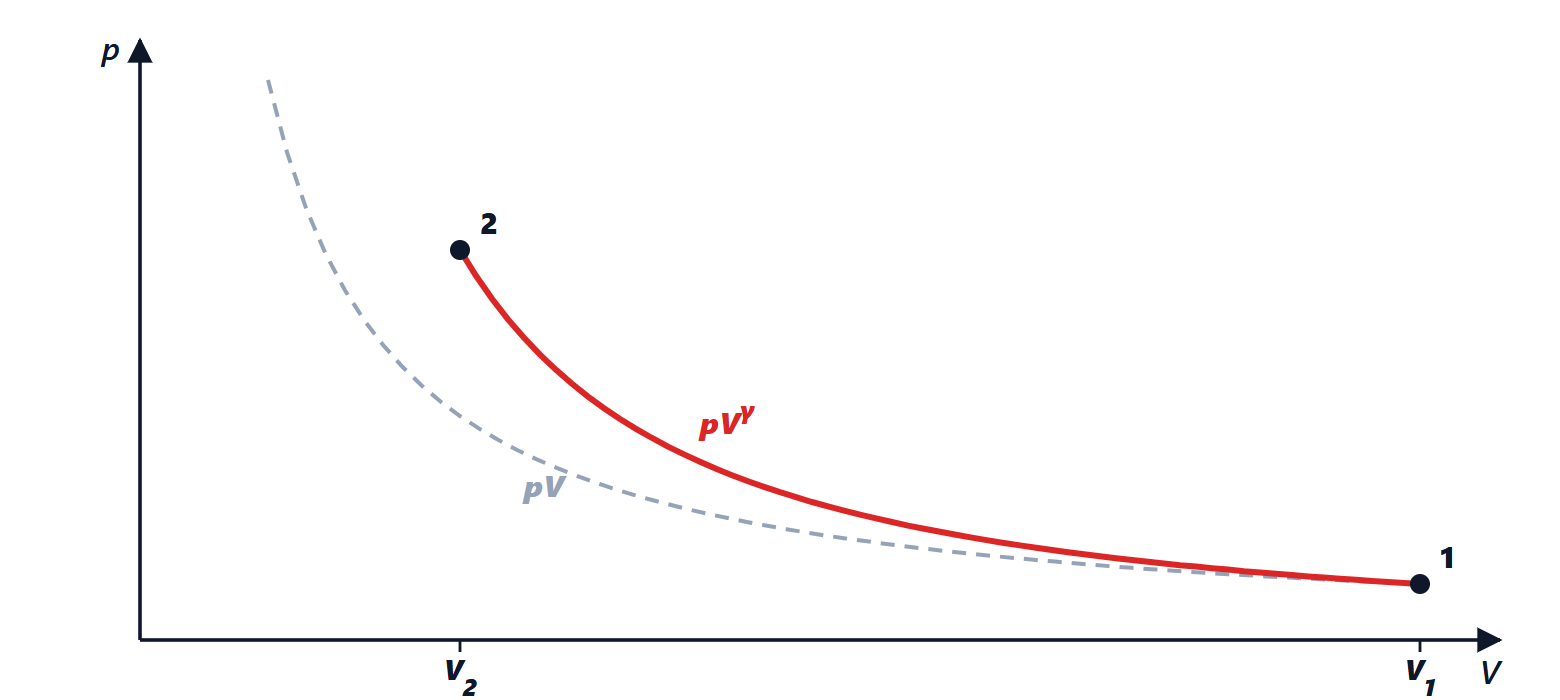
 constant:
 K (481 °C).
 constant:
 atm.
Work on the gas: it all goes into internal energy,  kJ/mol.
Comparison: an isotherm with the same volume ratio would have brought the pressure only to 10 atm. This is the principle of the Diesel engine: the compressed air becomes hot enough to ignite the fuel without a spark.
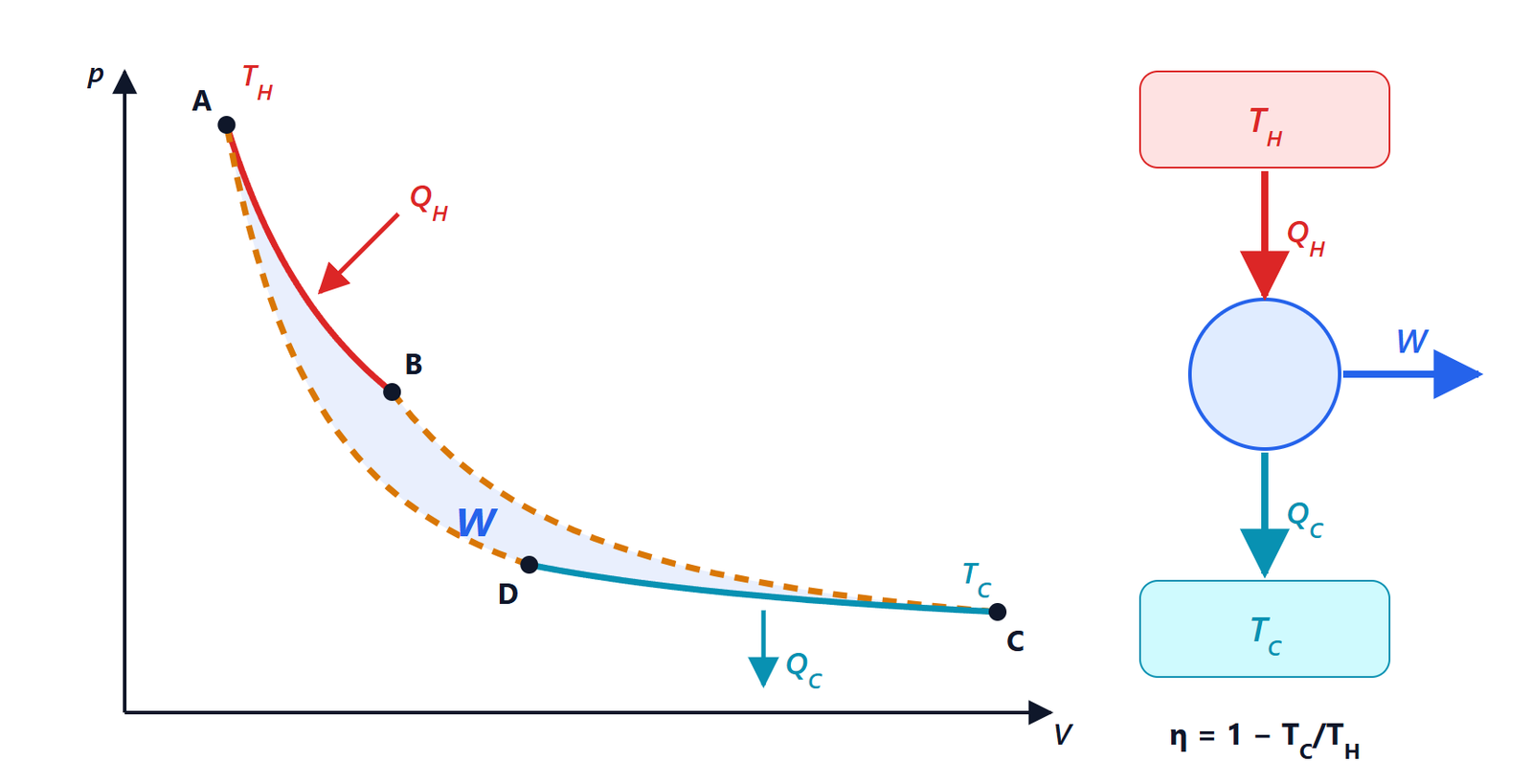
Exercise 6. A Carnot engine
A Carnot engine works between 500 K and 300 K and absorbs 1000 J per cycle. Find the efficiency, the work, the heat given out and the entropy change of the universe in one cycle.
Result: 40 %; 400 J; 600 J; 0.
Solution
 .
 J;
 J.
Entropy: the hot reservoir loses  J/K, the cold one gains
 J/K, the gas returns to its initial state. Total zero: this is the hallmark of a reversible cycle. A real engine between the same reservoirs would give out more than 600 J, and the entropy of the universe would increase.

Exercise 7. The heat pump
A heat pump must deliver 10 kW to a house at 20 °C taking heat from the outside air at 0 °C. What is the minimum electrical power needed? And the real one, with a coefficient of performance of 3.5?
Result: minimum 0.68 kW (ideal COP 14.7); real 2.86 kW.
Solution
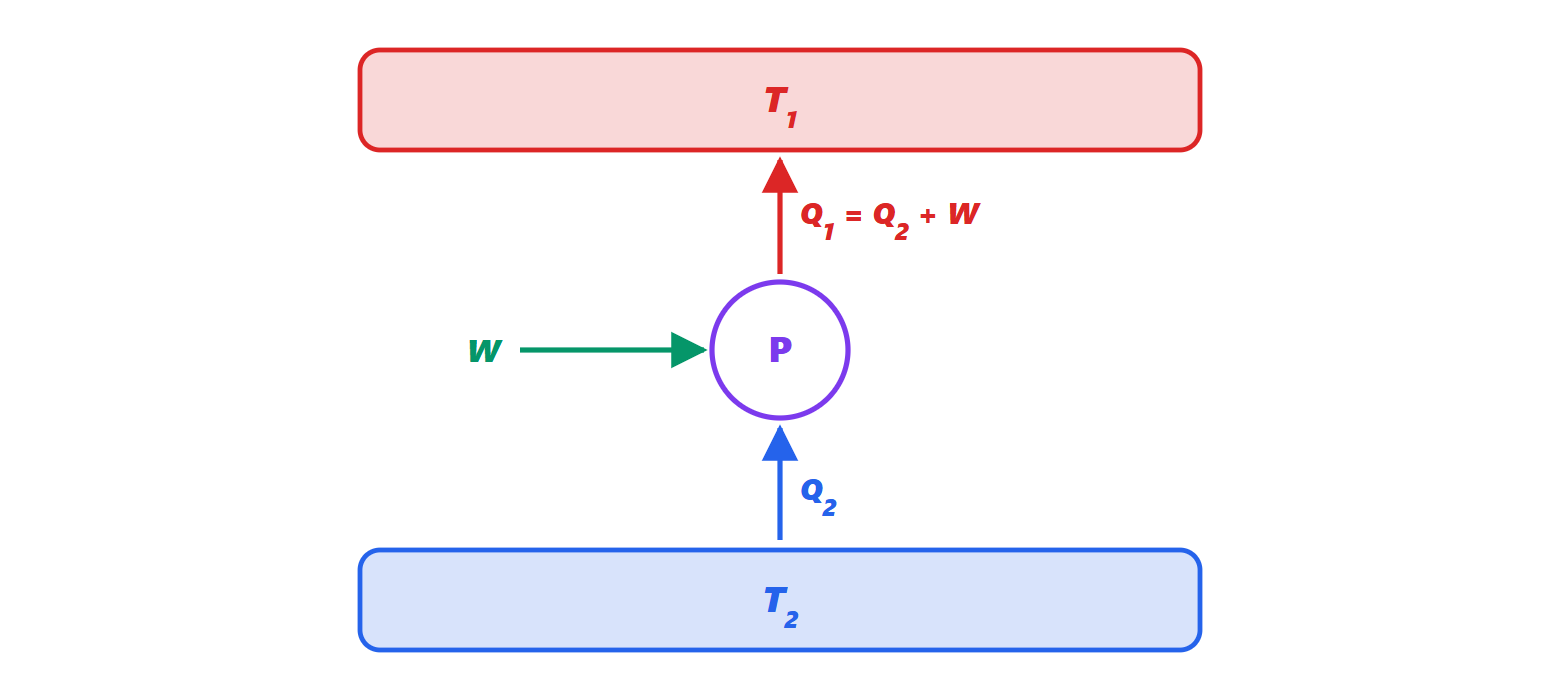
For a heat pump the coefficient of performance is the heat delivered divided by the work:  . The maximum, for a reversible machine, is
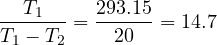 .
Minimum power:  kW. With a real COP of 3.5:
 kW, against 10 kW for an electric heater. The heat pump does not “create” energy: it moves heat from the cold outside to the warm inside, and the work only serves to make it go against its natural direction.
Exercise 8. The entropy of melting ice
100 g of ice at 0 °C slowly melt in a room at 25 °C. Compute the entropy change of the ice, of the room and of the universe (neglect the warming of the water after melting).
Result: ice +122.3 J/K; room −112.0 J/K; universe +10.3 J/K.
Solution
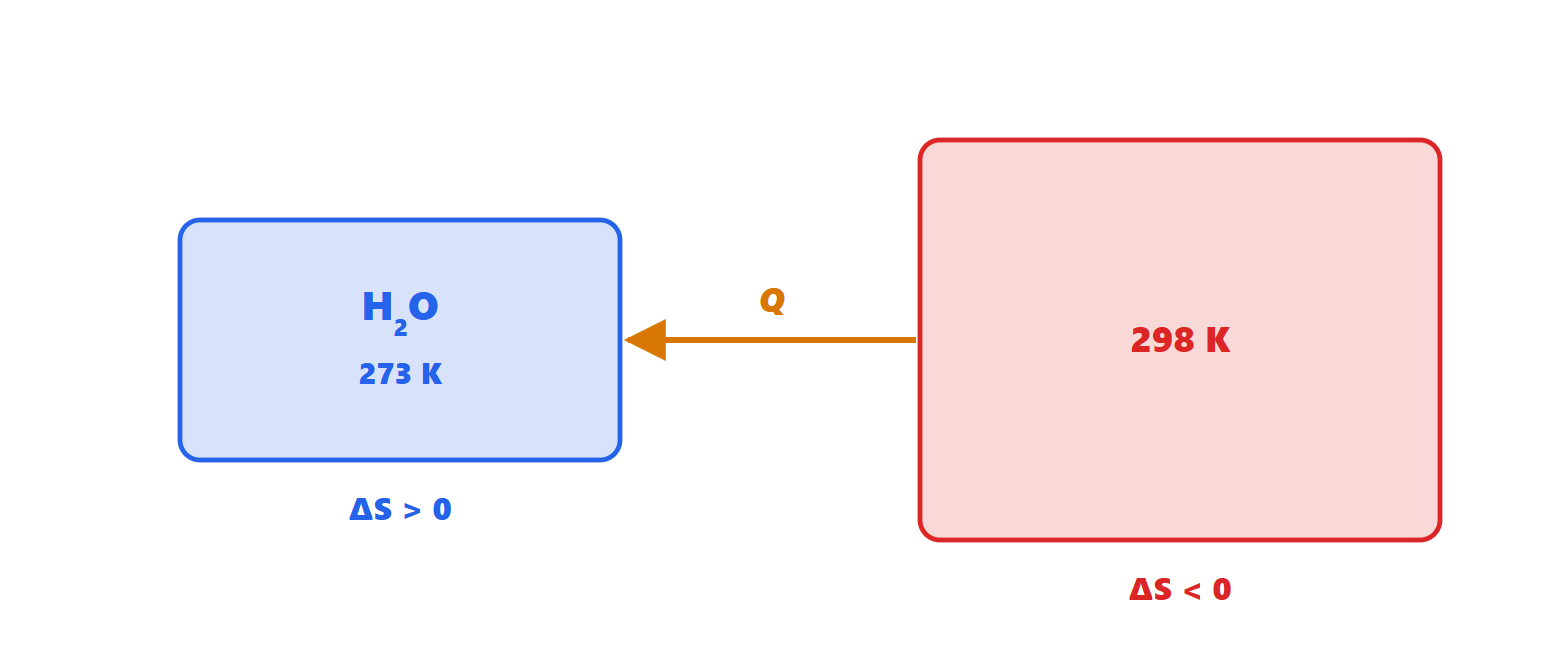
Heat absorbed:  kJ, at constant temperature.
Ice:  J/K. Room (which stays practically at 298.15 K):
 J/K.
Universe:  J/K. The same heat weighs more in entropy at the lower temperature: this is why heat flows spontaneously from hot to cold.
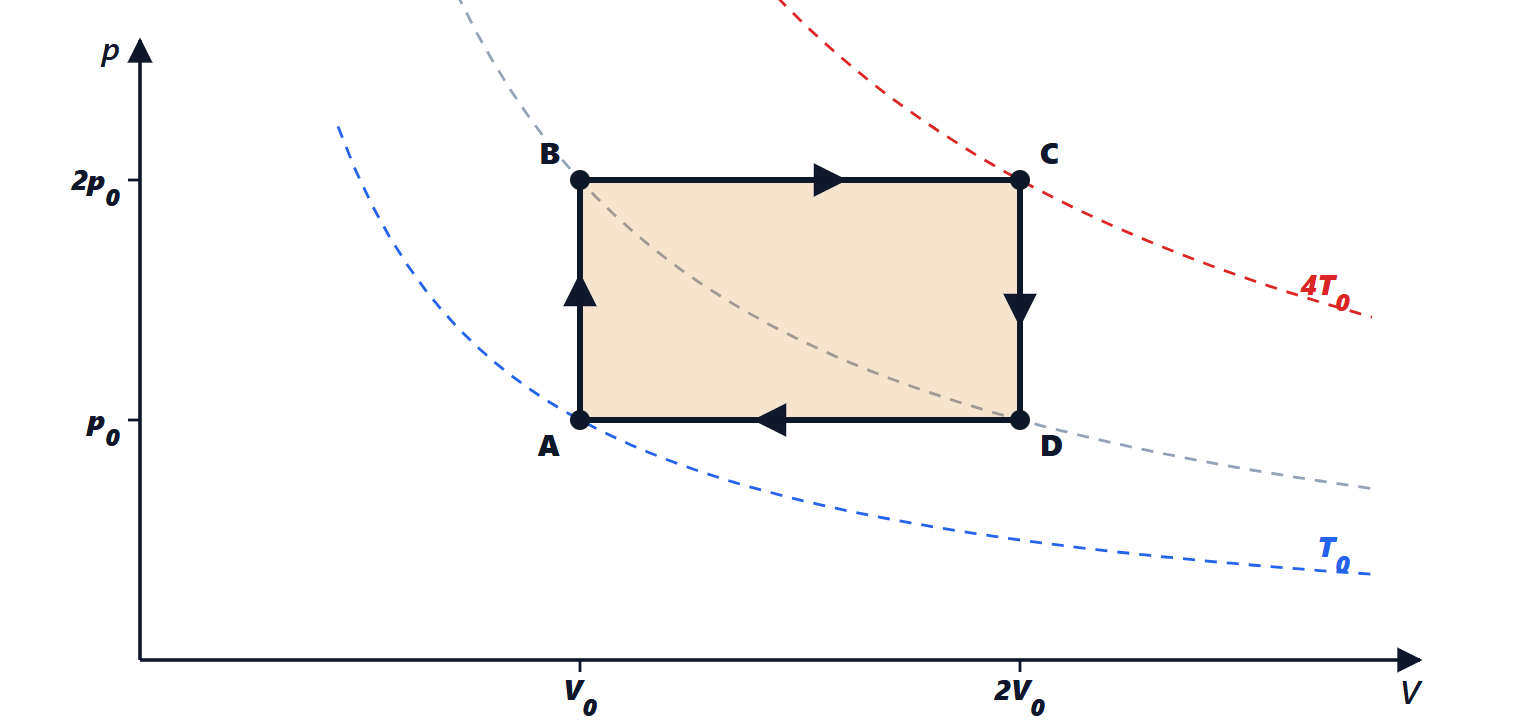
Exercise 9. A rectangular cycle
1 mol of monatomic gas performs the cycle A→B→C→D→A of the figure, with A at  , B at
 , C at
 , D at
 . Express in terms of
 the work, the heat absorbed and the efficiency, and compare with a Carnot engine between the extreme temperatures.
Result:  ;
 ;
 %, against 75 % for Carnot.
Solution
Work. It is the area of the rectangle:  .
Temperatures. With  :
 ,
 ,
 .
Heats. A→B isochoric:  (absorbed). B→C isobaric:
 (absorbed). C→D and D→A give out heat. Absorbed in total:
 .
Efficiency. 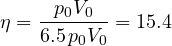 %. Carnot between
 and
 :
 %. The rectangular cycle exchanges heat at temperatures far from the extreme ones, and this makes it inefficient.
Typical mistake: dividing the work by the net heat (which equals the work, and would give 100 %) instead of by the heat absorbed.
Exam level
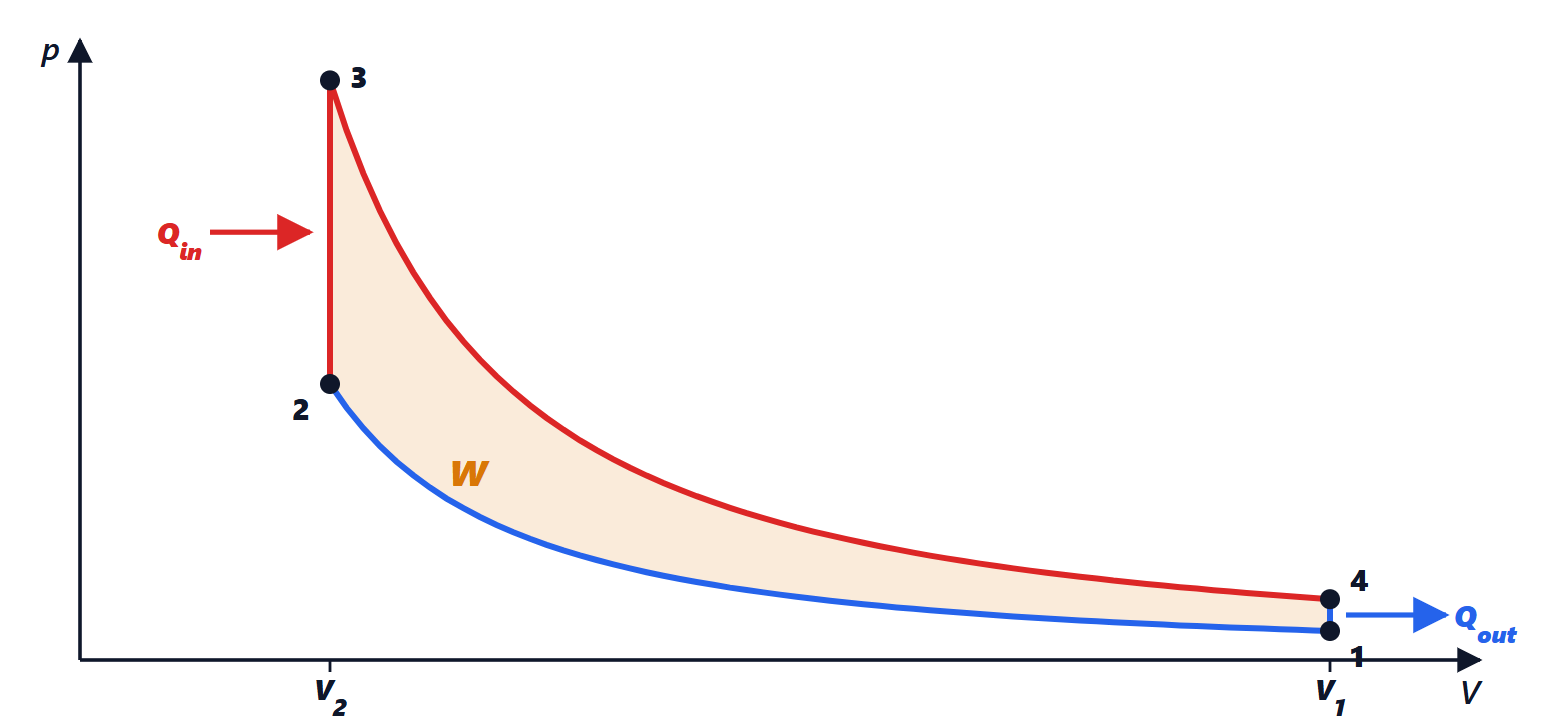
Exercise 10. The Otto cycle
An ideal petrol engine has a compression ratio of 9. Air enters at 1 bar and 300 K, and after combustion reaches 1800 K. Find the temperatures at the four vertices, the heat absorbed and given out and the work per mole, and the efficiency.
Result:  K,
 K;
 kJ/mol,
 kJ/mol,
 kJ/mol;
 %.
Solution
Adiabatic compression 1→2:  K.
Isochoric combustion 2→3:  K (given).
 kJ/mol.
Adiabatic expansion 3→4:  K.
Isochoric exhaust 4→1:  kJ/mol.
 kJ/mol,
 %, equal to
 (in-depth study). Carnot between 1800 K and 300 K would give 83 %: the Otto cycle absorbs heat at temperatures between 722 and 1800 K, not all at the maximum.
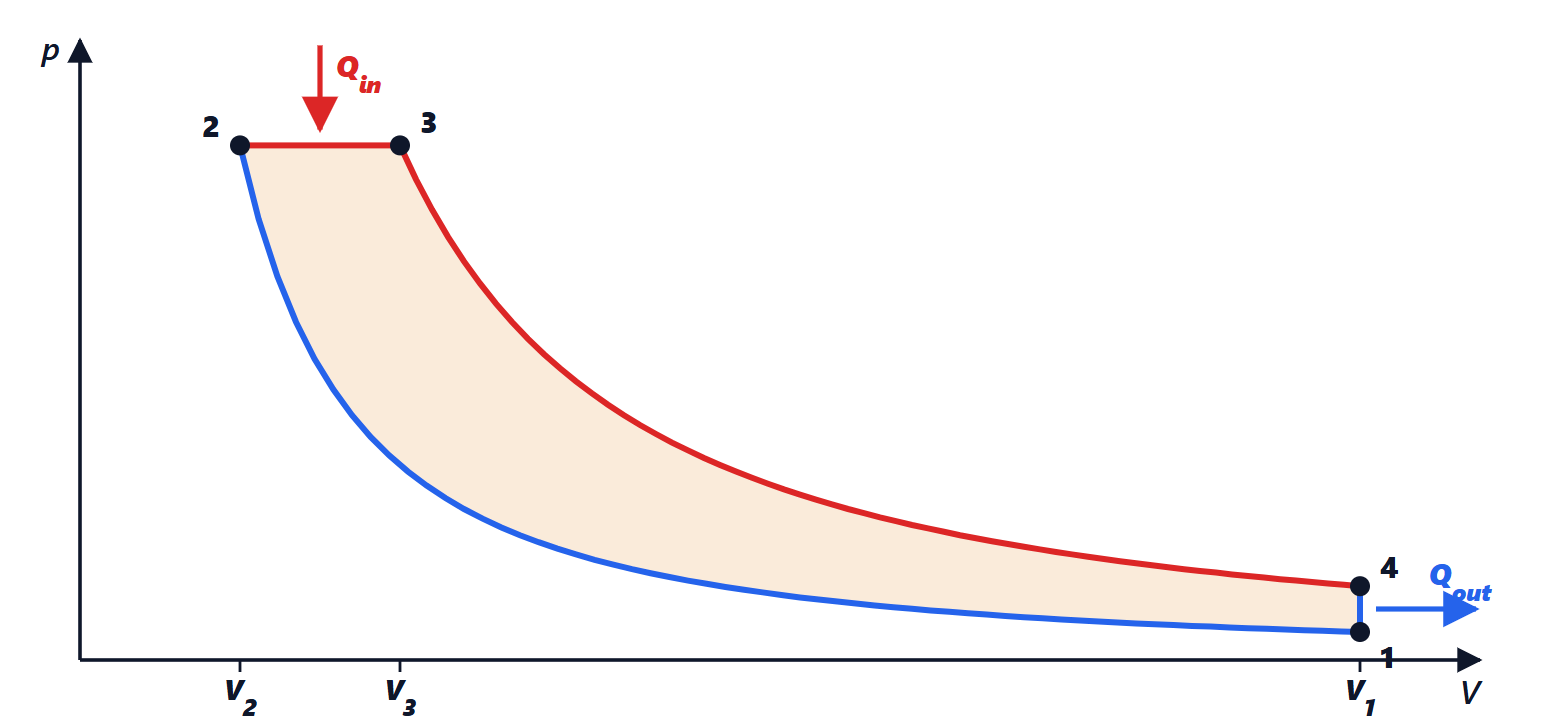
Exercise 11. The Diesel cycle
An ideal Diesel engine has a compression ratio of 18 and a cut-off ratio of 2. Compute the efficiency and compare it with that of an Otto cycle with the same compression ratio.
Result: 63.2 %; the Otto would give 68.5 %.
Solution
From the formula of the in-depth study:

Otto with  :
 %. For the same compression the Otto is more efficient, but a petrol engine cannot reach 18 without detonation: in practice it works around 10 (60 %), and the Diesel wins.
Exercise 12. Two blocks in contact and the lost work
Two 1.0 kg copper blocks ( J/(kg·K)), at 400 K and 300 K, are put in contact and insulated. Find the final temperature and the entropy change. What is the maximum work that could have been obtained by running a reversible engine between the two blocks until equilibrium?
Result: 350 K;  J/K; maximum work 2.76 kJ.
Solution
Direct contact. Equal masses and specific heats:  K.
 J/K.
Reversible engine. Now the total entropy does not change:  , so
 and
 K, the geometric mean.
The work is the heat given by the hot block minus that received by the cold one:  kJ.
In direct contact this work is lost: the final temperature is higher (350 against 346.4 K) because the energy that could have become work has remained as heat.
Exercise 13. Free expansion
1.0 mol of ideal gas at 300 K, in an insulated container, expands into a vacuum doubling its volume. Find  ,
 ,
 ,
 and
 . How much work could have been obtained with a reversible isothermal expansion?
Result:  ; J/K; 1.73 kJ.
Solution
The gas pushes nothing (the vacuum has no pressure):  . The container is insulated:
 . So and, for an ideal gas,
 .
Entropy is a state function: it is computed along any reversible path between the same states, for example the isotherm:  J/K, although no heat has flowed.
Lost work: a reversible isotherm would have given  kJ. In general the energy “wasted” by an irreversible process at temperature is
 .

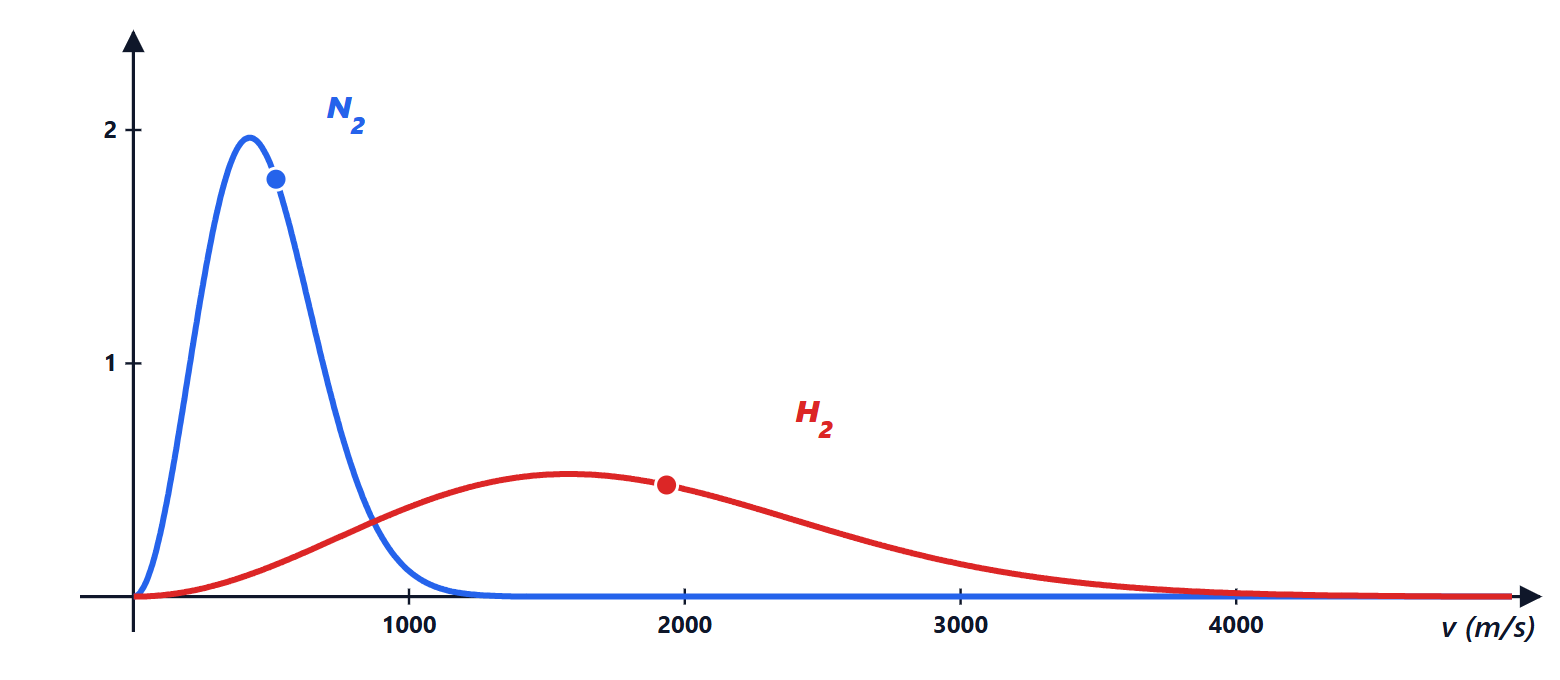
Exercise 14. The speed of molecules
Compute the root-mean-square speed of nitrogen molecules ( g/mol) and of hydrogen molecules (
 g/mol) at 300 K. Why has the Earth’s atmosphere lost almost all its free hydrogen, although the escape velocity is 11.2 km/s?
Result: nitrogen 517 m/s; hydrogen 1930 m/s.
Solution
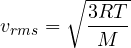 : nitrogen
 m/s; hydrogen
 m/s. At the same temperature the mean kinetic energies are equal, so the speeds go as
 .
Both are far below the escape velocity, but speeds are distributed (Maxwell distribution): a small fraction of molecules is much faster than average. In the upper atmosphere, where the temperature reaches 1000 K and more, the tail of the hydrogen distribution exceeds the escape velocity often enough to empty it over geological times; for nitrogen the fraction is negligible.