Stoichiometry in depth: extent of reaction, limiting reagent, redox and mixtures
The mole by the 2019 definition, extent of reaction and the limiting-reagent rule proved, redox balancing with half-reactions in acidic and basic solution, yields in series, mixtures, error propagation.
https://www.electronics-engineering.com/en/stoichiometry-in-depth-extent-limiting-reagent-redox/
This page goes deeper into the lesson on stoichiometry: it revisits the concepts with every step shown, proves the rules that are used “by heart” in exercises, and presents the methods needed for the harder exam problems. We look at the mole and Avogadro’s number with the current definitions, the extent of reaction with the proof of the limiting-reagent rule, balancing redox reactions with the half-reaction method in acidic and basic solution, reactions in series and mixtures, and how errors propagate through a chain of calculations.
The mole, defined precisely
Since 2019 the International System defines the mole by fixing the exact value of the Avogadro constant:

One mole is therefore, by definition, a collection of exactly  entities (atoms, molecules, ions, electrons). Before 2019 the mole was defined as the number of atoms in 12 g of carbon-12: the practical difference is nil, but the molar mass of carbon-12 is now no longer exactly 12 g/mol, only to within a few parts per billion.
The molar mass  of a substance is the mass of one mole, in g/mol, obtained by adding the atomic masses of the elements present, each multiplied by the number of atoms in the formula. The atomic masses in the periodic table are weighted averages over the natural abundance of the isotopes: chlorine (35.45) is about 76 %
 Cl and 24 %
 Cl, and indeed
 .
The three fundamental relations follow directly from the definitions:
 : if one mole weighs grams,
 grams are
 moles;
 : the number of entities;
 for ideal gases, with
 L·atm/(mol·K)
 J/(mol·K). At standard conditions (0 °C, 1 atm) one mole occupies
 L; at 25 °C and 1 atm, 24.47 L.

The extent of reaction
The most rigorous way to treat a reaction is the extent of reaction  (in moles). The reaction is written as
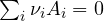 , with stoichiometric coefficients
 negative for reactants and positive for products. For the combustion of methane,
 , the coefficients are
 .
When the reaction has advanced by , the number of moles of each species is

This single formula replaces all proportions: it says that changes in moles are in the ratio of the coefficients, and it is the reason why “coefficients apply between moles, not grams”.
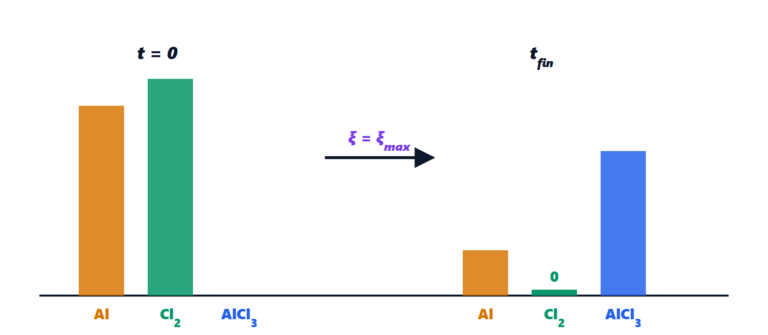
Theorem (limiting reagent). Starting from amounts  , a reaction going to completion stops at the extent
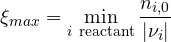
and the reactant achieving the minimum is the limiting reagent.
Proof. The number of moles of a reactant cannot become negative:  , i.e.
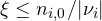 , for every reactant. All the inequalities must hold together, so cannot exceed the smallest of the ratios. The reaction, if it goes to completion, reaches exactly that value: at that moment the corresponding reactant is exhausted, while the others still have positive moles (or zero, if there were several equal minima). ∎
This is the proof of the “trick” in the lesson: divide the moles of each reactant by its coefficient and take the smallest.
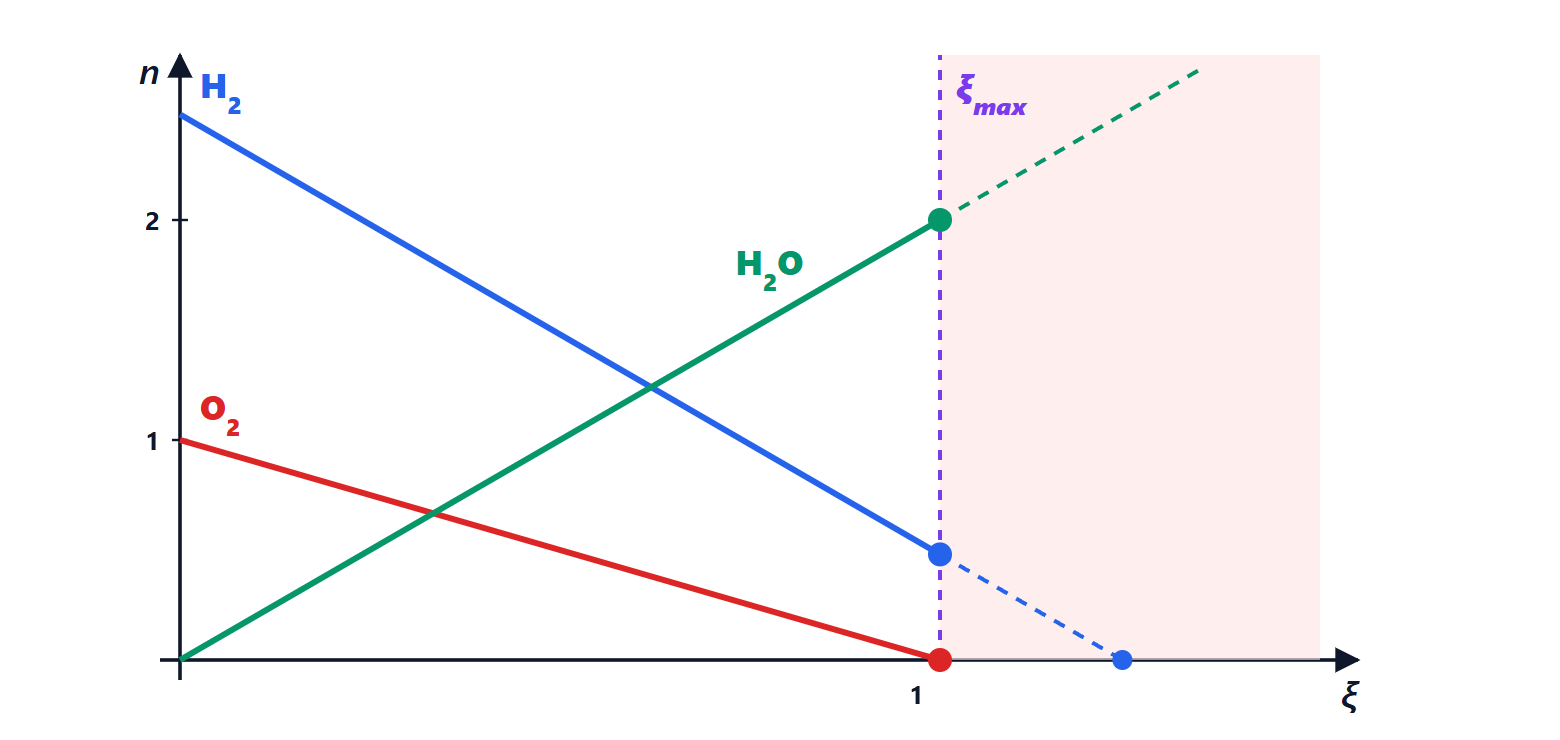
Example. 2.48 mol of H2 and 1.00 mol of O2 for  : the ratios are 2.48/2 = 1.24 and 1.00/1 = 1.00, so
 mol. At the end: H2
 mol, O2 0, H2O
 mol. All the numbers come out of one formula, without setting up proportions case by case.
The extent of reaction also serves for reactions that do not go to completion: at equilibrium is obtained from the equilibrium constant (lesson on chemical equilibrium), and the moles of all species again follow from  .
Balancing redox: the half-reaction method
Many exam reactions are redox reactions, and balancing them “by eye” is a lottery. The half-reaction (ion-electron) method always works, in five steps.
Example in acidic solution. Permanganate oxidises oxalate:

1. Oxidation numbers. Mn goes from +7 to +2: it is reduced. C goes from +3 to +4: it is oxidised.
2. Half-reactions, balancing atoms other than O and H first. Reduction:  . Oxidation:
 .
3. Oxygen with H2O, hydrogen with H+ (acidic solution).  . The oxalate needs no correction.
4. Charges with electrons. On the left of the reduction the charge is  , on the right
 : 5 electrons are needed on the left,
 . In the oxidation the charge goes from
 to 0:
 . The number of electrons equals the change in oxidation number (5 for Mn; 2 for two C atoms each rising by 1): a useful check.
5. Equal electrons exchanged. Multiply the reduction by 2 and the oxidation by 5 (10 electrons each) and add:

Final check: Mn 2 = 2; C 10 = 10; O  ; H 16 = 16; charge
 on the left and
 on the right.
In basic solution one first balances as if acidic, then adds to both sides as many OH− as there are H+: H+ and OH− on the same side become water, and repeated water molecules cancel. For example, permanganate in basic solution is reduced to MnO2:  becomes, adding 4 OH−,
 .
Why is the method always correct? Because it imposes, one by one, the three conservation laws: of atoms (steps 2-3), of charge (step 4) and of electrons, which can neither appear nor disappear in the overall reaction (step 5).
Reactions in series and yields
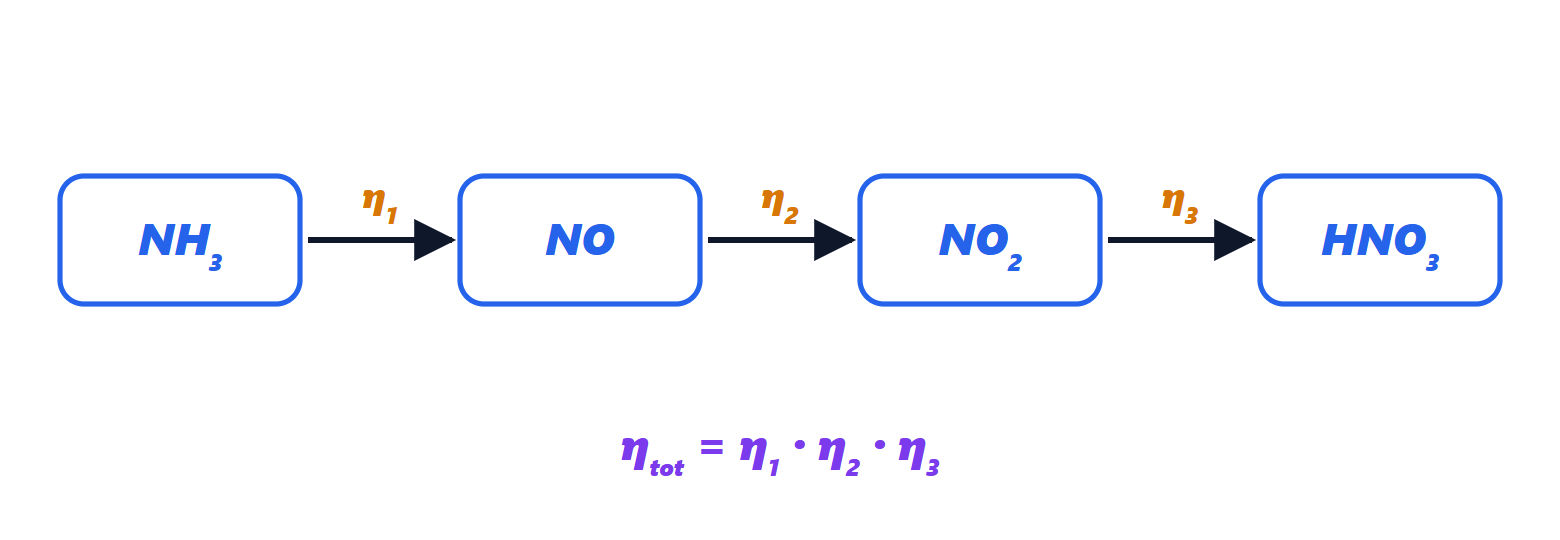
In a multi-stage process, if stage  has yield
 (the fraction of the theoretical amount actually obtained), the overall yield is the product of the yields:

because each stage starts from the product actually obtained by the previous one. Three stages at 90 % give 72.9 %, not 90 %. This is why industrial syntheses try to reduce the number of steps.
Mixtures: a system of equations
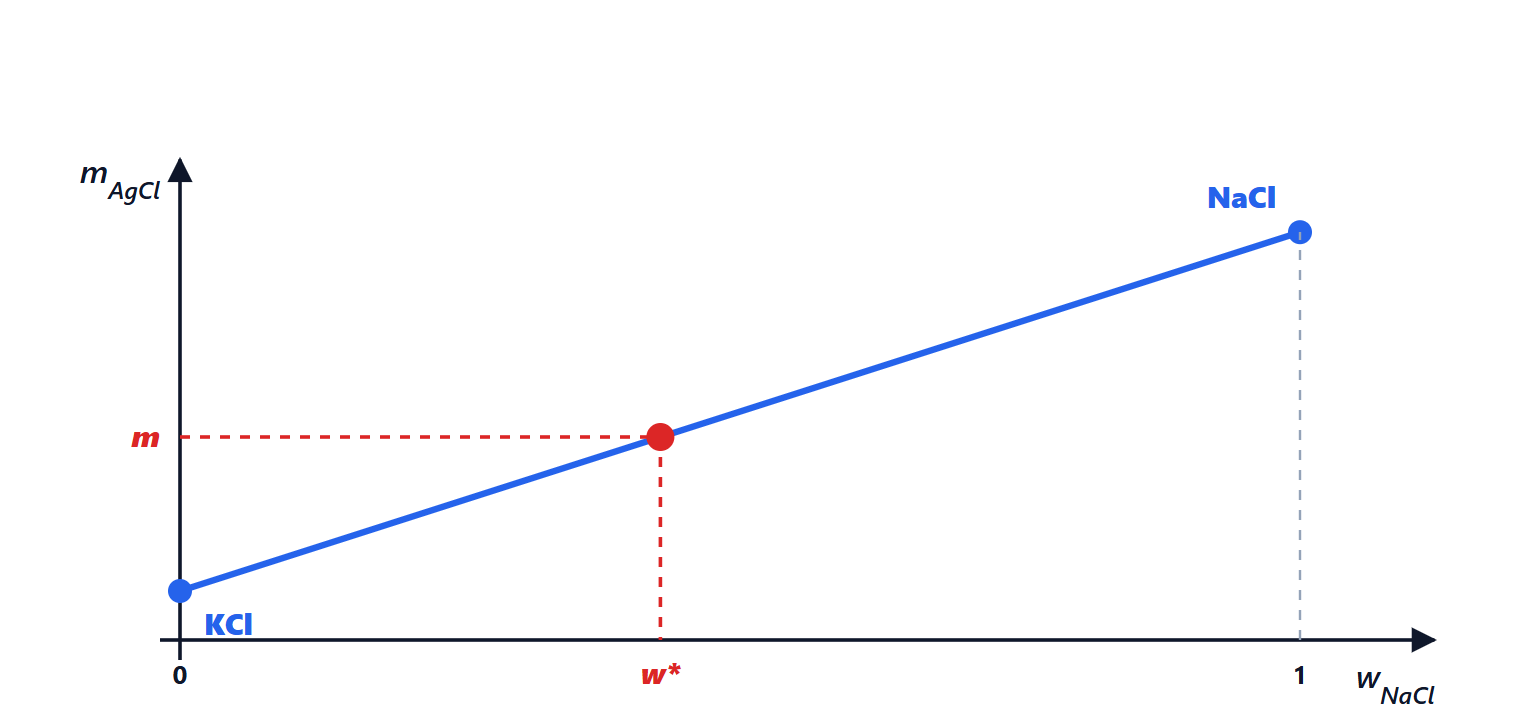
When a sample is a mixture of two substances that react in the same way (for example two chlorides both precipitating with silver), a single datum is not enough to tell them apart: two equations are written, one for the total mass and one for the amount of product. With masses  and
 of the two components:

where  and
 are the moles of product per mole of each component. It is a linear system of two equations in two unknowns (Geometry and Algebra lesson on linear systems). The method works better the more different the molar masses of the two components are: if they were equal, the two equations would be proportional and the system indeterminate.
How many significant figures
The result cannot be more precise than the data. In chains of multiplications and divisions, which are almost all stoichiometric calculations, a provable rule holds.
Theorem. If  and the quantities have small, independent relative errors
 , the relative error of the result is at most about
 , and statistically about
 .
Proof. Taking logarithms,  , and differentiating,
 . In the worst case the terms add in absolute value; if they are independent random errors, the variances add (Electrical Measurements lesson on uncertainty). ∎
In practice the result should be given with as many significant figures as the least precise datum: with a mass of 10.0 g (three figures) and molar masses to four figures, the result has three figures. During the calculation, however, it pays to keep one or two extra figures and round only at the end, so as not to accumulate rounding errors.
The most frequent mistakes, explained
- Proportions between grams. Coefficients express ratios between numbers of particles, i.e. between moles. A proportion between masses is right only by chance.
- Choosing the limiting reagent by looking at moles, not ratios. The reactant with fewer moles is not necessarily the limiting one: what counts is the ratio to the coefficient (proof above).
- Yield computed from the reactant in excess. The theoretical yield is always computed from the limiting reagent.
- Temperatures in °C in the gas equation. The absolute temperature is needed: at 25 °C,
 K.
- Forgetting water of crystallisation. CuSO4·5H2O has a molar mass of 249.7 g/mol, not 159.6.
Exercises on the topic, from basic level to exam level, are on the exercise page linked at the top.





Benvenuti nella pagina su «Stechiometria, approfondimento: avanzamento, reagente limitante, redox e miscele». L'ho scritta pensando a chi studia ingegneria elettronica: se un passaggio non vi torna, un esercizio vi dà un risultato diverso o volete altro materiale sull'argomento, chiedete pure nei commenti e vi risponderò. Un voto con le stelle qui sopra mi aiuta a capire quali pagine migliorare.Welcome to the page on “Stoichiometry in depth: extent of reaction, limiting reagent, redox and mixtures”. I wrote it for engineering students: if a step does not add up, an exercise gives you a different result or you would like more material on the topic, just ask in the comments and I will reply. A star rating above helps me understand which pages to improve.