Solved stoichiometry exercises, from basic to exam level
Fourteen exercises with solutions: moles, composition, formulas, limiting reagent, yield and purity, acid-base and redox titrations, combustion analysis, mixtures, multi-stage processes, gases.
Stoichiometry exercises of the kind set in university Chemistry courses, in three levels: basic, to fix the method; intermediate, with limiting reagent, yield, analysis and gases; exam, with the kind of problems found in written exams and mid-term tests. For each exercise the result is given straight away, so you can check yours; the full solution opens with a click. The method and the proofs are in the lesson and the in-depth study linked at the top.
Atomic masses used (g/mol): H 1.008; C 12.01; N 14.01; O 16.00; Na 22.99; Mg 24.31; Al 26.98; S 32.06; Cl 35.45; K 39.10; Ca 40.08; Fe 55.85; Mn 54.94; Ag 107.87. Gas constant  L·atm/(mol·K).
Basic level
Exercise 1. Moles, formula units and atoms
How many moles, how many formula units and how many oxygen atoms are there in 25.0 g of calcium carbonate, CaCO3?
Result: 0.250 mol;  formula units;
 O atoms.
Solution
Molar mass:  g/mol.
Moles:  mol, i.e. 0.250 mol to three significant figures.
Formula units:  .
Each unit contains 3 oxygen atoms:  .
Exercise 2. Percentage composition
Compute the percentage composition by mass of ammonium sulfate, (NH4)2SO4, a fertiliser.
Result: N 21.2 %; H 6.1 %; S 24.3 %; O 48.4 %.
Solution
The formula contains 2 N, 8 H, 1 S, 4 O. Molar mass:  g/mol.
Percentages: N  %; H
 %; S
 %; O
 %. The sum is 100.0 %: the check to make every time.
Exercise 3. Combustion of propane
22.0 g of propane, C3H8, are burned. How many grams of oxygen are needed and how many grams of CO2 are formed?
Result: 79.8 g of O2; 65.9 g of CO2.
Solution
Balanced equation:  (3 C on the right in CO2, 8 H in 4 H2O, hence
 O atoms, i.e. 5 O2).
Moles of propane:  g/mol,
 mol.
Oxygen:  mol,
 g.
Carbon dioxide:  mol,
 g.
Mass conservation check:  g of water also form; reactants
 g, products
 g, equal within rounding.
Exercise 4. Empirical and molecular formula
A hydrocarbon contains 85.6 % carbon and 14.4 % hydrogen. Its molar mass is about 56 g/mol. Find the empirical and molecular formulas.
Result: CH2; C4H8.
Solution
In 100 g: C  mol; H
 mol.
Dividing by the smallest: C 1; H  . Empirical formula CH2, with mass
 g/mol.
Ratio of molar mass to empirical formula mass:  . Molecular formula C4H8 (for example a butene).
Exercise 5. A gas from a decomposition
Heating 12.25 g of potassium chlorate, KClO3, gives KCl and oxygen. How many litres of O2 are evolved at 0 °C and 1 atm?
Result: 3.36 L.
Solution
Equation:  .
 g/mol,
 mol.
Oxygen:  mol.
Volume:  L (i.e. 0.1499 mol times 22.41 L/mol).
Intermediate level
Exercise 6. Limiting reagent and excess reagent
10.0 g of aluminium react with 30.0 g of chlorine, according to  . How much aluminium chloride forms? Which reagent is left over, and how much?
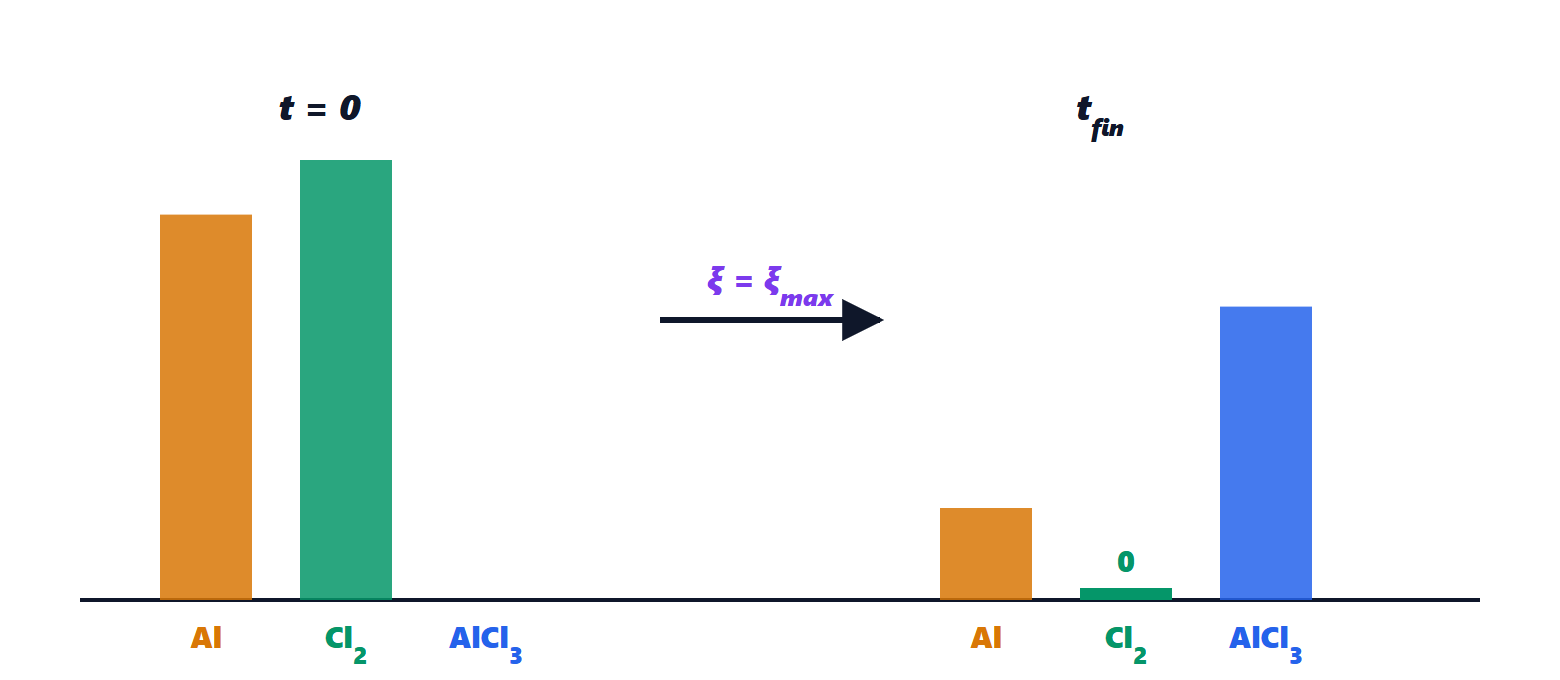
Result: 37.6 g of AlCl3; 2.39 g of Al left over.
Solution
Moles: Al  mol; Cl2
 mol.
Ratios to the coefficients: Al  ; Cl2
 . The smaller is chlorine’s: chlorine is limiting, even though in moles it is more abundant than aluminium.
Maximum extent  mol. AlCl3:
 mol;
 g/mol; mass
 g.
Aluminium consumed: mol; left over  mol, i.e.
 g.
Check:  g, equal to the initial mass of the reagents.
Exercise 7. Purity and yield
200 g of a limestone containing 85.0 % CaCO3 by mass are decomposed by heating:  . 70.0 g of CO2 are collected. What is the percentage yield?
Result: 93.6 %.
Solution
Pure carbonate:  g, i.e.
 mol.
Theoretical CO2: 1.698 mol (1 to 1 ratio),  g.
Yield:  %. The impurities produce no CO2 and must be excluded before computing the theoretical yield.
Exercise 8. An acid-base titration
25.0 mL of a sulfuric acid solution are neutralised by 32.4 mL of 0.150 M NaOH. What is the molarity of the acid?
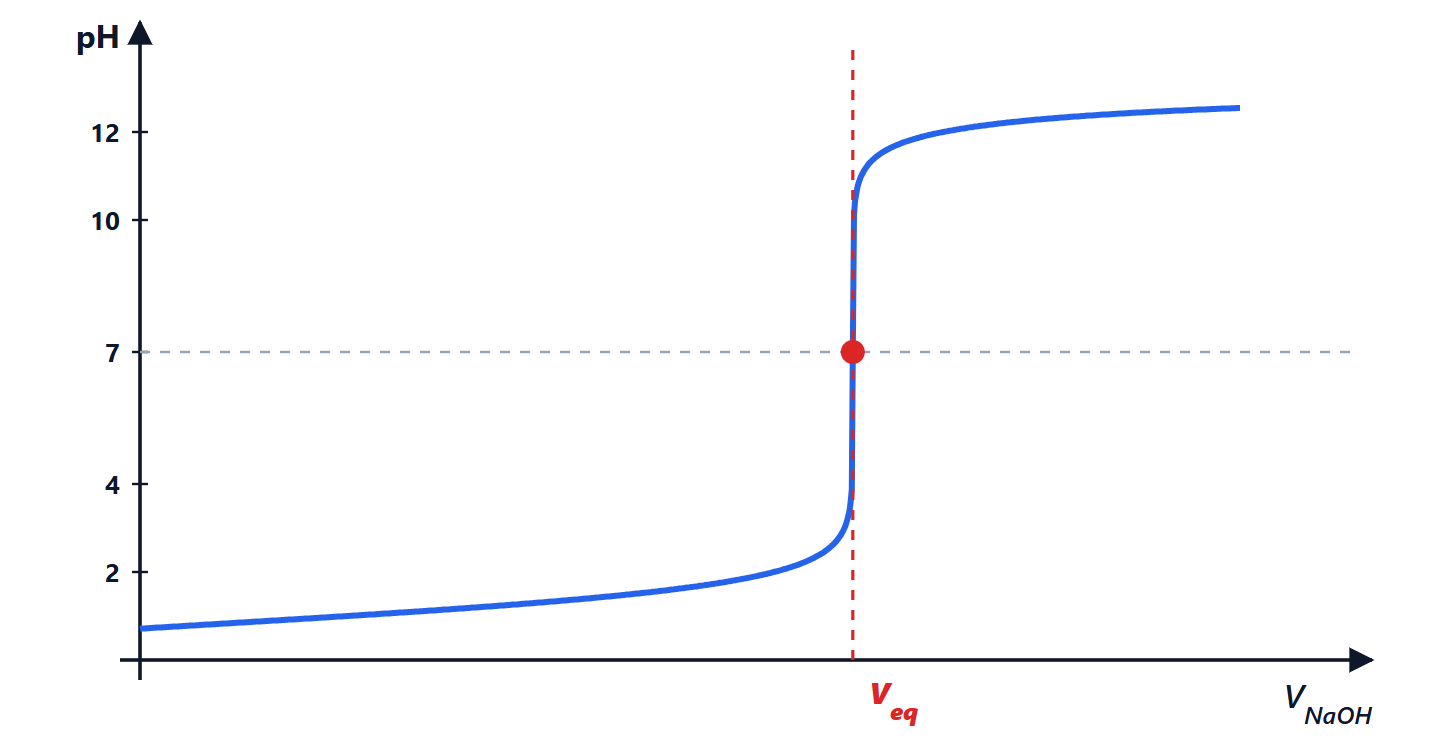
Result: 0.0972 M.
Solution
Reaction:  : the acid is diprotic, one mole of acid consumes two moles of base.
Moles of NaOH:  mol. Moles of acid:
 mol.
Molarity:  M. The typical mistake is forgetting the factor 2 and finding double.
Exercise 9. Combustion analysis
0.500 g of a compound containing C, H and O burns completely giving 0.999 g of CO2 and 0.409 g of H2O. The molar mass of the compound is 88.1 g/mol. Find the molecular formula.
Result: C4H8O2.
Solution
All the carbon ends up in CO2:  mol of C, i.e.
 g.
All the hydrogen ends up in water:  mol of H2O, hence
 mol of H, i.e. 0.0458 g.
The oxygen of the compound is found by difference (not from the products, because combustion adds oxygen):  g, i.e.
 mol.
Ratios, dividing by 0.011 35: C 2.00; H 4.00; O 1.00. Empirical formula C2H4O, mass 44.05 g/mol.  : molecular formula C4H8O2 (for example ethyl acetate).
Exercise 10. A gas at non-standard conditions
1.20 g of magnesium react with excess hydrochloric acid:  . What volume of hydrogen is collected at 25 °C and 0.980 atm?
Result: 1.23 L.
Solution
Moles of Mg:  mol, equal to the moles of H2.
 L. 22.4 L/mol cannot be used: it holds only at 0 °C and 1 atm.
Exam level
Exercise 11. Redox titration of an iron ore
1.000 g of an iron ore is dissolved in acid and all the iron brought to Fe2+. The solution requires 22.5 mL of 0.0200 M KMnO4 to be titrated in acidic solution. Compute the percentage by mass of iron in the ore.
Result: 12.6 %.
Solution
Reaction balanced with half-reactions (in-depth study): reduction  ; oxidation
 , to be multiplied by 5:

Moles of permanganate:  mol. Moles of iron:
 mol, i.e.
 g.
Percentage:  %.
Exercise 12. Analysis of a mixture
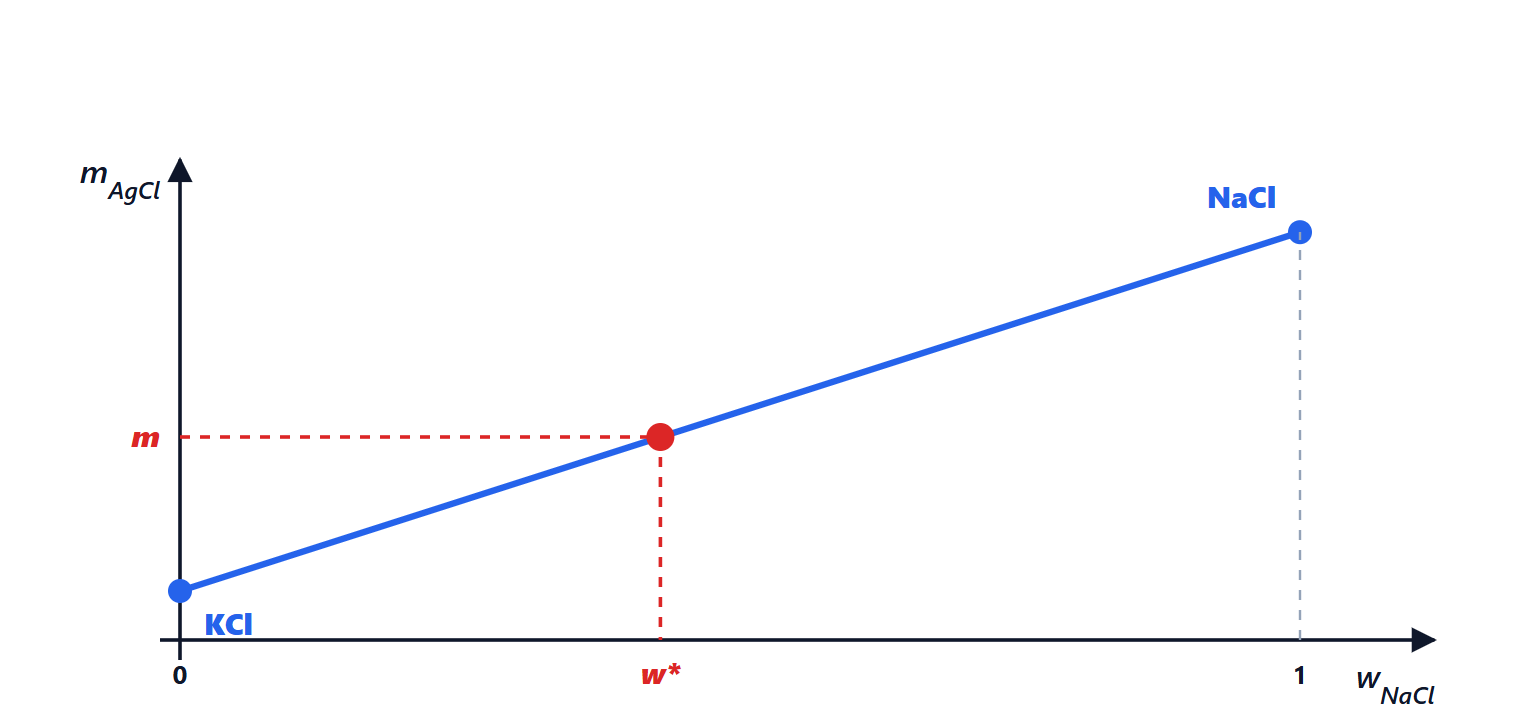
A 2.00 g sample is a mixture of NaCl and KCl. Dissolved in water and treated with excess AgNO3, it gives 4.30 g of AgCl. Compute the percentage by mass of NaCl in the mixture.
Result: 42.9 %.
Solution
Both chlorides give one mole of AgCl per mole ( ). Total moles of chloride:
 mol (
 ).
Let  be the mass of NaCl (
 ); that of KCl (
 ) is
 :

 , i.e.
 ,
 g.
Percentage of NaCl:  %. The system works because the two molar masses are different (in-depth study): the same mass of NaCl contains more chloride than one of KCl.
Exercise 13. A multi-stage industrial process
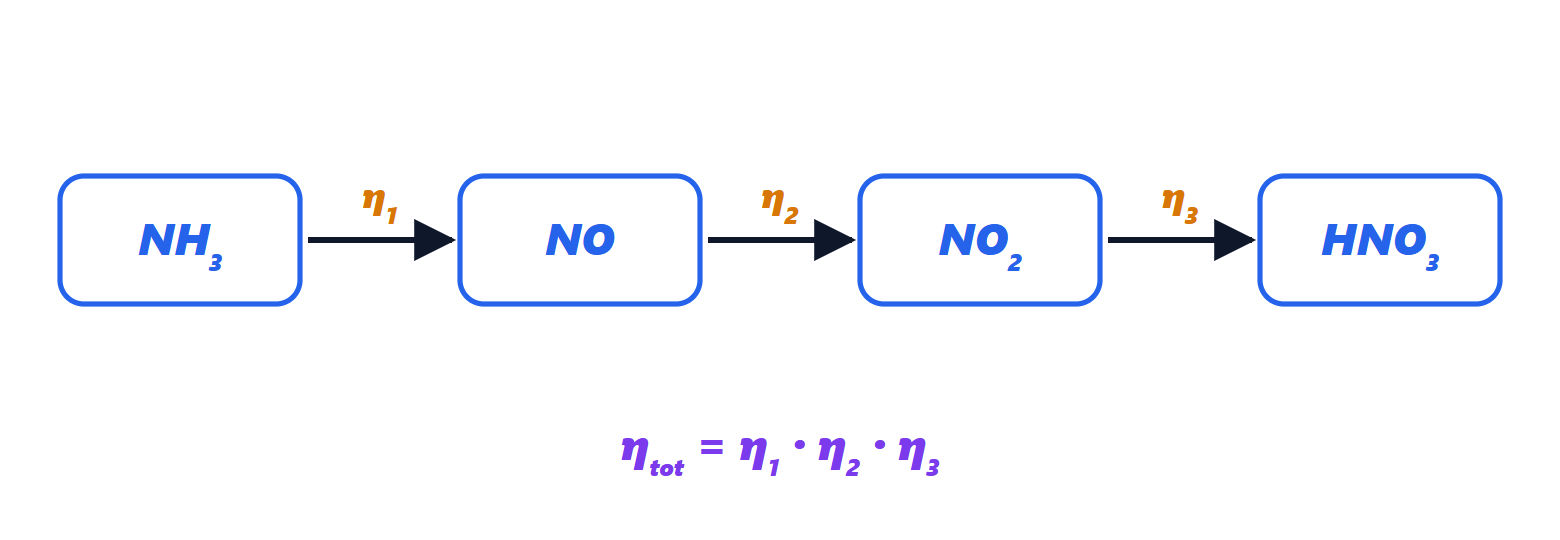
Nitric acid is produced from ammonia in three stages (Ostwald process):
 , yield 90.0 %;
 , yield 95.0 %;
 , yield 100 %.
How many kg of HNO3 are obtained from 100 kg of NH3, without recycling the NO produced in the third stage?
Result: about 211 kg.
Solution
Moles of ammonia:  mol.
Stage 1: theoretical NO 5872 mol (4 to 4 ratio), actual  mol.
Stage 2: NO2  mol (2 to 2 ratio).
Stage 3: HNO3  mol, i.e.
 kg.
Remark: the overall nitrogen yield is  %. In real plants the NO from the third stage is re-oxidised and recycled, and the yield rises above 90 %.
Exercise 14. A gas mixture
10.0 L of a mixture of methane and ethane, burned completely, consume 26.0 L of oxygen, measured at the same temperature and pressure. Find the volume composition of the mixture and the volume of CO2 produced.
Result: 60 % CH4, 40 % C2H6; 14.0 L of CO2.
Solution
At the same temperature and pressure, gas volumes are proportional to moles (Avogadro’s law), so one can reason directly in litres.
Reactions:  and
 .
With litres of methane and  of ethane:
 and
 . Substituting
 :
 , hence
 L and
 L.
CO2:  L.