Solved rigid body and rolling exercises, from basic to exam level
Twelve exercises with solutions: moments of inertia, Atwood machine with pulley, rolling on an incline, yo-yo, bowling ball, pulled cylinder, falling rod, turntable, loop-the-loop.
Exercises on rigid-body dynamics and rolling without slipping of the kind set in Physics 1 courses, in three levels: basic, for moments of inertia and the rotation equation; intermediate, with rolling, inclined planes and friction; exam, with complete problems as in written exams and mid-term tests. The result is given straight away; the full solution opens with a click. The proofs are in the lesson and the in-depth study linked at the top.
Unless stated:  m/s², uniform bodies,
 with
 for the disc or solid cylinder,
 for the solid sphere, 1 for the ring.
Basic level
Exercise 1. Moment of inertia of a system
Two 2.0 kg point masses are fixed at the ends of a rod of negligible mass, 1.0 m long. Compute the moment of inertia about an axis perpendicular to the rod through its centre, and about one through an end.
Result: 1.0 kg·m²; 2.0 kg·m².
Solution
About the centre, each mass is at 0.5 m:  kg·m².
About an end, one mass lies on the axis (zero contribution) and the other at 1.0 m:  kg·m². Check with the parallel-axis theorem:
 kg·m².
Exercise 2. A disc set spinning
A disc of 4.0 kg and radius 0.20 m, initially at rest, can rotate about its axis. A 10 N force is applied tangentially to the rim for 2.0 s. Find the angular acceleration, the final angular velocity and the final kinetic energy, and check that it equals the work of the force.
Result: 25 rad/s²; 50 rad/s; 100 J.
Solution
Torque:  N·m. Moment of inertia:
 kg·m². Angular acceleration
 rad/s².
After 2.0 s:  rad/s. Energy:
 J.
Work: the angle covered is 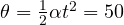 rad, and
 J. This is the work-energy theorem for rotation.
Exercise 3. The Atwood machine with a heavy pulley
Two masses of 3.0 kg and 2.0 kg hang on either side of a string passing over a disc pulley of mass 2.0 kg, without slipping. Find the acceleration and the tensions in the two parts of the string.

Result:  m/s²;
 N;
 N.
Solution
With  kg going down and
 kg going up:
 ;
 ; for the pulley
 , i.e.
 .
Adding the three equations:  , so
 m/s².
Tensions:  N;
 N. The tensions differ precisely because their difference turns the pulley: with a massless pulley they would be equal.
Exercise 4. Rolling and energy
A solid cylinder starts from rest and rolls without slipping down an inclined plane, dropping by a height of 1.5 m. How fast is it moving at the bottom?
Result: 4.43 m/s.
Solution
Energy conservation (static friction does no work, in-depth study):  , with :
 m/s.
A body sliding without friction would reach  m/s: a third of the cylinder’s energy has gone into rotation.
Intermediate level
Exercise 5. Sphere on an inclined plane: acceleration and minimum friction
A solid sphere rolls without slipping on a plane inclined at 30°. Find the acceleration of the centre, the friction force relative to the weight and the minimum coefficient of static friction needed.
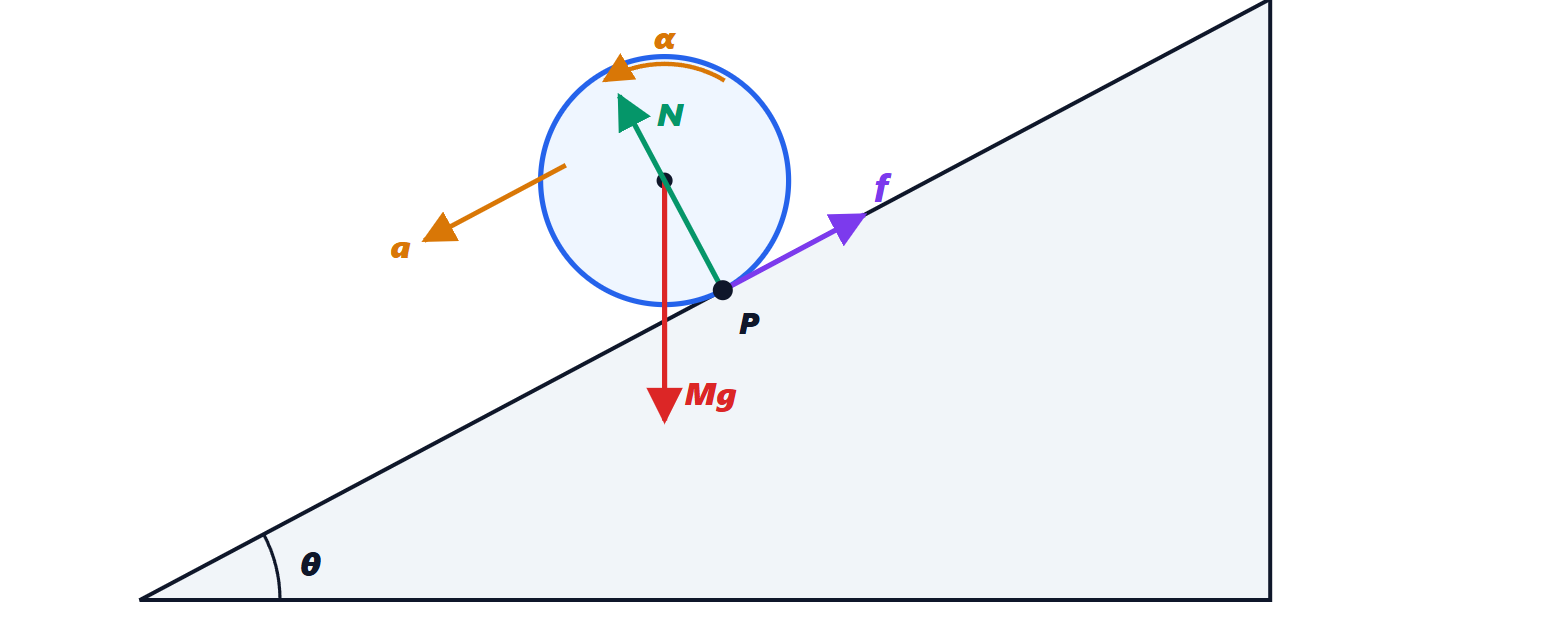
Result:  m/s²;
 ;
 .
Solution
From the equations of motion (in-depth study):  m/s².
Friction:  newtons, i.e.
 times the weight.
Normal reaction  . Minimum coefficient:
 , equal to
 .
Exercise 6. The race down the inclined plane
A disc and a ring start together from rest at the top of a 4.0 m long plane inclined at 30°. How long does each take to reach the bottom?
Result: disc 1.56 s; ring 1.81 s.
Solution
Accelerations: disc  m/s²; ring
 m/s².
Uniformly accelerated motion from rest:  . Disc:
 s. Ring:
 s.
The result depends neither on mass nor on radius, only on  : a lead ring loses to a wooden disc.
Exercise 7. The yo-yo
A disc of mass  and radius
 has a string wound around its rim; the end of the string is held still and the disc descends unwinding it. Find the acceleration of the disc and the tension in the string.
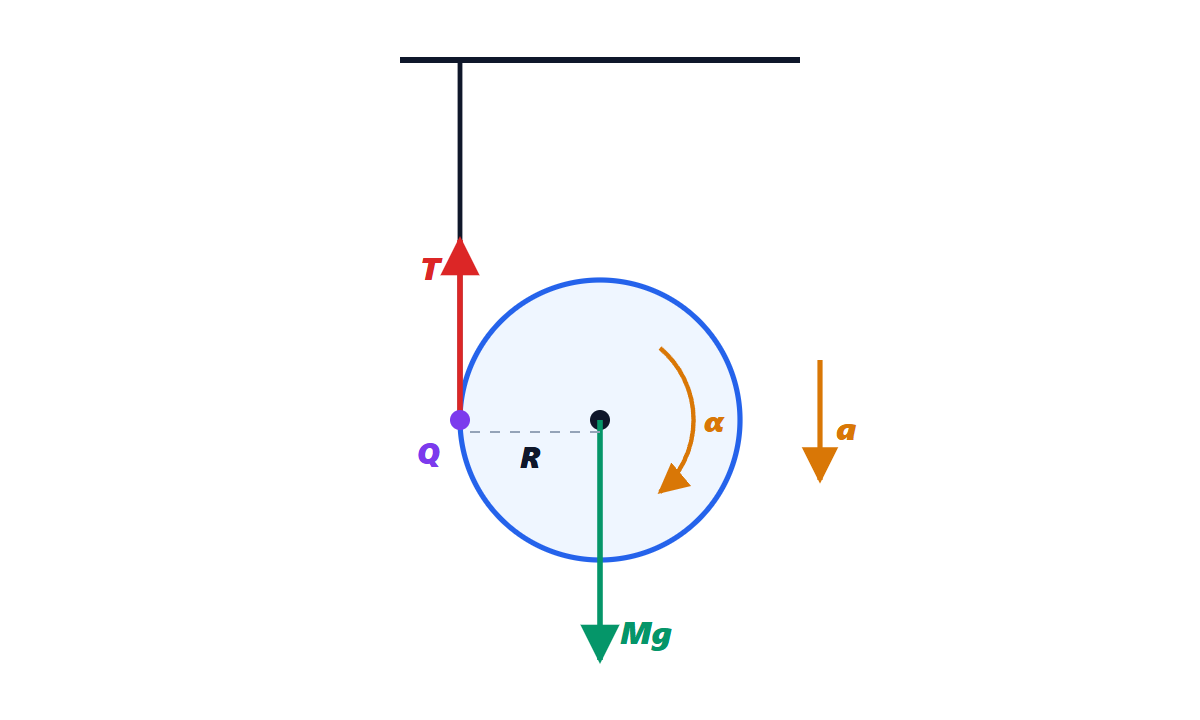
Result: 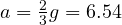 m/s²;
 .
Solution
The string unwinds without slipping: the point of the disc where the string leaves it is at rest, so  , as in rolling.
Translation:  . Rotation about the centre:
 , so
 .
Substituting: 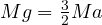 , m/s², and .
With moments about the point where the string leaves (in-depth study):  , the same result in one line.
Exercise 8. The sliding bowling ball
A 7.0 kg bowling ball (solid sphere) is thrown at 8.0 m/s without spin onto a lane with a coefficient of kinetic friction of 0.20. Find the speed when it starts rolling without slipping, the time and distance covered until then, and the energy dissipated.
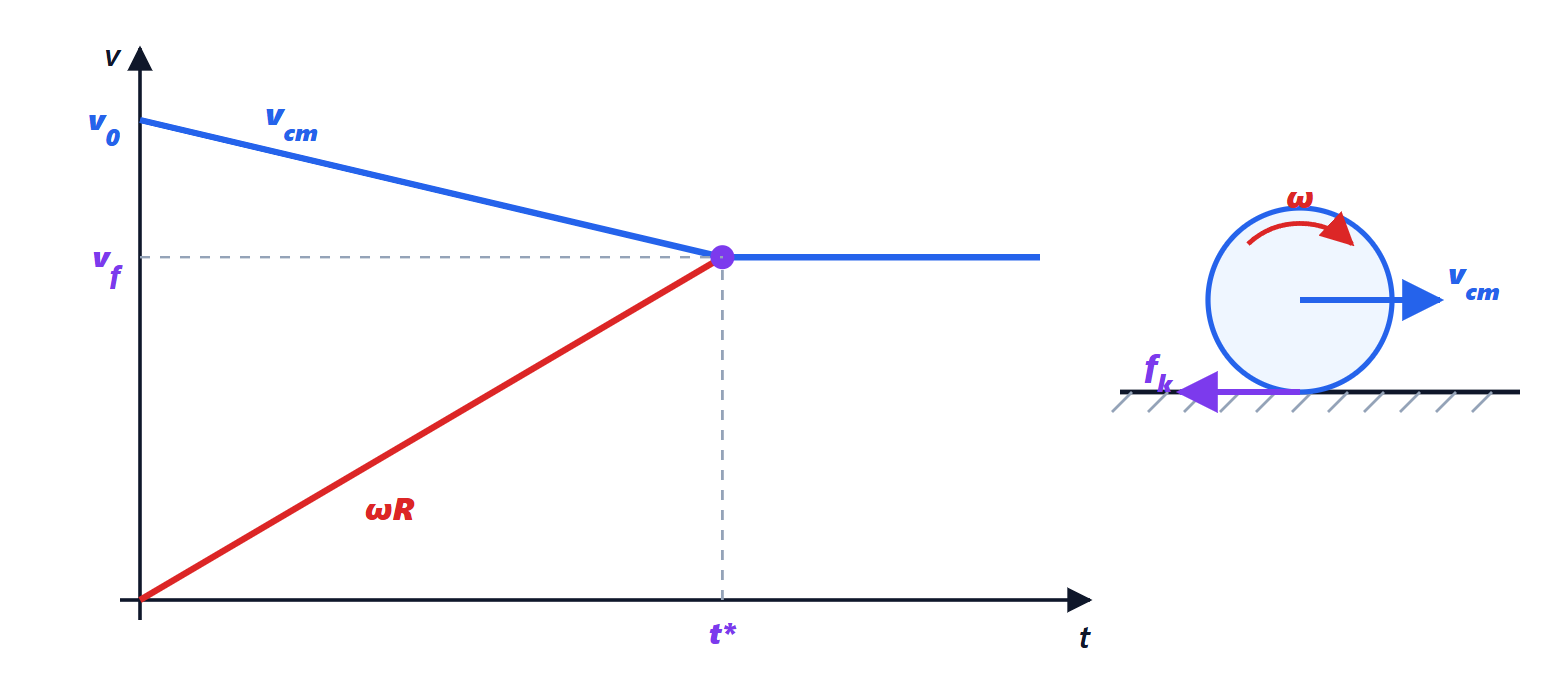
Result: 5.71 m/s; 1.17 s; 7.99 m; 64 J.
Solution
Final speed (in-depth study, conservation of angular momentum about a point on the lane):  m/s.
During sliding, kinetic friction slows the centre with  m/s². Time:
 s.
Distance:  m.
Energy: initial  J; final
 J; dissipated 64 J, i.e. 2/7 of the initial energy, as predicted.
Check on rotation: the moment of friction,  , gives
 , and after 1.165 s
 m/s, equal to
 .
Exam level
Exercise 9. The cylinder pulled at its centre
A 10 kg solid cylinder rests on a horizontal plane and is pulled by a 30 N horizontal force applied to its axis. Find the acceleration, the friction force (magnitude and direction) and the minimum coefficient of static friction for it to roll without slipping. Repeat with the force applied at the top (string wound around the cylinder).
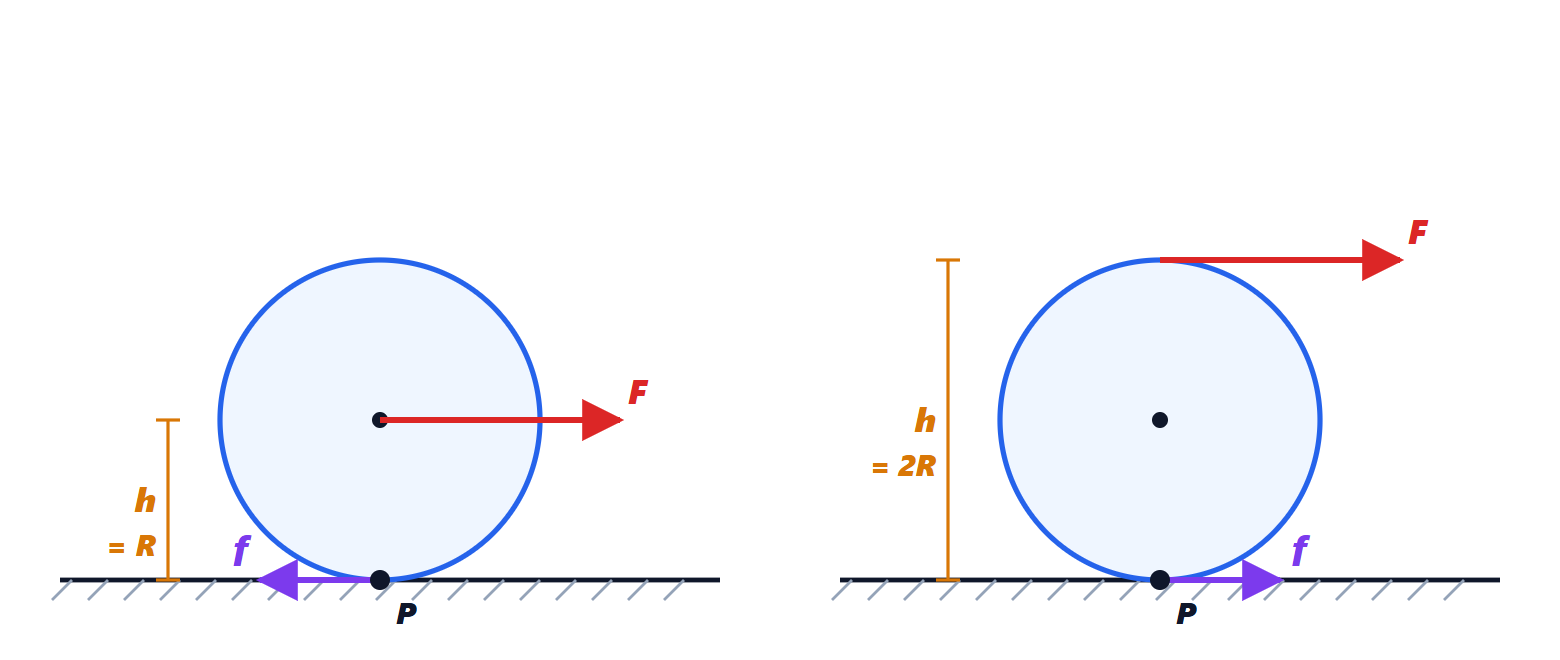
Result: from the centre  m/s², friction 10 N backwards,
 ; from the top
 m/s², friction 10 N forwards.
Solution
Moments about the contact point (in-depth study), 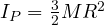 :
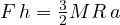 .
From the centre,  :
 m/s². Centre-of-mass equation:
 , so
 N: 10 N opposite to the force. Minimum coefficient:
 .
From the top,  :
 m/s², and
 N, in the same direction as the force. Friction “helps”: the cylinder accelerates more than it would under the force
 alone (3.0 m/s²), because the force applied at the top also spins it forwards.
Exercise 10. The falling rod
A uniform rod 1.0 m long is hinged at one end and released from rest in a horizontal position. Find the initial angular acceleration, the angular velocity as it passes the vertical, and the speed of the free end at that moment. Compare it with that of a body in free fall from the same height.
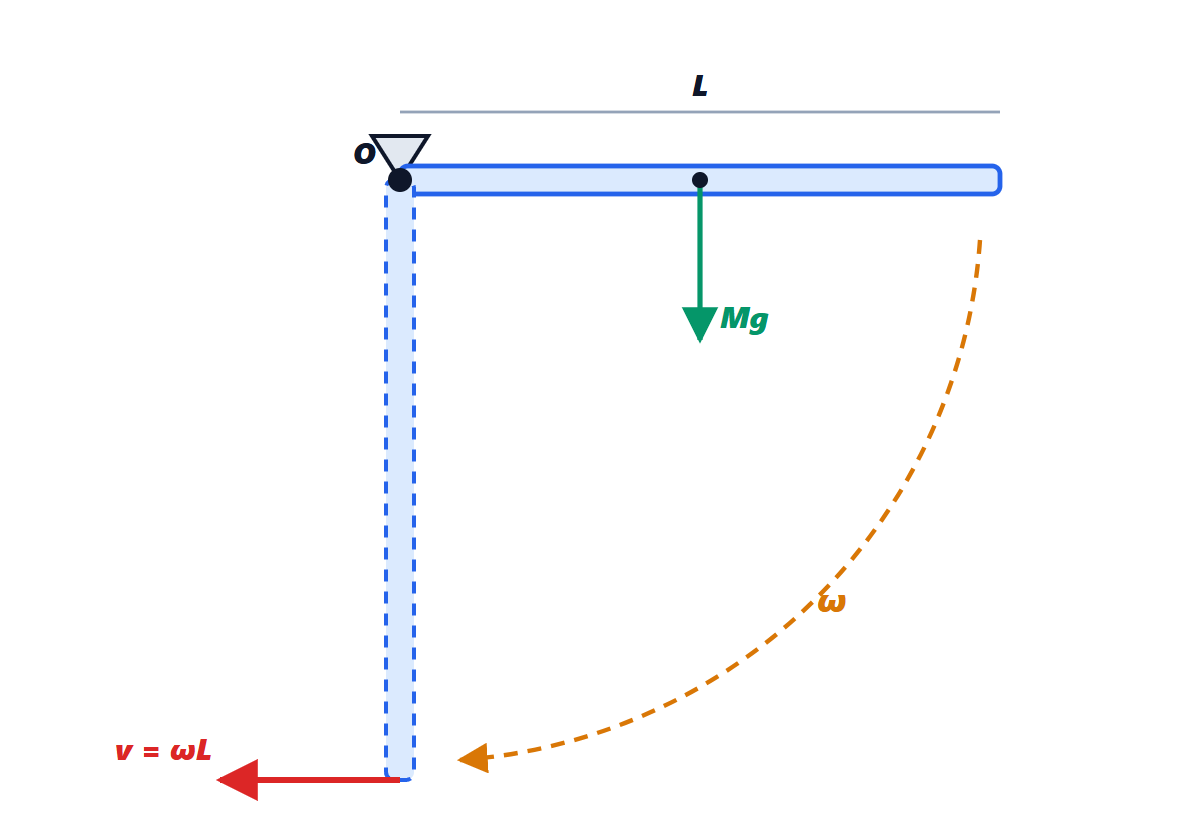
Result:  rad/s²;
 rad/s;
 m/s, more than the 4.43 m/s of free fall.
Solution
Moment of inertia about the end:  (lesson, with the parallel-axis theorem).
Start: the weight, applied at the centre at  , gives
 ;
 rad/s².
Energy: the centre drops by , so  ,
 rad/s.
Free end:  m/s. A body in free fall from 1.0 m reaches
 m/s: the end of the rod is faster. This is why a collapsing chimney breaks: the upper parts would have to accelerate faster than
 , and the structure cannot withstand the moments required.
Exercise 11. The turntable
A circular platform with moment of inertia 200 kg·m² rotates without friction at 1.0 rad/s. A 70 kg person, modelled as a point, stands on the edge 2.0 m from the centre and walks to 0.50 m from the centre. Find the new angular velocity and the change in kinetic energy. Where does the energy come from?
Result: 2.21 rad/s; the energy goes from 240 J to 530 J.
Solution
Moments of inertia: initial  kg·m²; final
 kg·m².
No external torque:  ,
 rad/s.
Energies:  J;
 J. The energy increases by 290 J: it is the work of the person’s muscles, who must pull themselves towards the centre against the centrifugal force (seen in their rotating frame). Angular momentum is conserved, energy is not.
Exercise 12. Loop-the-loop with a rolling ball
A small solid sphere rolls without slipping along a track ending in a circular loop of radius . From what minimum height must it start from rest to go all the way round? Compare with a body sliding without friction.
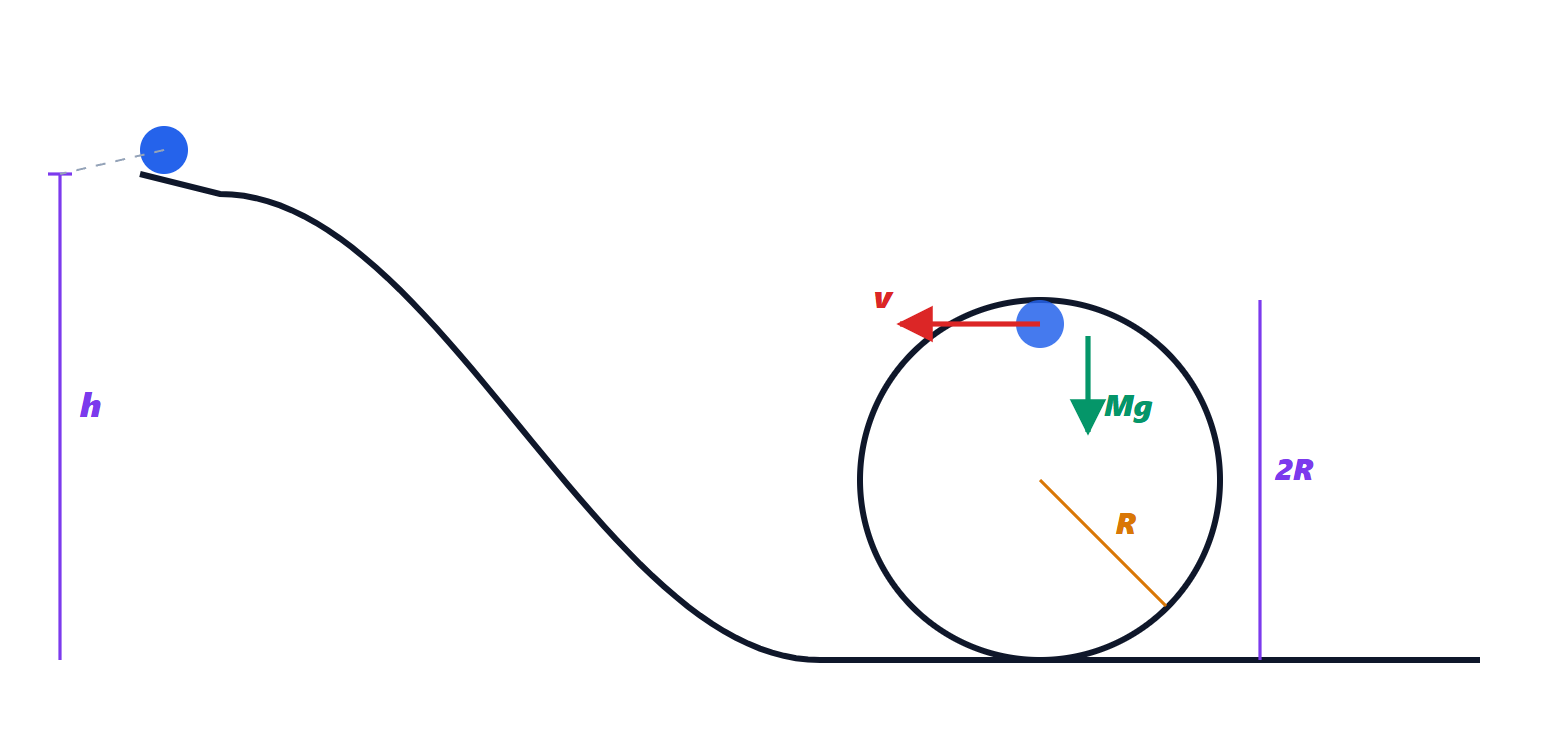
Result:  (against
 without rotation).
Solution
At the top of the loop the sphere stays on the track if the required centripetal force is not less than the weight: at the limit  , i.e.
 (neglecting the ball’s radius compared with ).
Energy: starting from  and reaching height
 ,
 .
So  . For a body sliding without rotation (
 )
 would suffice: the rolling ball must start higher because part of its energy is locked up in rotation.