Gravitation: Newton's law, Kepler's laws and orbits
Universal gravitation and the value of g, proofs of Kepler's second and third laws, the geostationary orbit, gravitational potential energy, escape velocity and GPS.
The same force that makes an apple fall keeps the Moon in orbit and holds GPS satellites 20,000 km up. Newton was the first to see it, joining the physics of the Earth and that of the sky. In this lesson we derive the value of  , Kepler’s laws, gravitational potential energy and escape velocity.
The law of universal gravitation
Two masses  and
 at distance
 attract each other with a force along the line joining them:

 is tiny: two 70 kg people one metre apart attract each other with about
 N. Gravity only matters when at least one of the masses is huge. For a spherically symmetric body, like a planet, the force outside it is the same as if all the mass were at the centre (the shell theorem, proved by Newton).
Proof: where comes from
At the Earth’s surface the weight  is the gravitational pull of the Earth, of mass
 and radius
 :

With  kg and
 m you get
 m/s². The mass cancels: that is why all bodies fall with the same acceleration. At height
 the acceleration becomes
 : on the Space Station, at 400 km, it is still about 8.7 m/s². Astronauts float not because gravity is missing, but because they fall together with the station.
Kepler’s three laws
Kepler derived them in the early seventeenth century from Tycho Brahe’s observations, without knowing their cause. Newton proved all of them from his law.
- Planetary orbits are ellipses, with the Sun at one focus.
- The line joining the Sun to a planet sweeps out equal areas in equal times.
- The square of the period is proportional to the cube of the semi-major axis:
 .
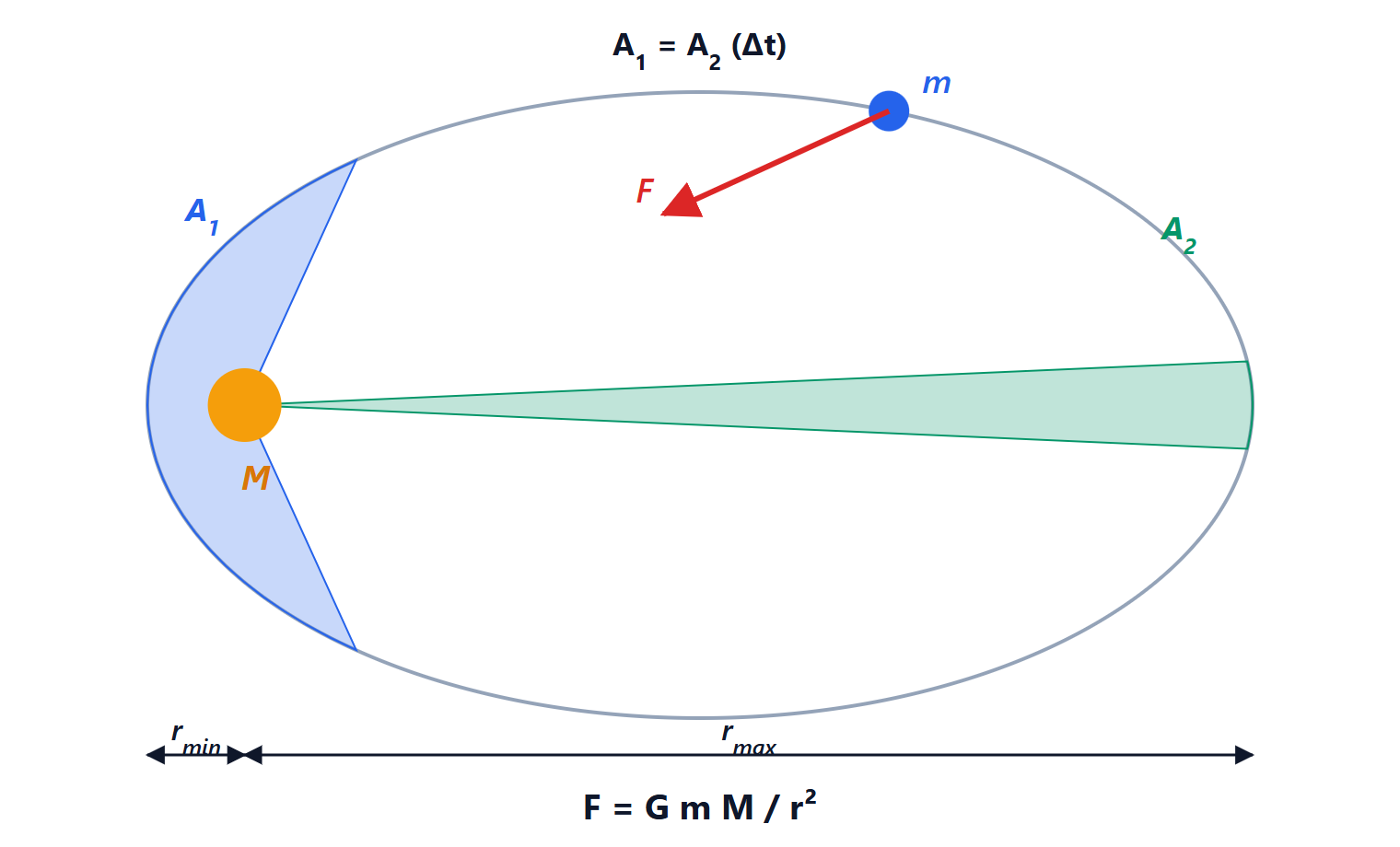
 ) the planet must therefore move faster than far from it (
 ).
Proof of the second law
The gravitational force points at the Sun, so it is parallel to  and its torque about the Sun is
 . The angular momentum
 is conserved. In a time
 the planet moves by
 and the radius sweeps a triangle of area

The second law is therefore conservation of angular momentum: it holds for any central force, not just gravity.
Proof of the third law (circular orbit)
For a circular orbit of radius gravity supplies the centripetal force:

The period is the circumference divided by the speed,  . Squaring:
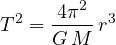
For ellipses the same result holds with the semi-major axis  in place of . The constant depends only on the mass of the central body: by measuring the period and radius of a moon’s orbit you can “weigh” its planet.
Example: the geostationary orbit. A satellite that goes round in 24 hours (more precisely one sidereal day, 86,164 s) stays above the same point on the equator. From the third law:

that is about 35,786 km above the surface. It is the orbit of TV satellites: that is why satellite dishes always point at the same spot in the sky.
Gravitational potential energy
Far from the surface  is no longer enough, because the force changes with distance. Take
 at infinite distance and compute the work gravity does when a mass comes in from infinity to :

Since  :
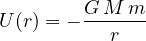
The minus sign means a bound state: you must supply energy to move the mass away. For small displacements near the surface, a series expansion gives back  .
Escape velocity and orbital energy
Escape velocity is the minimum speed needed to leave a planet for good, that is to reach infinity with zero kinetic energy. With energy conservation:

For the Earth  km/s, for the Moon 2.4 km/s: this is why the Moon has no atmosphere, gas molecules escape easily.
For a circular orbit, using 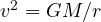 , the kinetic energy is
 , half the absolute value of the potential energy. The total energy is
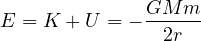
This leads to a counter-intuitive result: to climb to a higher orbit you must supply energy, but the satellite ends up going slower. Conversely, drag from the upper atmosphere makes satellites in low orbit sink and speed up.
A note for electronics people: GPS
GPS satellites orbit about 20,200 km up with a period of half a sidereal day. Because of relativity their atomic clocks gain about 38 microseconds a day compared with clocks on the ground: 45 µs more because they sit higher in the gravitational field, 7 µs less because of their speed. Multiplied by the speed of light, without correction the error would grow by about 11 km a day. That is why the frequency of the on-board oscillators is slightly offset before launch.


