Work and energy: the work-energy theorem and conservation of mechanical energy
Work of constant and variable forces, power, the work-energy theorem, conservative forces and potential energy, energy conservation with the pendulum and the loop-the-loop, friction.
With Newton’s laws you can solve any mechanics problem, but sometimes the road is long: you need the forces at every instant and you have to integrate. Energy offers a powerful shortcut. Instead of following the motion step by step, you compare the initial and final states. In this lesson we define work, kinetic and potential energy, and prove the conservation of mechanical energy.
The work of a force
If a constant force  acts on a body that moves by
 , the work is

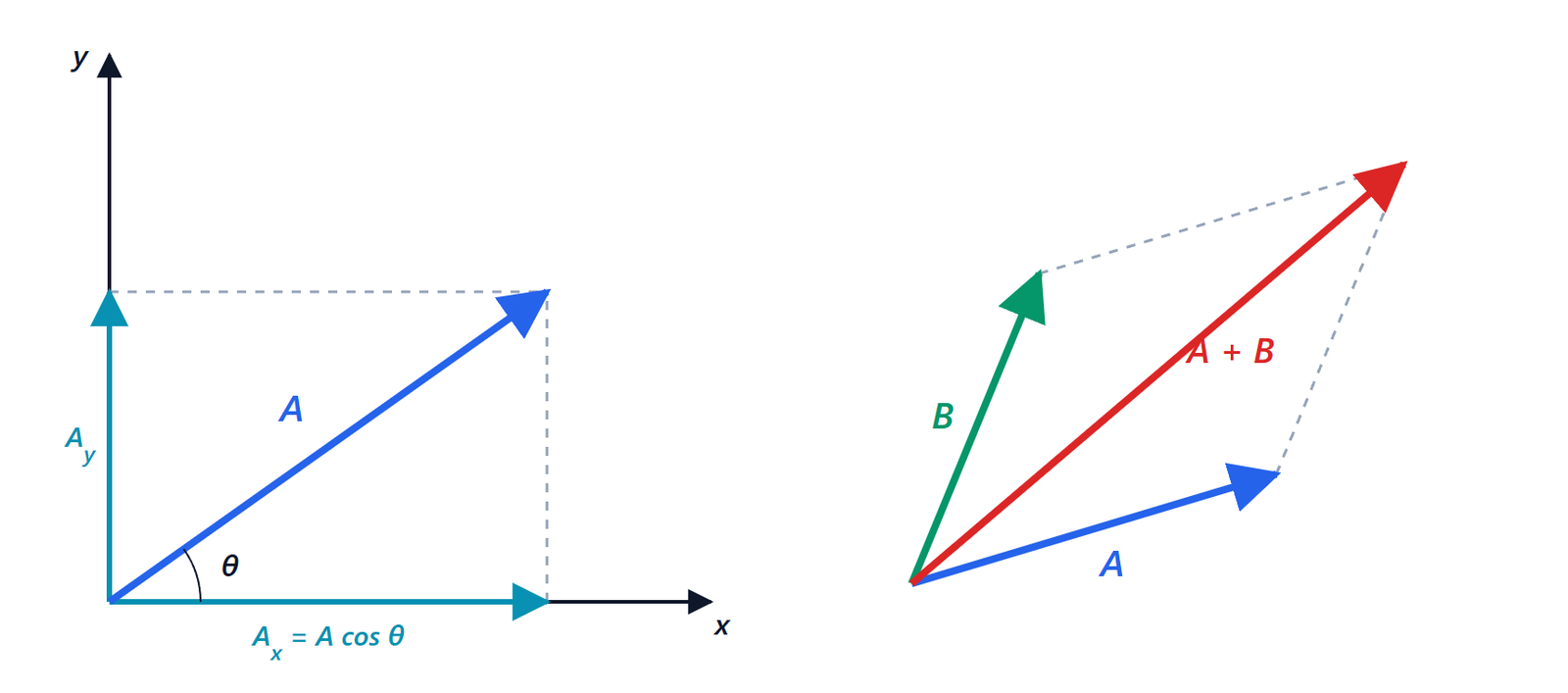
Only the component of the force along the displacement counts. A force perpendicular to the motion does no work: the normal force on a body sliding on a level surface, or the centripetal force in circular motion. Work is negative if the force opposes the motion, like friction. The unit is the joule,  .
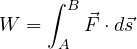
If the force varies along the path, split the path into infinitesimal pieces and add them up:
Example: the work of a spring
A spring of constant  exerts
 . To stretch it from
 to
 we must apply the opposite force,
 , and the work we do is
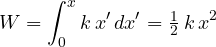
On the force-extension graph it is the area of the triangle under the line.
Power
Power is the work done per unit time,  . Since
 , we also have
 . The unit is the watt. An electric motor lifting a 200 kg load at 0.5 m/s delivers
 W, losses excluded.
The work-energy theorem
The kinetic energy of a body of mass  and speed
 is defined as

Proof
Take the work of the net force along a piece of the path. Use the second law in the form  (only the tangential component counts, the normal one does no work) and
 :

So the work of all the forces applied equals the change in kinetic energy:

The theorem always holds, friction included, as long as every force is counted.
Conservative forces and potential energy
A force is conservative if the work it does between two points does not depend on the path, only on the start and end points. Equivalently: the work around any closed path is zero. Weight, the spring force and gravity are conservative; friction is not, because a longer path dissipates more energy.
For a conservative force we can define a potential energy  such that

- weight:
 , with
 the height above a level of your choice;
- spring:
 , with the deformation;
- a planet’s gravity:
 (see the lesson on gravitation).
In one dimension the force follows from the potential energy by a derivative,  : the force always pushes towards lower potential energy. Minima of are positions of stable equilibrium.
Conservation of mechanical energy
Proof
If only conservative forces act on the body, the total work is  . By the work-energy theorem it is also
 . So
 , that is
 :

Mechanical energy turns from kinetic into potential and back, but the sum stays the same.
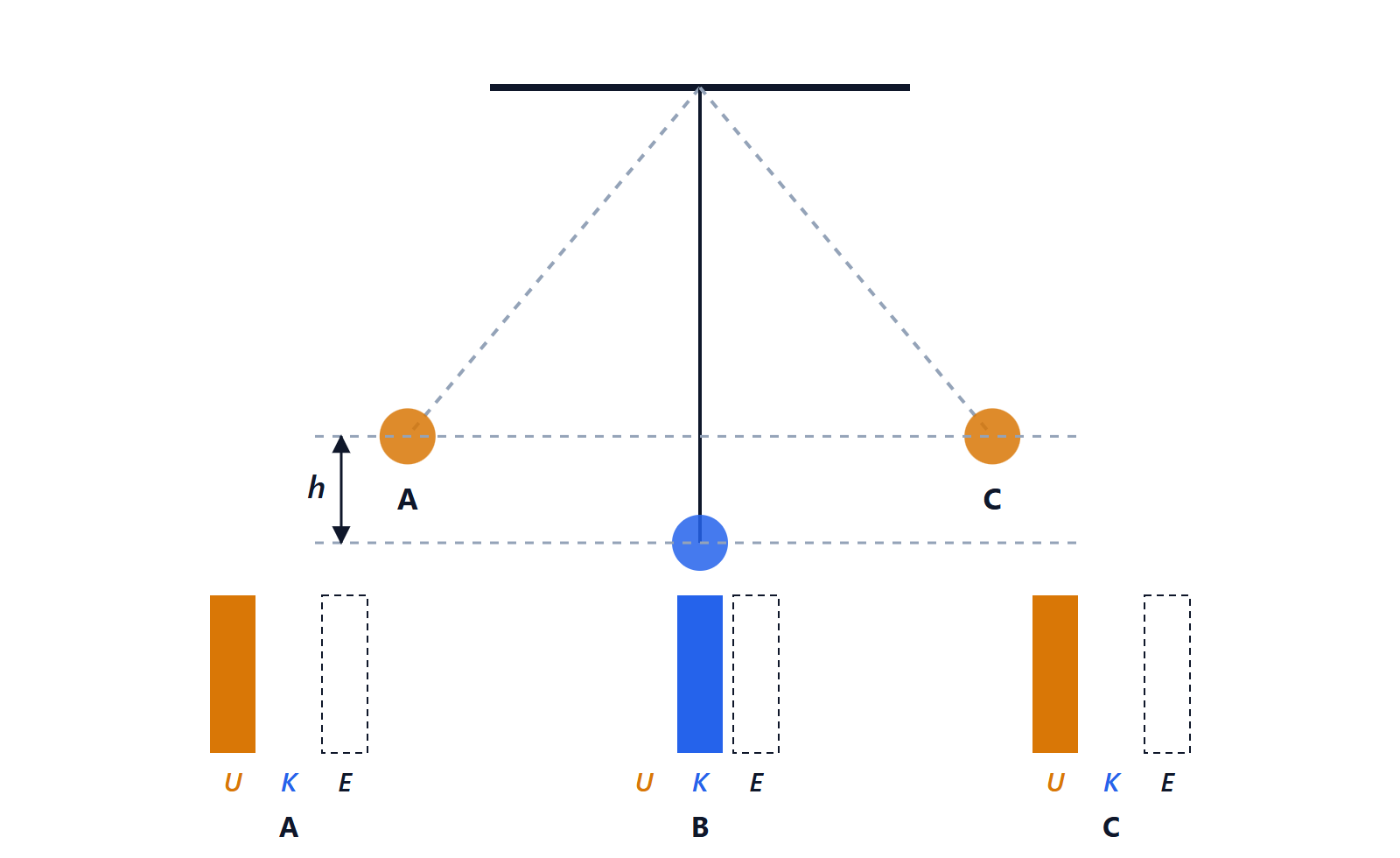
Example: the pendulum’s speed at the bottom. The bob starts at rest from A, a height above B. At A:  ,
 . At B:
 ,
 . Setting them equal:
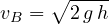
It is the same speed it would have falling straight down from the same height: the shape of the path does not matter, because the string’s tension is always perpendicular to the motion and does no work.
Example: the loop-the-loop
A cart runs down without friction from a height and enters a vertical loop of radius  . What is the minimum height for it not to leave the track at the top?
At the top of the loop the force towards the centre is  and must equal
 . The cart stays on the track if
 , that is if
 . Using energy conservation between the start and the top, at height
 :

Without energy this result would require solving an equation of motion along the whole track.
When there is friction
If non-conservative forces act too, their work  changes the mechanical energy:

Friction gives  : mechanical energy decreases, but it does not vanish. It becomes internal energy, that is heat, as you find out by touching a bike’s brakes after a descent. Counting this form as well, total energy is always conserved: it is the first law of thermodynamics, which we will meet later.
Example. A 1200 kg car at 90 km/h (25 m/s) brakes to a stop. The brakes receive  kJ of heat. Electric cars recover part of this energy by using the motor as a generator: regenerative braking.