Momentum, centre of mass and collisions
Impulse and momentum, the centre of mass and its motion, conservation of momentum, elastic and inelastic collisions in one dimension, the ballistic pendulum and the rocket equation.
When two bodies collide, the forces involved are huge and last a few milliseconds: there is no way of knowing them instant by instant. Yet the outcome of a collision is easy to calculate, thanks to a quantity that never changes in an isolated system: momentum. In this lesson we define it, introduce the centre of mass and solve collisions in one dimension.
Momentum and impulse
The momentum of a body is its mass times its velocity:

Newton himself wrote the second law in this form, which is more general than  because it also holds when the mass changes:

Integrating over time gives the impulse-momentum theorem: the impulse of a force, its integral over time, equals the change in momentum.
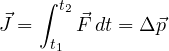
This is why airbags and helmets work. The change in momentum in a crash is fixed (from  to zero); stretching the stopping time from 5 to 50 milliseconds makes the average force
 ten times smaller.
Systems of particles and the centre of mass
For a system of  bodies the centre of mass is defined as
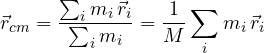
It is an average of the positions weighted by mass. Differentiating, the total momentum of the system is  .
Proof: the motion of the centre of mass
Each body feels forces from outside the system and internal forces from the other bodies of the system. Adding the law  over all bodies:
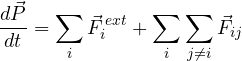
where  is the force of body
 on body
 . By the third law
 : in the double sum the internal forces cancel in pairs. What is left is
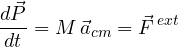
The centre of mass moves like a single point carrying the whole mass of the system, acted on only by the external forces. A firework exploding in flight: the fragments fly in every direction, but their centre of mass carries on along the same parabola.
Conservation of momentum
If the net external force is zero (an isolated system), then  :
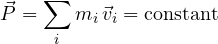
The principle holds even when the internal forces are huge and unknown, and it is more general than conservation of mechanical energy, which often fails in collisions. During a short collision it can be used even with external forces such as weight, because their impulse over a few milliseconds is negligible compared with that of the impact forces.
Collisions in one dimension
In every collision between isolated bodies momentum is conserved. We distinguish:
- elastic collision: kinetic energy is conserved too (steel balls, gas molecules);
- inelastic collision: part of the kinetic energy becomes deformation and heat;
- perfectly inelastic collision: the bodies stick together and move on as one.
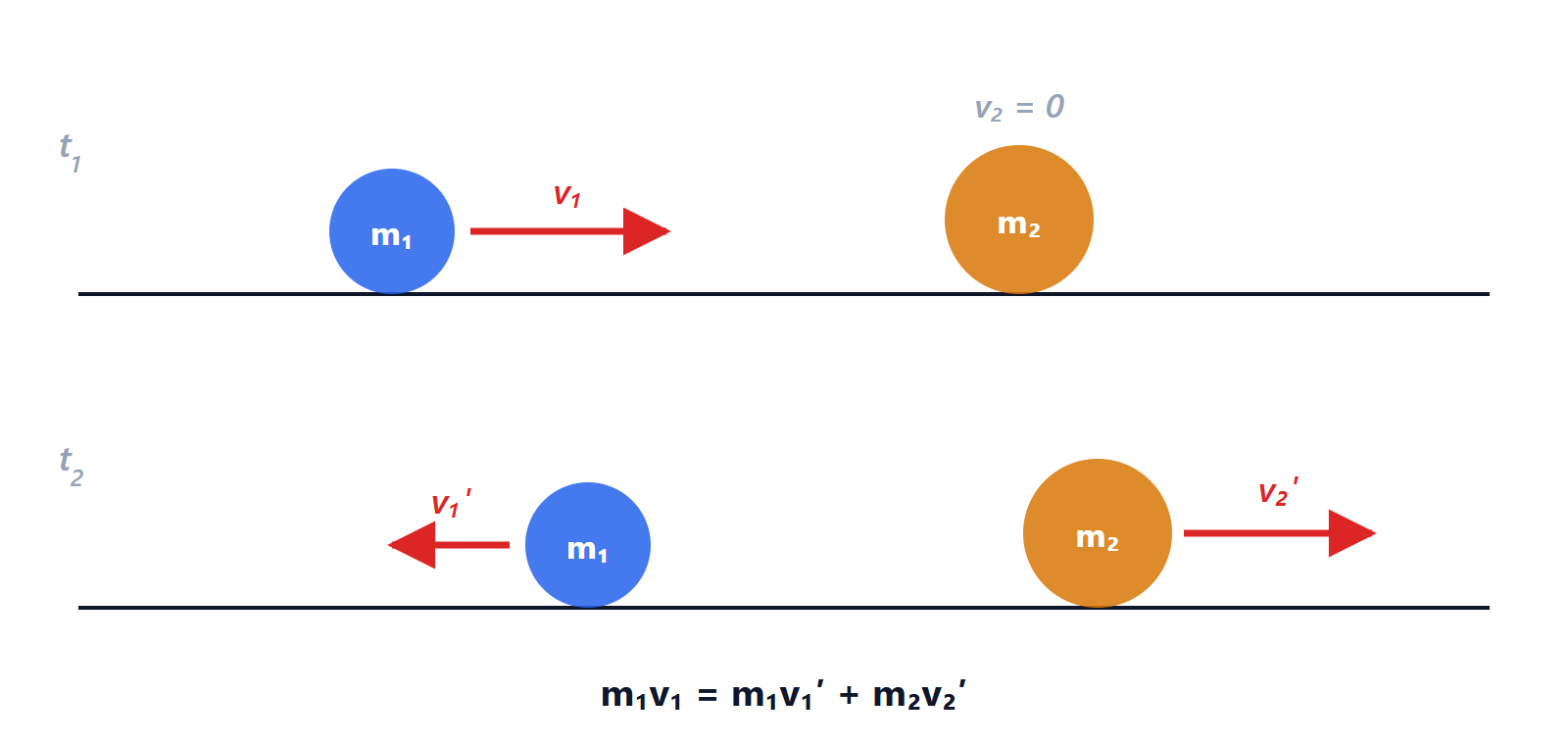
 ) mass
 moves at
 towards
 at rest; after it (
 ), if
 , bounces back and moves forward.
Proof: velocities after an elastic collision
Let be initially at rest. Conservation of momentum and of kinetic energy:


Rewrite both equations grouping the terms:

Dividing the second by the first (with  , otherwise there is no collision) gives
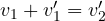 : in an elastic collision the relative velocity is reversed. Substituting into the first equation:

Three cases worth remembering:
- equal masses:
 ,
 . The velocities are swapped, as in Newton’s cradle or a head-on shot in billiards;
 (a ball against a wall):
 , the ball bounces back at the same speed;
 (a truck hitting a ball):
 , the ball flies off at twice the truck’s speed.
Perfectly inelastic collision
The two bodies move on with the same velocity  . From momentum alone, with at rest:
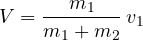
The kinetic energy lost is the fraction  of the initial one: it is largest when the target is much heavier than the projectile.
Example: the ballistic pendulum. A 10 g bullet lodges in a 2 kg wooden block hanging from a string, which rises by 5 cm. After the collision energy is conserved:  m/s. During the collision momentum is conserved:
 m/s. Be careful not to use energy conservation across the collision: more than 99% of the bullet’s energy becomes heat and deformation.
Variable-mass systems: the rocket
A rocket ejects gas at speed  relative to itself. In a time
 its mass changes by
 and, by conservation of momentum in empty space,
 . Integrating from the initial mass
 to the final mass
 gives Tsiolkovsky’s equation:
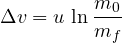
The logarithm explains why rockets are almost all fuel: for a velocity change of 9 km/s, what it takes to reach low orbit, with  km/s you need
 . Payload and structure are only 5% of the lift-off mass, which is why multi-stage rockets are used.