Newton's laws: forces, friction, the inclined plane and circular motion
The three laws of motion, weight, normal force, tension, friction and the spring force, the free-body diagram, the inclined plane, the Atwood machine, a car on a bend and fictitious forces.
Kinematics tells us how a body moves, dynamics explains why. Everything rests on three principles stated by Newton in 1687, which are enough to design a bridge, send a probe to Mars or work out the force on a spinning disk. In this lesson we look at them one at a time, then move on to the most common forces and to the method for solving problems.
Newton’s three laws
First law (inertia). A body with no forces acting on it, or with zero net force, stays at rest or moves in a straight line at constant speed. The frames in which this holds are called inertial. A braking car is not one: passengers are pushed forwards without any real force pushing them.
Second law. In an inertial frame, the sum of the forces on a body equals its mass times its acceleration:
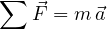
It is a vector equation: it holds separately for each component,  ,
 . Mass measures inertia, that is how much a body resists a change in velocity. The unit of force is the newton:
 gives a mass of
 an acceleration of
 .
Third law (action and reaction). If body A exerts a force on B, B exerts on A a force that is equal and opposite. The two forces act on different bodies, so they never cancel each other: a rocket pushes the gas backwards, the gas pushes the rocket forwards.
The most common forces
- Weight:
 , pointing down. It is the Earth’s gravity near the surface.
- Normal force
 : the force with which a surface pushes on a body resting on it, perpendicular to the surface. It is not always equal to the weight.
- Tension
 : the force carried by a taut rope, directed along the rope. An ideal rope (massless, inextensible) carries the same tension from one end to the other.
- Sliding friction: it opposes sliding. Static friction is at most
 and keeps a body from starting to move; kinetic friction is
 and slows a body that is already sliding. Usually
 : pushing a piece of furniture is hardest at the start.
- Spring force: a spring stretched or compressed by
 exerts
 (Hooke’s law), opposite to the deformation.
The method: the free-body diagram
Almost every dynamics problem is solved with the same steps:
- isolate the body and draw only the forces acting on it;
- choose convenient axes, usually with one axis along the motion;
- split the forces into components along the axes;
- write
 for each axis and solve the system.
The inclined plane
A block of mass  rests on a plane inclined at an angle
 . It is convenient to take the axis along the plane and the
 axis perpendicular to it: that way the acceleration has a single component.
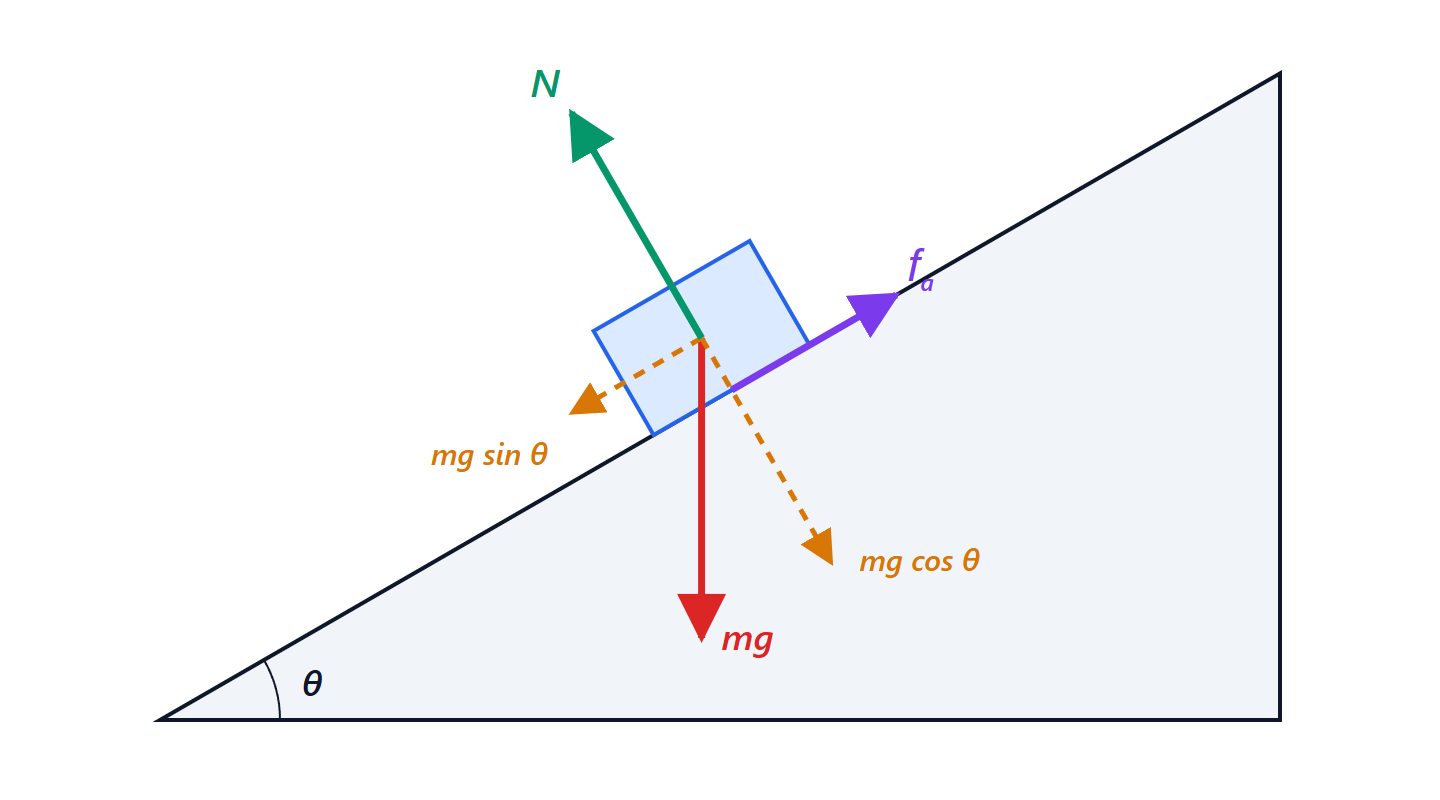
 , split into
 along the plane and
 perpendicular to it; the normal force ; friction
 , opposing the downhill motion.
Proof: acceleration along the plane
The angle between the weight and the perpendicular to the plane equals (its sides are perpendicular to those of the plane’s angle). So the components of the weight are along the plane and into the plane.
Along the block does not move:  , so
 . The normal force is less than the weight, and kinetic friction is
 .
Along , taking downhill as positive:

The mass cancels: a heavy block and a light one of the same material slide with the same acceleration. Without friction  .
How to measure the static friction coefficient
The block stays put as long as  , that is as long as
 . Slowly tilting the plane and noting the angle
 at which the block starts to slide gives
 . For rubber on dry asphalt
 is close to 1, for lubricated steel on steel it drops below 0.1.
Two connected bodies: the Atwood machine
Two masses  hang from the ends of a rope running over a massless, frictionless pulley. The tension
 is the same on both sides and both masses have the same acceleration
 (the rope is inextensible),
 downwards and
 upwards:

Adding the two equations removes the tension:

With almost equal masses the acceleration becomes small and easy to measure: this is how  was measured in the eighteenth century without electronic timers.
Dynamics of circular motion
In circular motion the centripetal acceleration  must be produced by a real force pointing to the centre: the tension of a rope, gravity for a satellite, tyre friction for a car on a bend.
Example. A car takes a flat bend of radius  m. The centripetal force is static friction between tyres and asphalt, at most
 :

With  (dry asphalt)
 m/s, about 71 km/h. In the wet, with
 , it drops to 50 km/h. Again, the mass does not appear.
Non-inertial frames and fictitious forces
In an accelerating frame Newton’s laws can still be used by adding fictitious forces, which are not exerted by any body. In a frame with acceleration  a force
 appears: it is what presses you into your seat when a plane takes off. In a rotating frame the centrifugal force
 appears, pointing outwards: it is the principle of a washing machine’s spin cycle, and of the MEMS accelerometers in smartphones, which measure exactly the fictitious force on a tiny suspended mass.