Rigid body dynamics: torque, moment of inertia and rolling
Torque and lever arm, the proof of τ = Iα, moments of inertia and the parallel axis theorem, rotational energy, angular momentum, rolling without slipping and equilibrium.
So far we have treated bodies as points. A wheel, a propeller or a motor’s rotor, however, spin, and describing them needs a new set of quantities: torque, moment of inertia, angular momentum. The good news is that each one matches a quantity we already know from straight-line motion, and the equations have the same form.
The rigid body and rotational kinematics
A rigid body is a system in which the distances between points do not change. In a rotation about a fixed axis all points turn with the same angular velocity  and the same angular acceleration
 ; a point at distance
 from the axis has speed
 . The laws of uniformly accelerated rotation are identical to those of straight-line motion:
 ,
 .
Torque
The same force turns a door much more if you apply it far from the hinges. The turning effect of a force is measured by its torque (moment) about a point O:

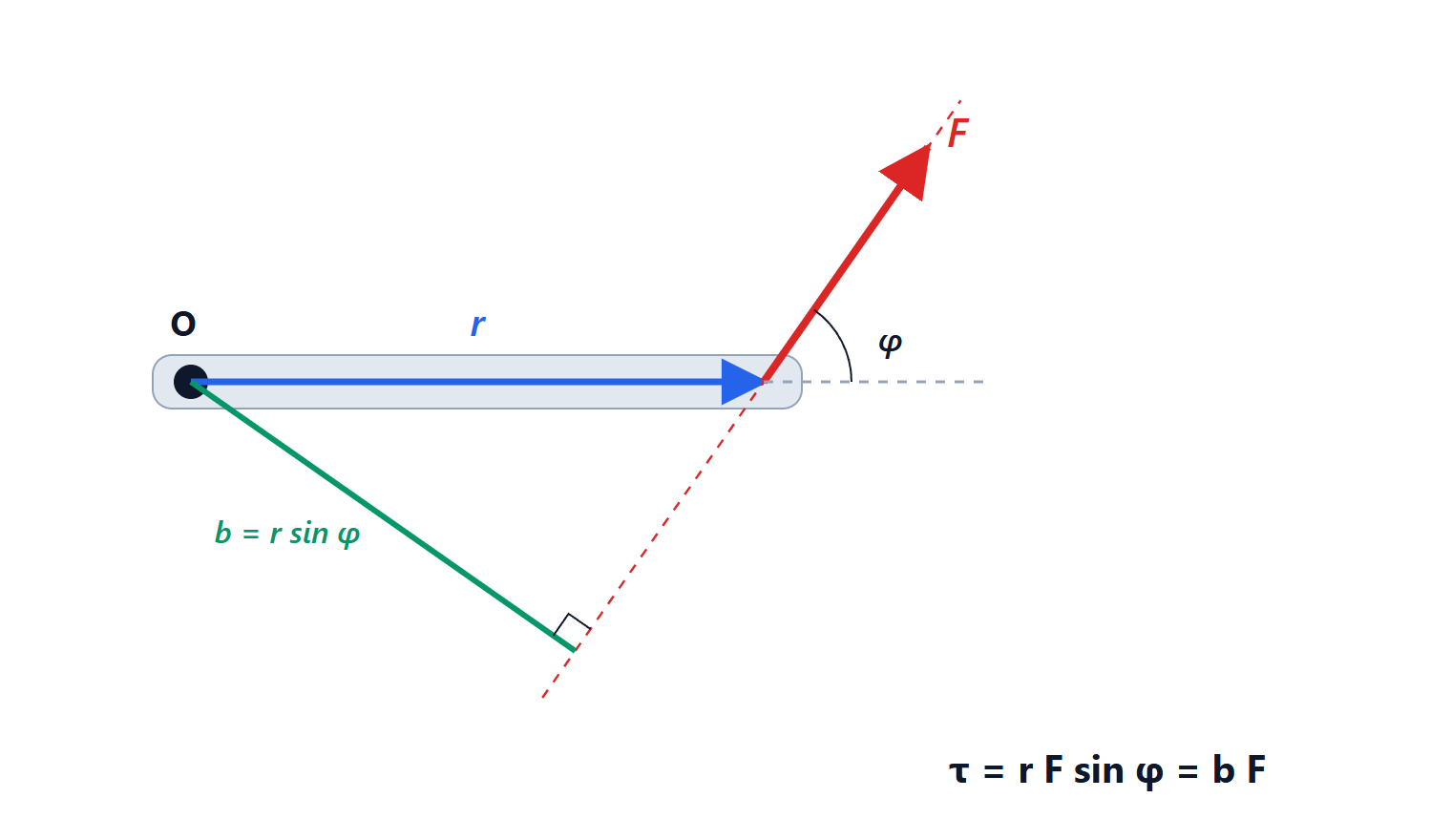
 . Equivalently, it is the force times the lever arm
 , the distance from O to the force’s line of action.
The lever arm  is the distance between the pivot and the line of action of the force. A force pointing at the pivot has zero lever arm and turns nothing. The unit is the newton-metre (N·m), dimensionally the same as the joule, but a different quantity: that is why torque is never written in joules.
Moment of inertia and the rotation equation
Proof: 
Split the body into many elements of mass  at distance
 from the axis. Each element moves on a circle with tangential acceleration
 . By the second law the tangential component of the force on it is
 , and its torque about the axis is
 . Adding over all elements, the torques of the internal forces cancel in pairs (action and reaction along the same line), leaving:
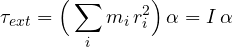
The quantity 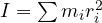 (or
 for a continuous body) is the moment of inertia: it plays the role of mass in rotation. It depends not only on how much mass there is, but on how far it is from the axis.
| Body (axis through the centre) | Moment of inertia |
|---|---|
| thin ring or hollow cylinder |  |
| solid disc or cylinder |  |
| solid sphere |  |
| thin hollow sphere |  |
thin rod of length  |  |
The parallel axis theorem
If you know  about an axis through the centre of mass, about a parallel axis at distance


Proof. Put the origin at the centre of mass and the shifted axis at  . For each element
 . Summing with weights : the first term gives , the last gives
 , and the middle term
 is zero because
 . For example, a rod turning about one end has
 .
Rotational kinetic energy
Each element has energy  . Adding up:
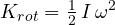
This is exactly how a flywheel stores energy. A 100 kg steel disc of radius 0.3 m at 6000 rpm (628 rad/s) has  and
 MJ, about 0.25 kWh.
Angular momentum
For a point mass the angular momentum is  . For a rigid body spinning about a symmetry axis
 . Differentiating gives the rotational counterpart of
 :

If the external torque is zero, angular momentum is conserved. A skater pulling in her arms reduces  and, since
 stays constant, spins faster. A neutron star, the collapsed core of a star, spins hundreds of times per second for the same reason.
| Translation | Rotation |
|---|---|
position  | angle  |
velocity  | angular velocity |
mass  | moment of inertia |
force  | torque  |
 |  |
 |  |
 | |
Rolling without slipping
A wheel rolling without slipping has its contact point at rest relative to the ground, instant by instant. This gives the constraint

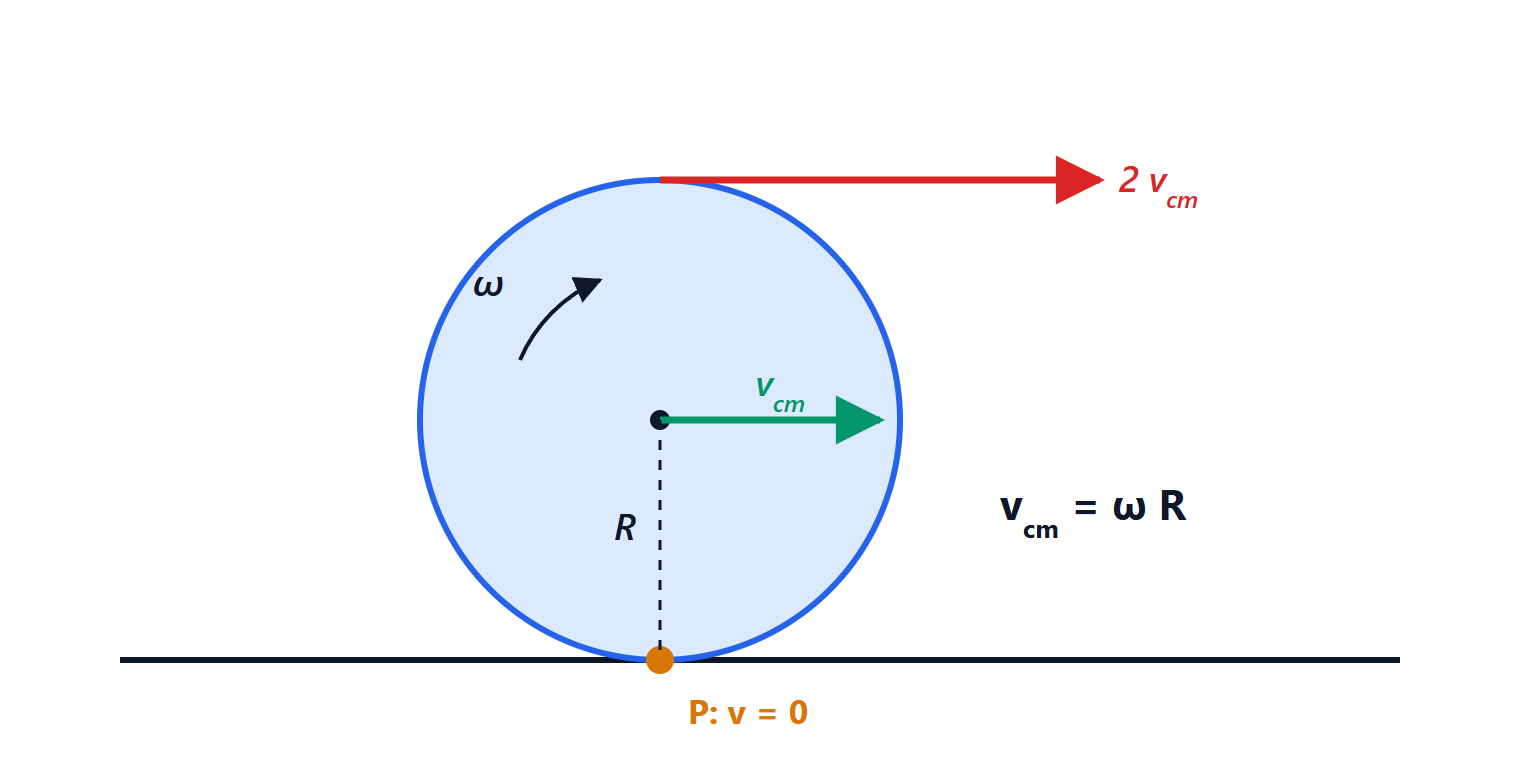
 and a rotation about the centre. At the contact point P the two velocities cancel; at the top they add up to
 .
The total kinetic energy is that of the centre of mass plus that of rotation:  .
Proof: who reaches the bottom of the slope first?
A body of mass  , radius
 and moment of inertia rolls down from a height
 , starting at rest. Static friction at the contact point does no work (the point is at rest), so mechanical energy is conserved:

The further the mass is from the axis, the more energy goes into rotation and the slower the body. With  equal to 2/5 for the solid sphere, 1/2 for the solid cylinder and 1 for the ring, in a race down the same slope the sphere wins, then the cylinder, with the ring last. Neither mass nor radius matters, only shape.
Equilibrium of a rigid body
A rigid body is in equilibrium if both the sum of the forces and the sum of the torques about any point are zero:

Example. A 4 m, 50 kg beam rests on supports at its two ends and carries a 100 kg mass 1 m from support A. Torques about A:  , so
 ≈ 490 N. Sum of vertical forces:
 ≈ 981 N. Choosing the pivot on an unknown force removes it from the equation: that is the trick that makes these problems quick.