Fourier transform in depth: Gaussian, Parseval, spectral decay, uncertainty and sampling
Transform of the Gaussian, properties and Parseval's theorem proved, signal smoothness and spectral decay, uncertainty principle, sampling theorem with the reconstruction formula, tables of pairs.
This page goes deeper into the lesson on the Fourier transform. It computes step by step the transform of the Gaussian, proves the properties and Parseval’s theorem, explains why a spectrum decays more or less quickly depending on the smoothness of the signal, derives the uncertainty principle and proves the sampling theorem with the reconstruction formula. At the end are the tables to remember of transform pairs and properties.
Convention:  ,
 .
The Gaussian: a function that transforms into itself
Theorem.  .
Proof. Let 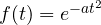 with
 . The function satisfies the differential equation
 . Transform both sides: on the left the derivative becomes
 ; on the right, since
 (differentiating the definition with respect to
 under the integral sign), we get
 . So

It is the same equation, with  in place of
 :
 . Finally
 (Gaussian integral). ∎
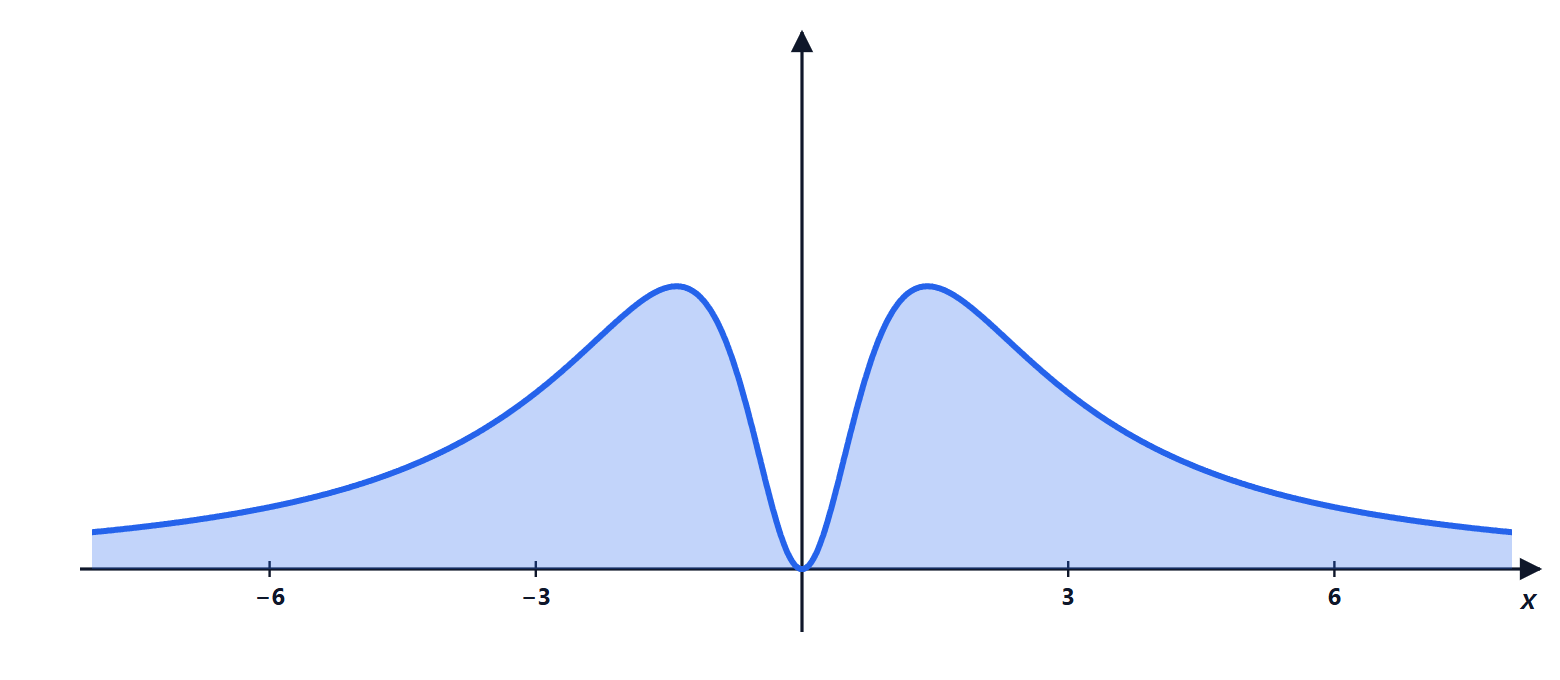
A Gaussian that is narrow in time (small σ) is wide in frequency (width  ), and vice versa: the product of the two widths is constant.

The properties, proved
They all follow from the definition with a change of variable.
- Delay.
 , with
 , becomes
 .
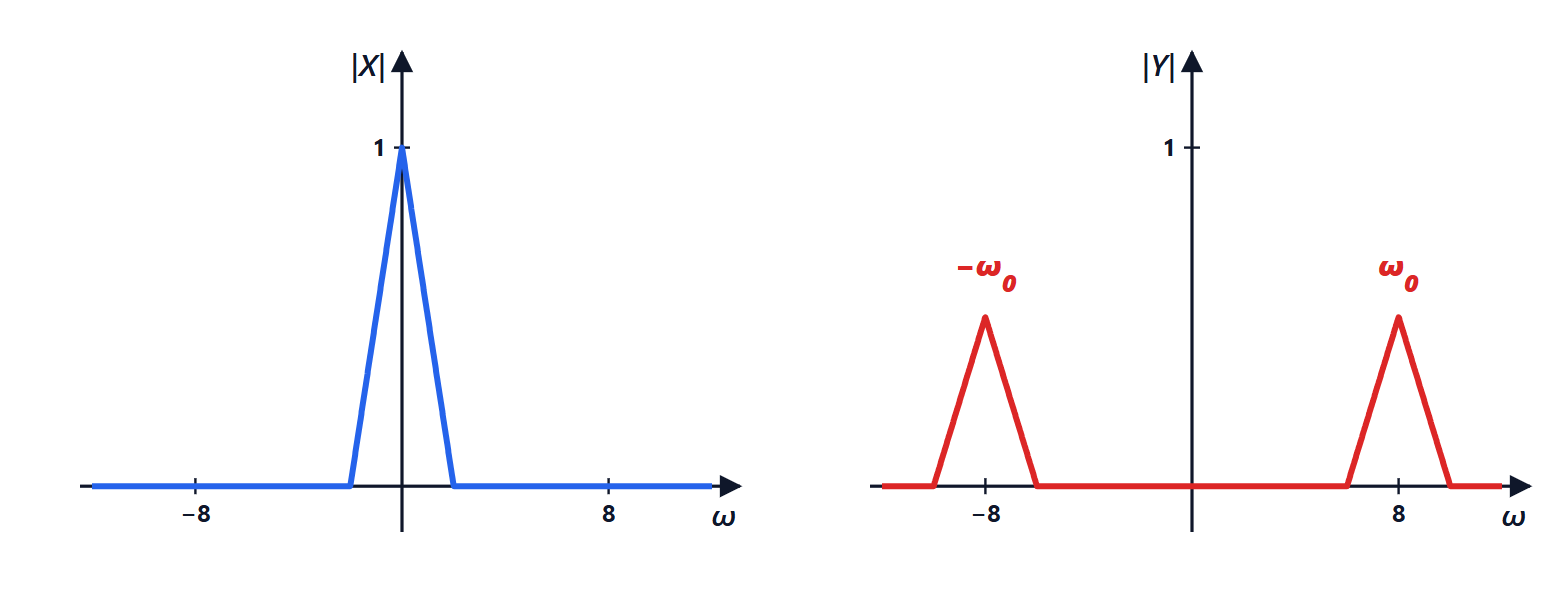
- Modulation.
 . With cosine,
 , the spectrum splits into two halved copies centred at
 .
- Scaling. For
 , with
 :
 .
- Derivative. By parts, if
 at infinity:
 .
- Real signal. If
 is real,
 : the magnitude is even and the phase odd. This is why instruments show only positive frequencies.
Theorem (Parseval).  .
Proof. Write  and replace
 with the conjugate inversion formula:

swapping the order of the integrals. ∎
Smoothness and spectral decay
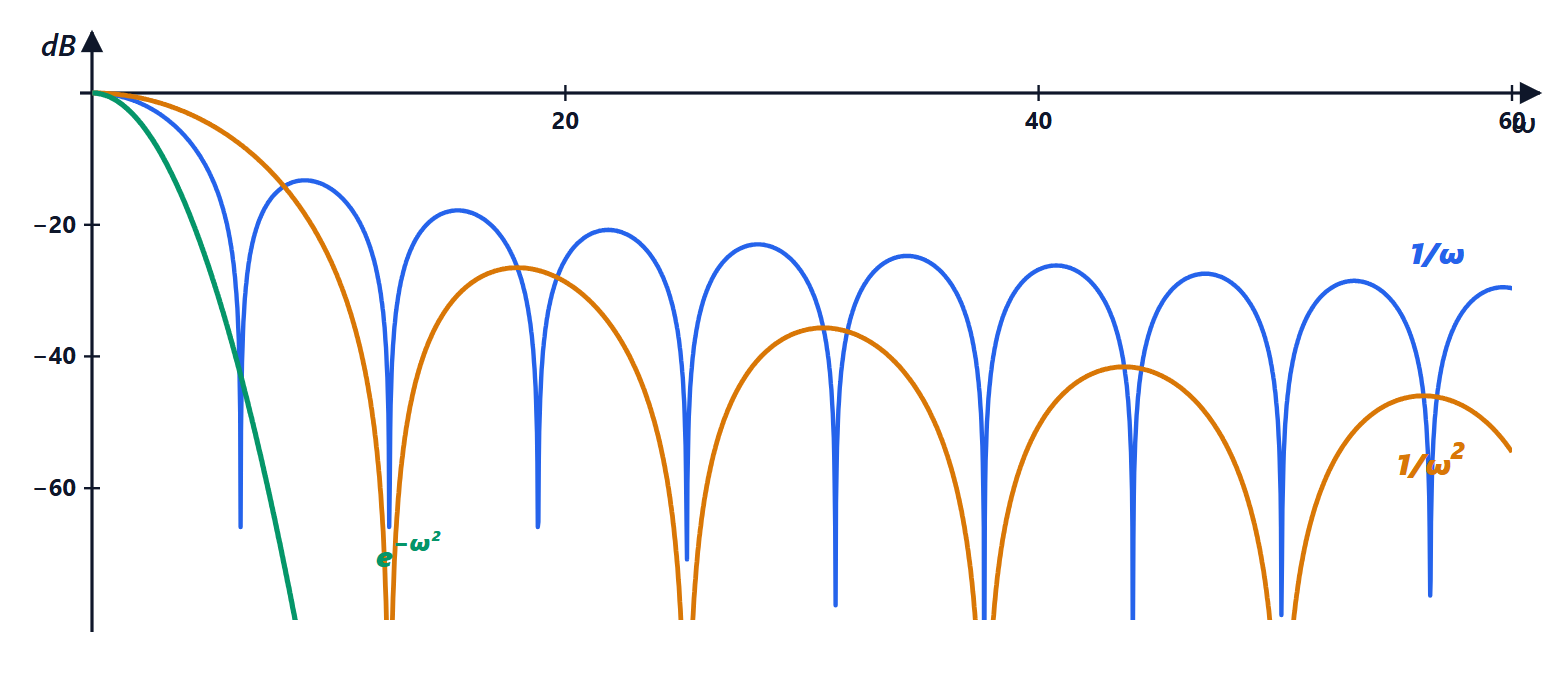
How fast  goes to zero as
 depends on how “smooth” the signal is:
- if has a jump (rectangular pulse),
 ;
- if is continuous but its derivative has a jump (triangular pulse),
 ;
- in general, if the first
 derivatives are continuous and the
 -th has a jump,
 ;
- if has all derivatives (Gaussian),
 decays faster than any power.
Why. Applying the derivative rule times,  . If
 has a jump of size
 at
 , its derivative contains
 , whose transform does not decay: so
 stays bounded and non-zero. ∎
This is of great practical importance: the steep edges of digital signals generate harmonics up to very high frequencies and hence interference (electromagnetic compatibility). This is why fast signals are “rounded” with edges of controlled duration.

The uncertainty principle
Define the duration and the bandwidth of a signal as standard deviations, weighted by energy:

Theorem. For every signal (decaying fast enough at infinity)  , with equality only for the Gaussian.
Idea of the proof. By Parseval and the derivative rule,  . By the Cauchy-Schwarz inequality,
 , and integrating by parts the left-hand side is at least
 . Putting things together gives the inequality; equality in Cauchy-Schwarz requires
 , i.e. the Gaussian. ∎
It is the same as Heisenberg’s principle in quantum mechanics, where time and frequency become position and momentum.
The sampling theorem, proved
Theorem (Nyquist-Shannon). If  for
 and one samples with period
 such that
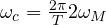 , then

Proof. The sampled signal is  . The Dirac comb has transform
 (lesson on the delta), and the product in time becomes a convolution in frequency divided by
 :
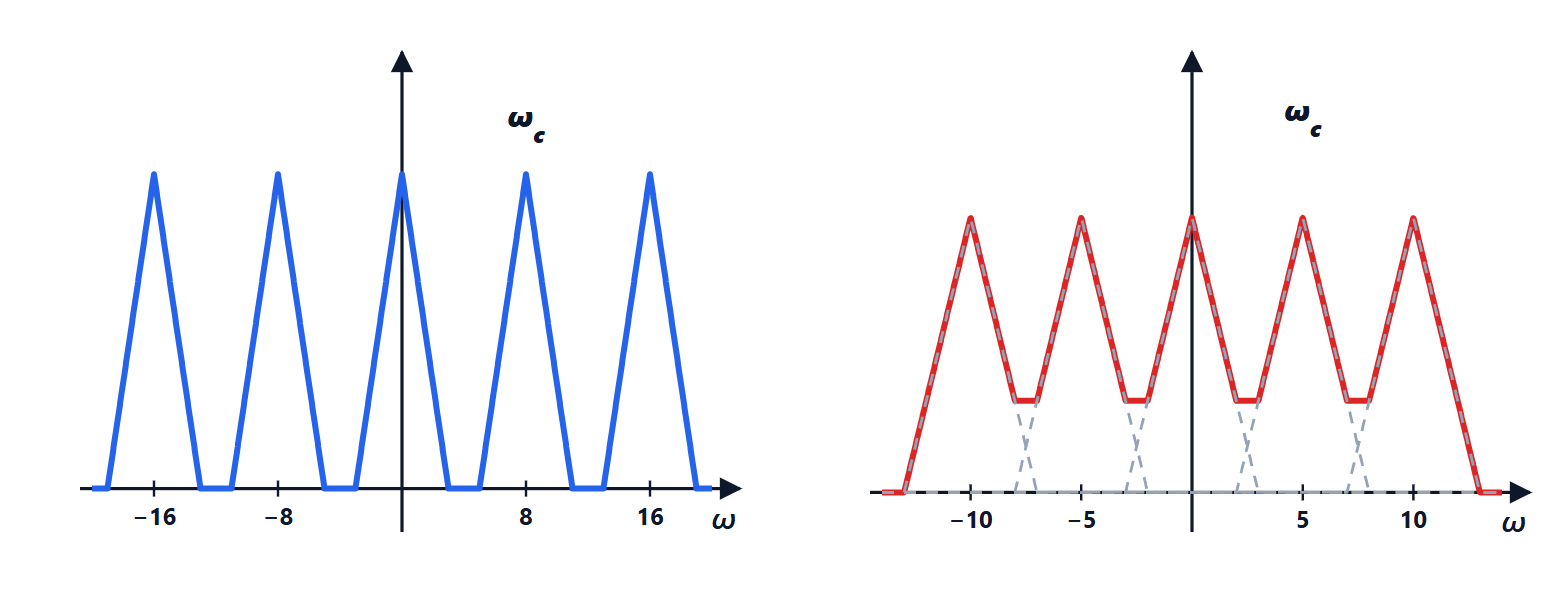
 . The spectrum repeats with period
 . If
 the copies do not overlap, and an ideal low-pass filter
 for
 gives back
 . The impulse response of that filter is
 , and the output
 is the sum in the formula. ∎
Each sample contributes a sinc centred at its instant, which is 1 there and 0 at all other sampling instants: the formula interpolates exactly. If instead  , the copies overlap and high frequencies “fold” onto low ones (aliasing), irreparably: this is why every A/D converter is preceded by an anti-aliasing filter.
Tables to remember
Transform pairs (;  is the step,
 is 1 for
 ,
 is the triangle of base
 and height 1)
 | |
|---|---|
 | 1 |
| 1 |  |
 |  |
 |  |
 |  |
 |  |
 |  |
 |  |
 |  |
 |  |
 |  |
 |  |
 | ,  |
Properties (besides those in the lesson):  ;
 (duality);
 ;
 and
 (areas);
 (generalised Parseval).
Exercises from basic to exam level are on the exercise page linked at the top.