Cauchy's theorem and integral formula in depth: Goursat, contour deformation, infinite derivatives, Liouville and the fundamental theorem of algebra
ML estimate and the fundamental integral, Cauchy-Goursat theorem proved with triangles, contour deformation, integral formula and derivative formula proved, Cauchy's estimate, Liouville, fundamental theorem of algebra, maximum modulus, Morera.
This page goes deeper into the lesson on Cauchy’s theorem and integral formula, the heart of complex analysis. It starts from the basic tools of the complex integral (parametrisation, the modulus estimate, the fundamental integral of  ), proves Cauchy’s theorem without superfluous hypotheses (Goursat’s triangle method), derives contour deformation and proves step by step the integral formula and the formula for derivatives. From here follow surprising results, proved in a few lines: a holomorphic function has infinitely many derivatives, Liouville’s theorem and the fundamental theorem of algebra.
The tools of the complex integral
If the curve  is parametrised by
 ,
 , the integral is
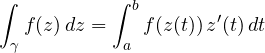
an integral of a complex function of a real variable, computed by separating real and imaginary parts.
Modulus estimate (ML inequality). If  on the curve and
 is the length of the curve, then
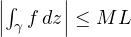 .
Proof.  , because
 is precisely the length. ∎
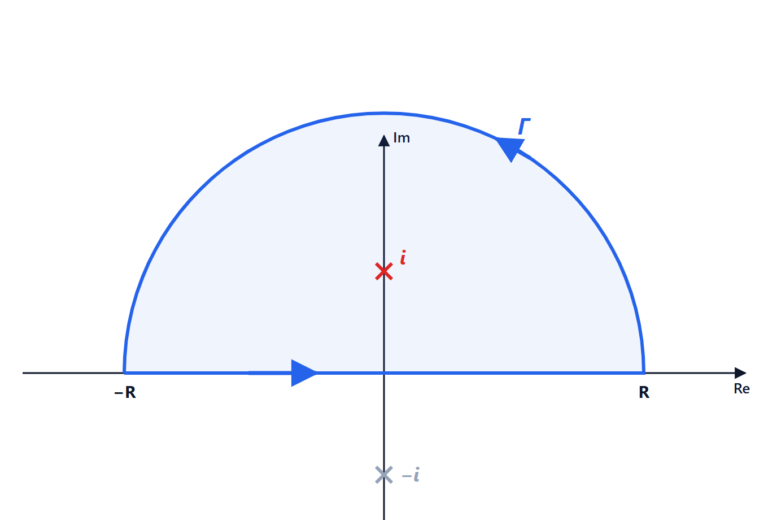
It is the tool used in almost all proofs and in all exercises on real integrals: it shows that the contribution of an arc “tends to zero”.
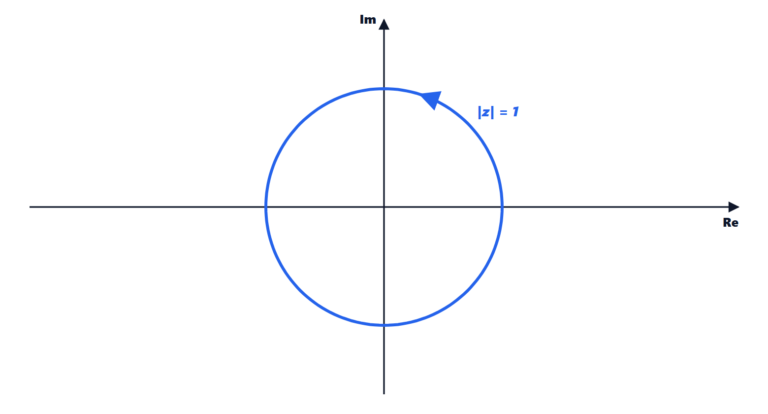
The fundamental integral. For a circle  traversed anticlockwise and
 an integer:

Proof. With  ,
 :
 . The last integral is
 if
 and 0 otherwise (a periodic function with zero mean). ∎
The whole theory of residues comes from here: in a Laurent series integrated over a circle only the term with  survives, the residue.
Cauchy’s theorem, without superfluous hypotheses
In the lesson the theorem is proved with Green’s theorem, assuming  continuous. Goursat (1900) showed that holomorphy is enough.
Theorem (Cauchy-Goursat for triangles). If  is holomorphic in an open set containing a solid triangle
 , then
 .
Proof. Let 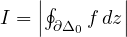 . Divide
 into four triangles by joining the midpoints of the sides. The sum of the four boundary integrals is the integral on the outer boundary, because the inner sides are traversed twice in opposite directions and cancel. So at least one of the four,
 , has
 . Repeating, one gets a sequence of nested triangles with

The triangles shrink to a point  (they are closed, nested, with diameter tending to zero). At the function is differentiable:
 , with
 . The first two terms are polynomials, which have antiderivatives, so their integral over a closed curve is zero. What remains is

by the ML estimate. Putting things together: 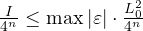 , i.e.
 , which tends to 0. So
 . ∎
From here the theorem for any closed curve in a simply connected domain follows by building an antiderivative 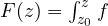 (the integral does not depend on the path because differences can be broken into triangles): a function with an antiderivative has zero integral over every closed curve.

Deforming contours
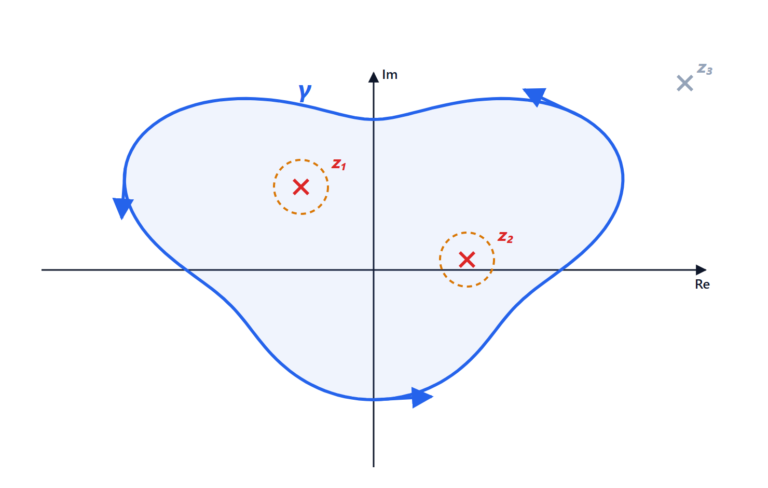
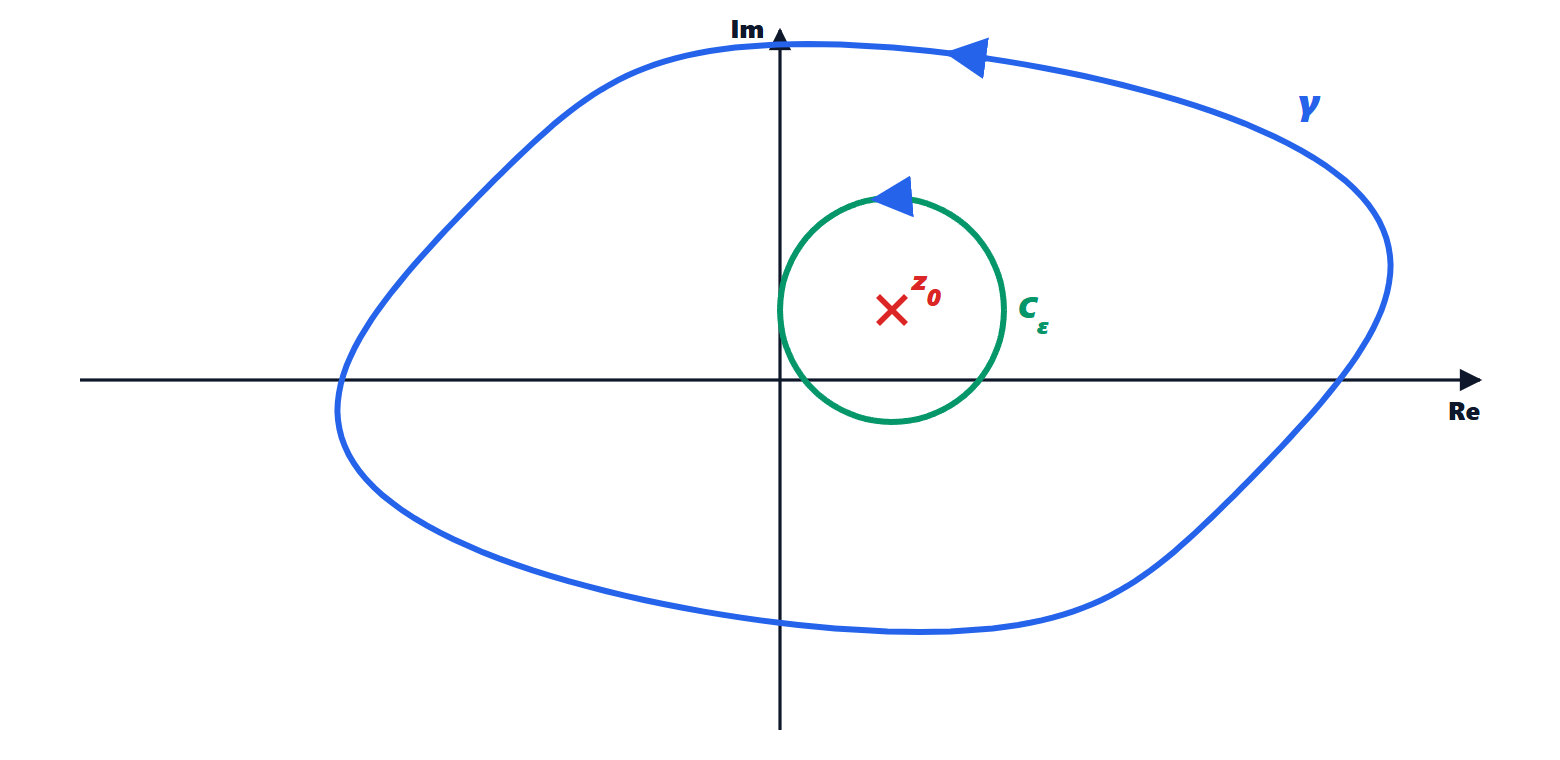
Theorem. If is holomorphic in the region between two simple closed curves and  , with inside , both traversed anticlockwise, then
 .
Proof. Join the two curves with two nearby segments, cutting the region into two simply connected parts. The boundary of each part is a closed curve on which is holomorphic, so it has zero integral. Adding the two boundaries, the joining segments are traversed in opposite directions and cancel; what remains is  (the inner curve is traversed clockwise in the boundary of the region). ∎
In practice: an integral around a singularity does not depend on the shape of the curve, and the curve can be replaced by an arbitrarily small circle. This is the key step of the integral formula.
The integral formula, proved carefully
Theorem. If is holomorphic inside and on a simple closed curve traversed anticlockwise and is inside :
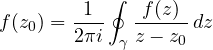
Proof. The function  is holomorphic except at . By deformation, the integral over equals that over the circle
 with centre and radius
 , for every small . Write

The first integral is  (fundamental integral). For the second, with the ML estimate: the integrand has modulus at most
 and the length is
 , so the integral is at most
 , which tends to 0 as
 by continuity of . But the integral does not depend on : so it is exactly 0, and what remains is
 . ∎
The formula says something extraordinary: the values of a holomorphic function inside a curve are determined by those on the boundary. There is nothing like this for differentiable real functions.
Infinitely many derivatives
Theorem. A holomorphic function has derivatives of every order, themselves holomorphic, and

Proof (for  ). With the integral formula, for small
 :

The difference from 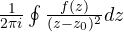 is
 . If
 is the distance of from and
 , the denominator has modulus at least
 , and by the ML estimate the difference is at most
 . So the derivative exists and is given by the formula with . Repeating the same reasoning on the new formula gives all the higher derivatives. ∎
Consequence: a function that is differentiable once in the complex sense can automatically be expanded in a Taylor series (lesson on Laurent series). Complex differentiability is an enormously stronger constraint than real differentiability.
Three consequences in a few lines
Cauchy’s estimate. If on the circle  , then
 . From the derivative formula with the ML estimate:
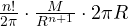 .
Liouville’s theorem. A function holomorphic on the whole of  and bounded, , is constant. Indeed for every
 :
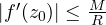 , and letting tend to infinity
 at every point.
Fundamental theorem of algebra. Every polynomial  of degree
 has at least one complex root.
Proof. If never vanished,  would be holomorphic on the whole of . As
 ,
 (the highest-degree term dominates), so
 : outside a large circle
 , and inside the circle
 is bounded because it is continuous on a closed bounded set. Then is bounded on the whole of and, by Liouville, constant: impossible, because is not constant. ∎
Dividing by  and repeating, every polynomial of degree has exactly complex roots counted with multiplicity: the fact on which partial fractions, the poles of transfer functions and the eigenvalues of matrices rely.
Mean value property and maximum modulus. With the circle of radius  around , the integral formula becomes
 : the value at the centre is the mean of the values on the circle. It follows that cannot have a maximum inside a domain without being constant (maximum modulus principle): the maximum is always on the boundary. The real and imaginary parts of are harmonic functions, and the same property holds for solutions of Laplace’s equation: the electrostatic potential in a charge-free region has its maximum and minimum on the boundary.
The converse: Morera
Theorem (Morera). If is continuous in a domain and  for every triangle in the domain, then is holomorphic.
Proof. The hypothesis allows an antiderivative to be defined independently of the path, with  . Then
 is holomorphic and, by the infinite-derivatives theorem, so is . ∎
Exercises on complex integrals, Cauchy’s formula and its consequences are on the exercise page linked at the top; the use of residues to compute real integrals is in the in-depth study on the residue theorem.