Solved exercises on the complex integral and Cauchy's integral formula
Nine exercises with solutions and contours drawn: holomorphic and non-holomorphic functions, integral formula, derivative formula, ML estimates, Cauchy's estimate, Liouville, maximum modulus.
Exercises on the complex integral, Cauchy’s theorem and Cauchy’s integral formula of the kind set in Mathematical Methods and Complex Analysis courses, in three levels: basic, with direct computation and Cauchy’s theorem; intermediate, with the integral formula and the formula for derivatives; exam, with estimates, Liouville’s theorem and the maximum modulus principle. The result is given straight away; the full solution, with the contour drawn, opens with a click. The proofs are in the in-depth study linked at the top; real integrals computed with residues are on a separate exercise page.
Basic level
Exercise 1. Holomorphic or not
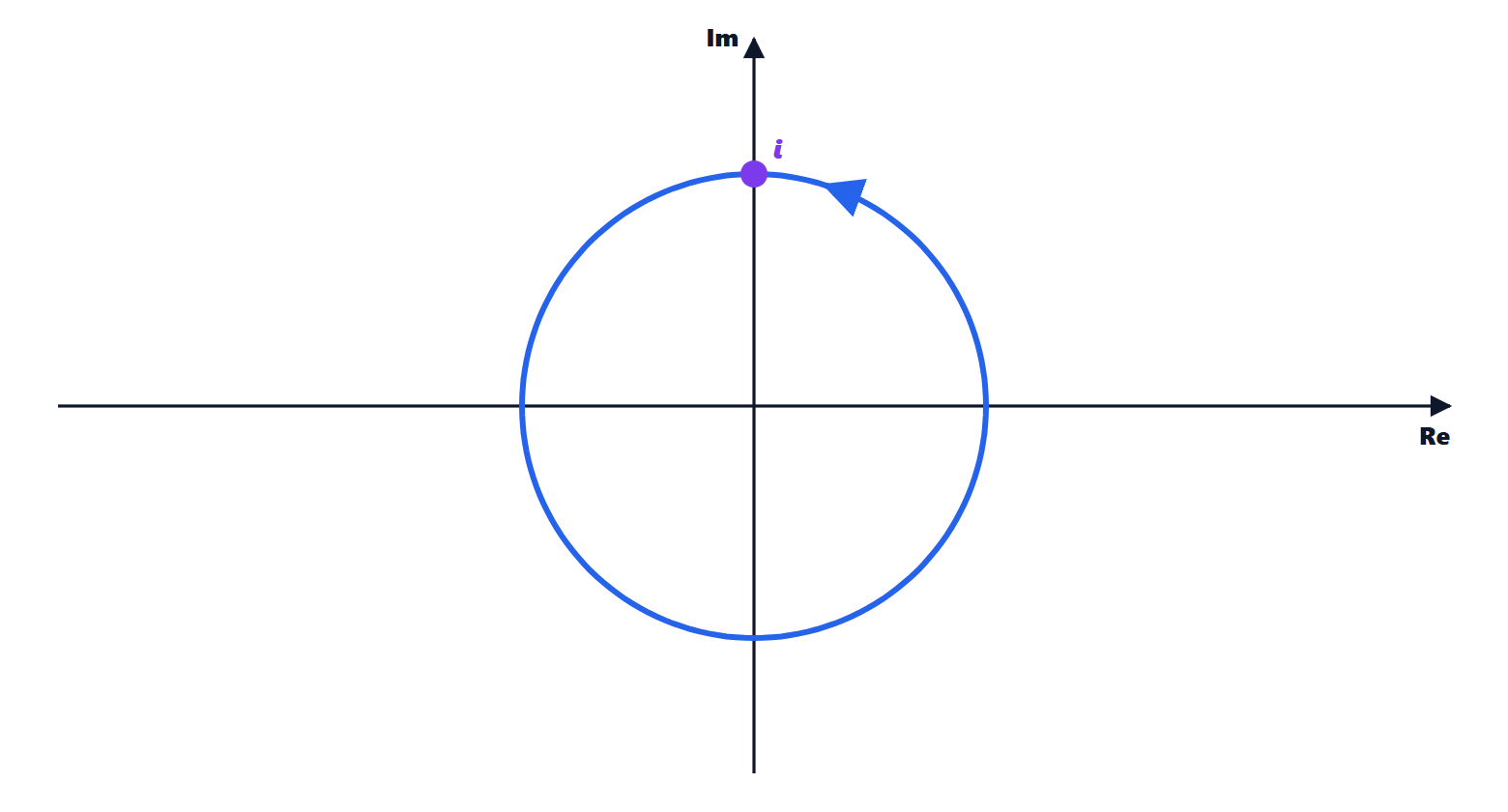
Compute  and
 , traversing the circle anticlockwise. Why are the results different?
Result:  and 0.
Solution
With  ,
 ,
 :

 is holomorphic (it has the antiderivative
 ), and Cauchy’s theorem guarantees a zero integral.
 is not holomorphic: with
 ,
 has
 ,
 , and the Cauchy-Riemann condition
 gives
 , false. On the unit circle
 , which is why the integral coincides with that of
 .
Exercise 2. The integral formula
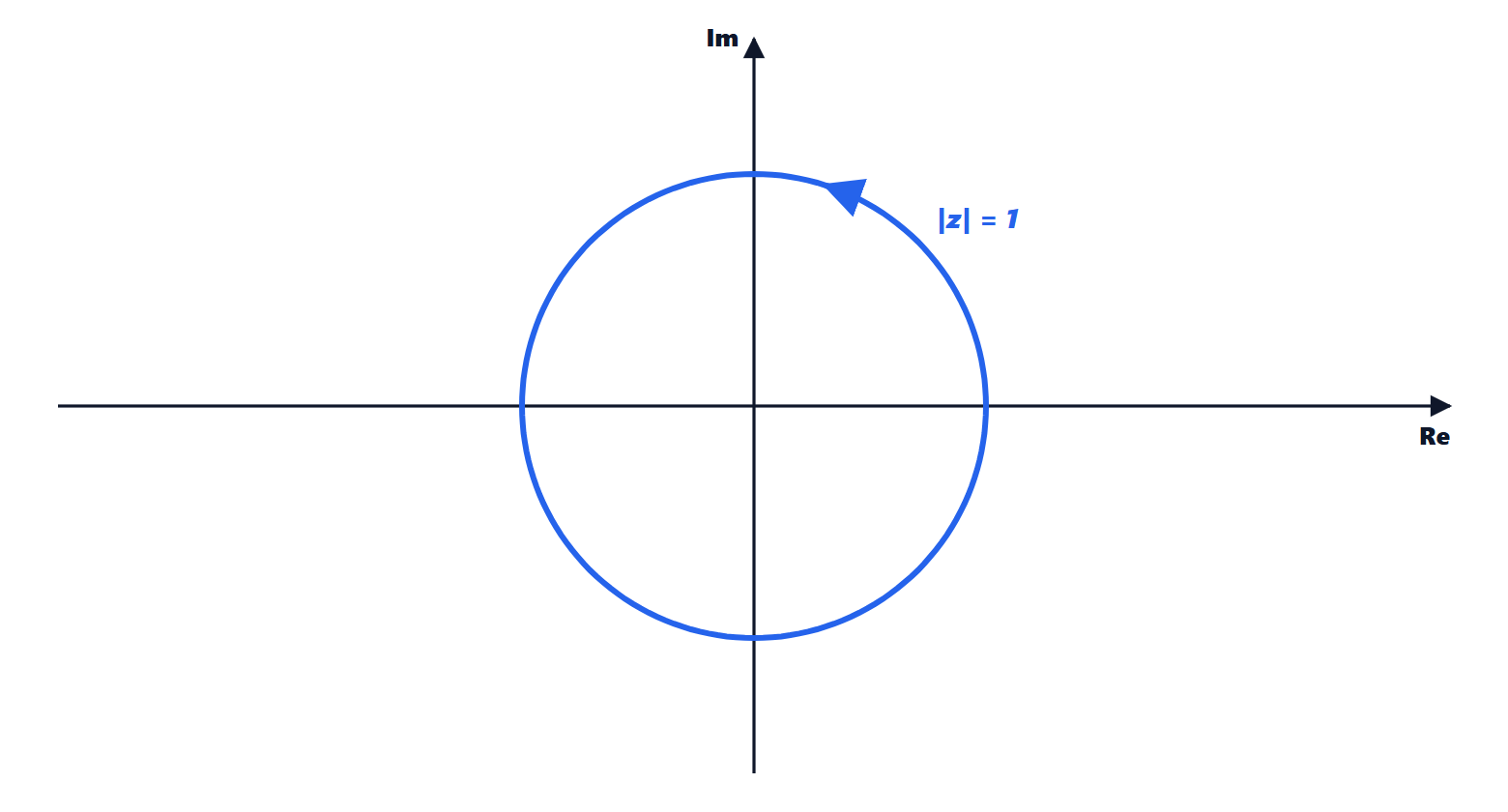
Compute  .
Result: .
Solution
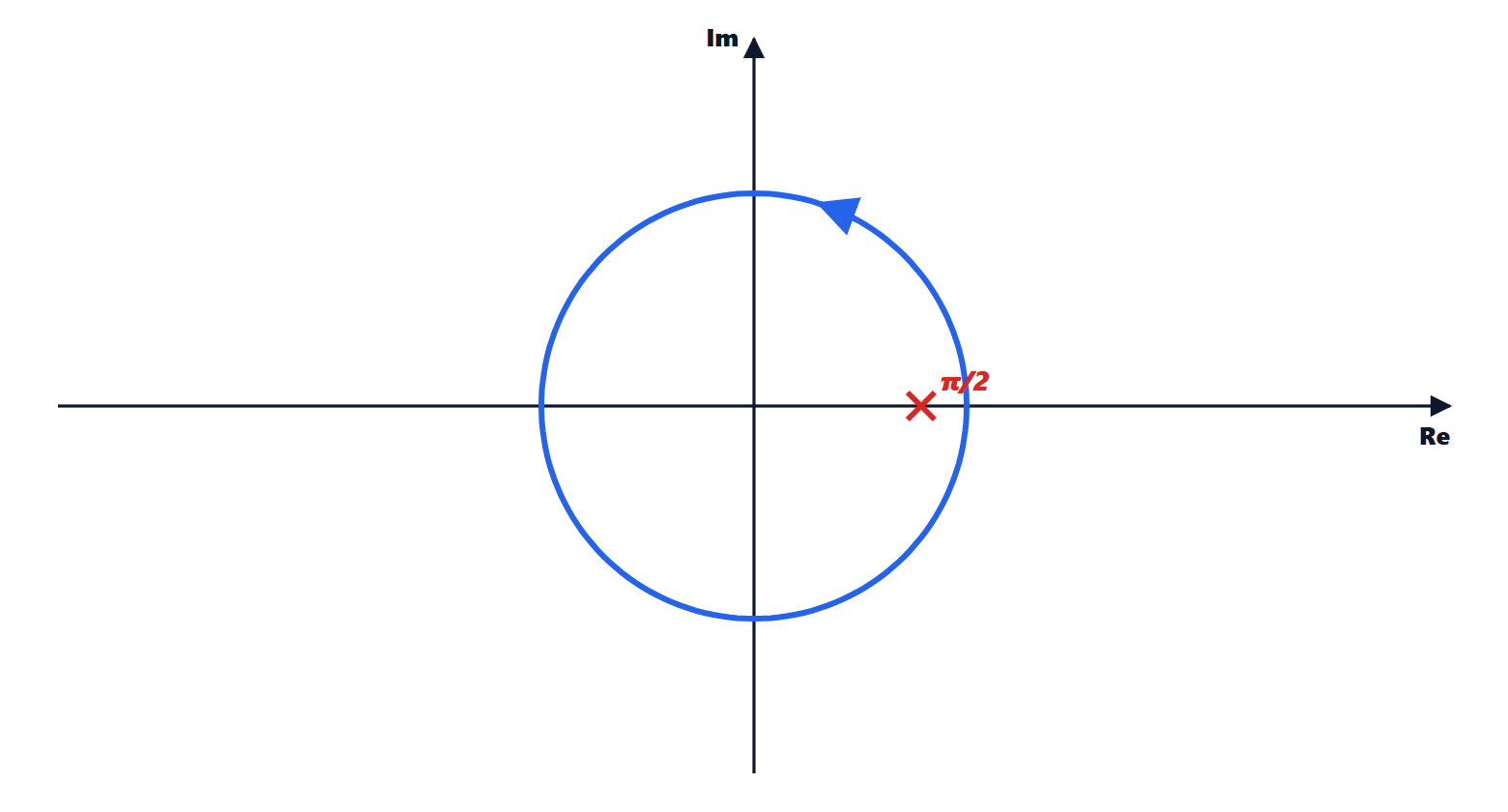
 is holomorphic everywhere and the point
 is inside the circle of radius 2. Integral formula with
 ,
 : the integral equals
 .
If the circle had radius 1, the point would be outside and the integral would be 0 (Cauchy’s theorem).
Exercise 3. One singularity inside and one outside
Compute 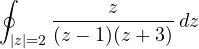 .
Result:  .
Solution
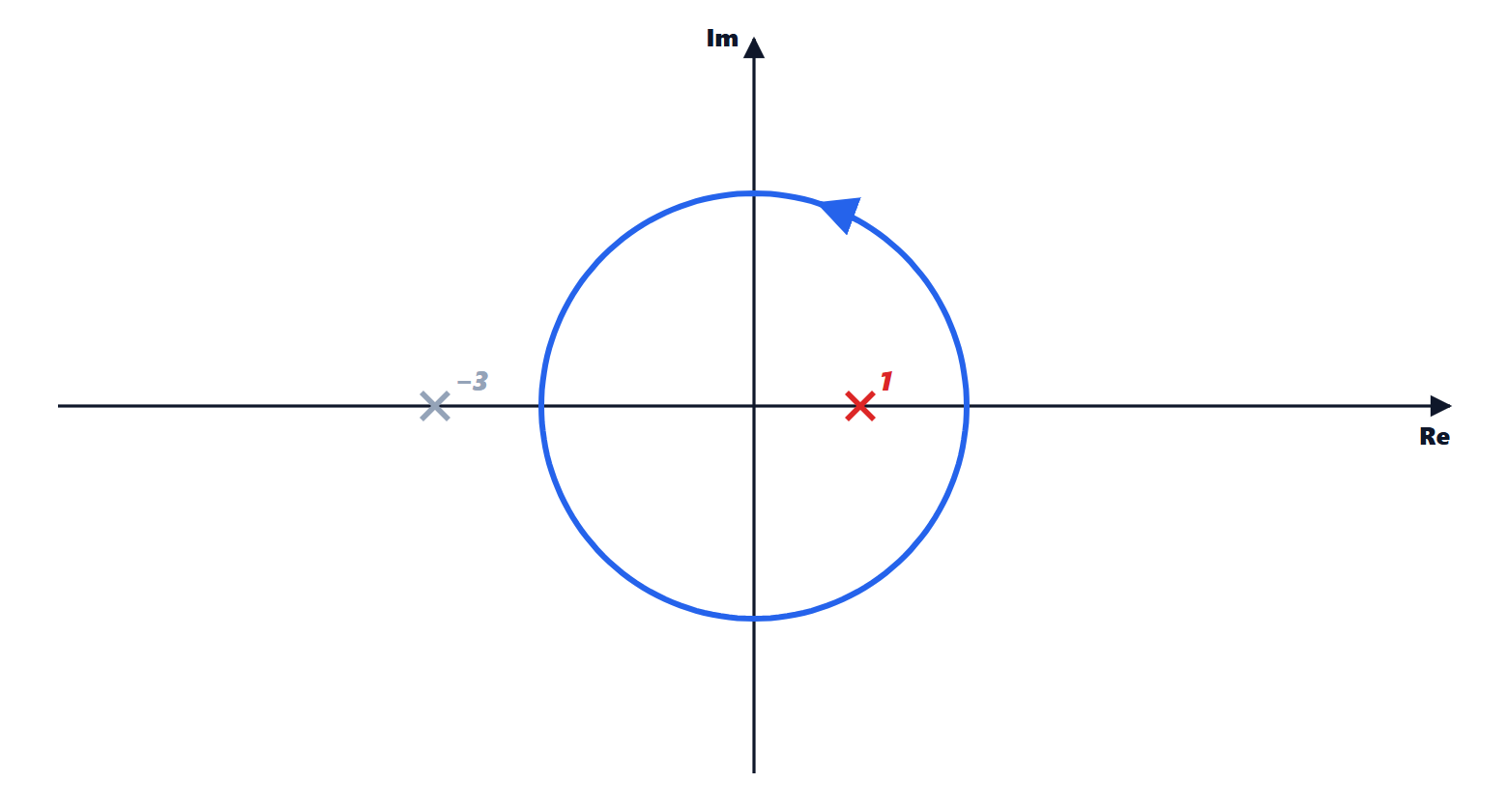
The singularities are 1 (inside) and  (outside). Write the integrand as
 with
 , holomorphic inside the circle. Integral formula:
 .
With radius 4 both would be inside, and the result would be  (the residues at 1 and are
 and
 ).
Intermediate level
Exercise 4. The derivative formula
Compute 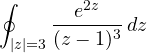 .
Result:  .
Solution
Derivative formula with  :
 , with
 and
 (inside).
 ,
 . Integral:
 .
Typical mistake: forgetting the factorial, or using the first derivative with a cubed denominator. The power of the denominator is  .
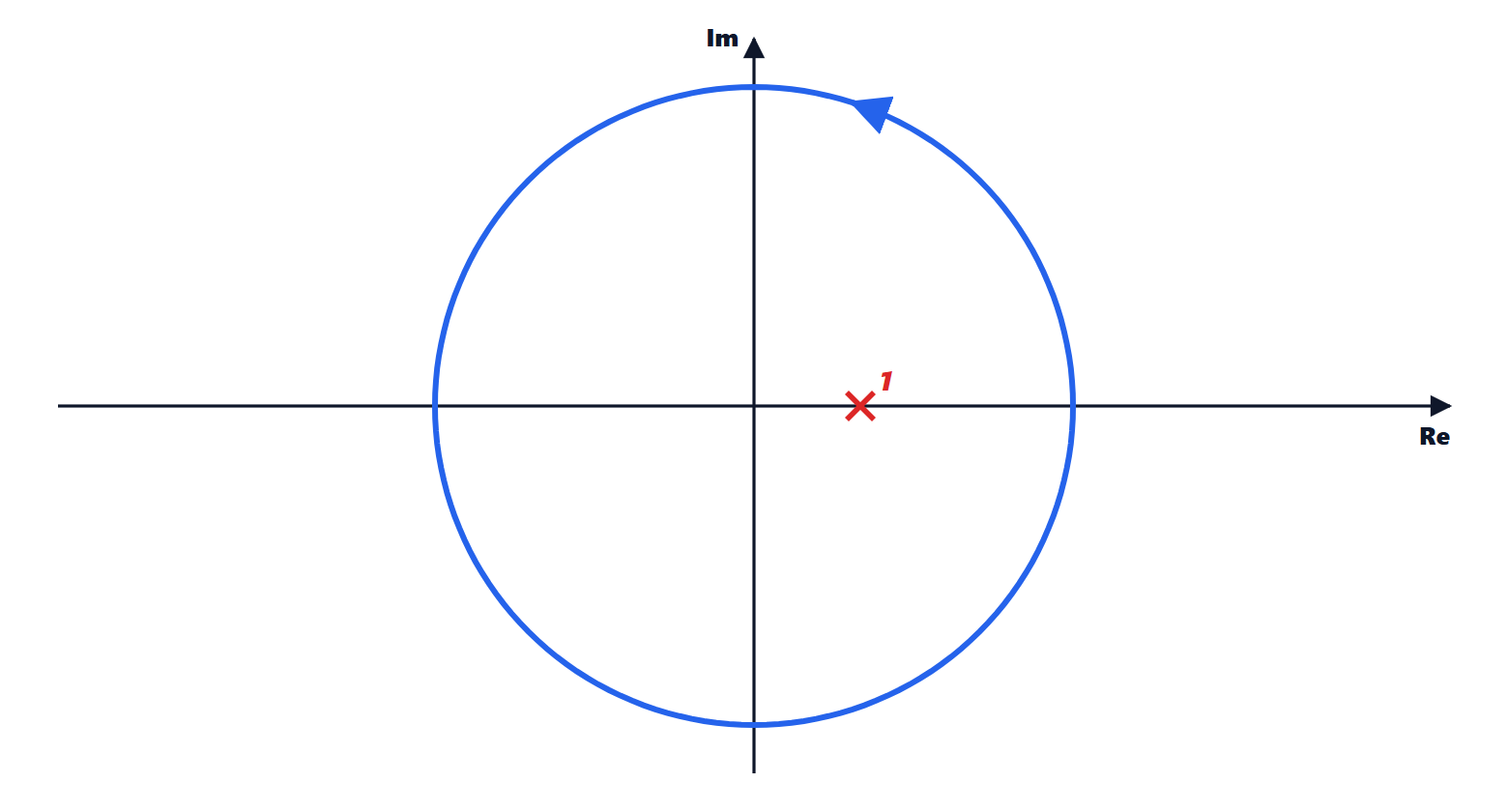
Exercise 5. A circle not centred at the origin
Compute  . What is the same integral on
 ?
Result:  ; on it is 0.
Solution
 . The circle with centre
 and radius 1 contains but not
 (which is at distance 2 from the centre). With
 :
 .
On both are inside: residues  and
 , sum zero, integral 0. This could be predicted: for large
 ,
 , and a large circle gives an integral tending to 0 by the ML estimate; by contour deformation, every circle containing both poles gives the same value, hence 0.
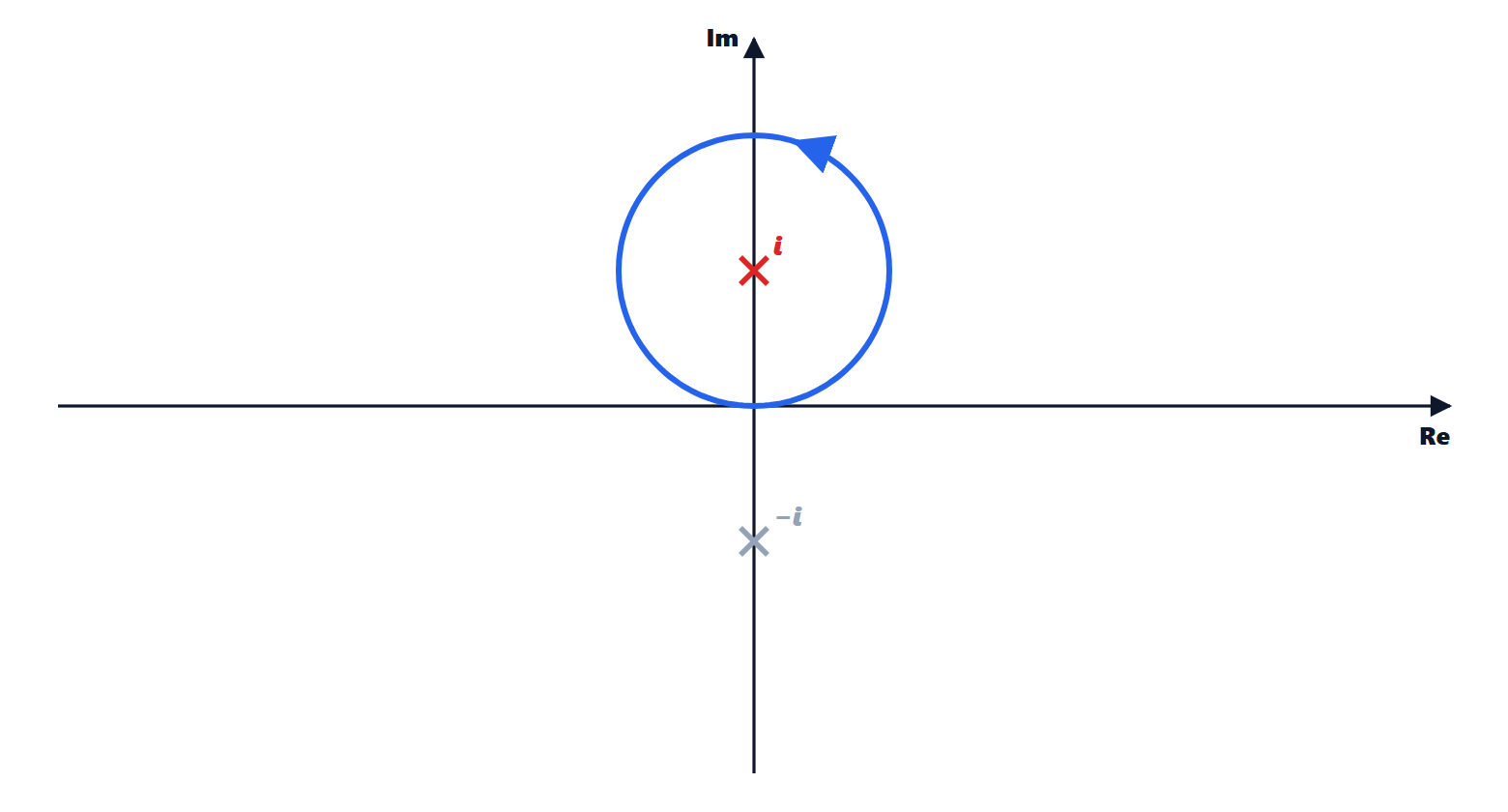
Exercise 6. An ML estimate
Show that, for  ,
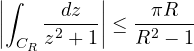 , where
 is the upper semicircle of radius
 , and deduce the limit as
 .
Result: the estimate follows from the reverse triangle inequality; the limit is 0.
Solution
On  :
 (reverse triangle inequality
 ). So
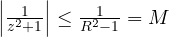 . The length of the semicircle is
 . ML estimate:
 .
This is the step that, in the in-depth study on residues, allows  to be computed by closing with the semicircle.

Exam level
Exercise 7. Cauchy’s estimate
A function  is holomorphic in the disc
 and
 on the circle . How large can
 be at most? Is the bound attained?
Result:  ; yes, for
 .
Solution
Cauchy’s estimate (in-depth study):  .
It is attained by  : on ,
 , and
 .
Meaning: a holomorphic function bounded on a large disc cannot oscillate quickly at the centre. The derivatives are controlled by the values on the boundary.
Exercise 8. A consequence of Liouville
Let be holomorphic on the whole of  with
 for every
 . Prove that is constant.
Result: apply Liouville to  , which has modulus at most 1.
Solution
is not necessarily bounded (the imaginary part can grow), so Liouville does not apply directly. Consider  : it is holomorphic on the whole of (composition of holomorphic functions) and
 . By Liouville
 is constant.
Then  , and since
 never vanishes,
 everywhere: is constant.
This is the typical scheme: transform the function with another one (exponential, reciprocal,  ) to obtain a bounded function.
Exercise 9. Maximum modulus
Find the maximum of 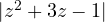 on the disc
 and the point where it is attained.
Result:  , at
 (and at
 ).
Solution
The polynomial is holomorphic: by the maximum modulus principle the maximum lies on the circle  . With ,
 . The modulus is
 , maximum for
 , i.e.
 :
 .
Check: at ,  , modulus . At
 , the most “natural” value to try, one gets only 3.