Functions of a complex variable: derivative, Cauchy-Riemann and elementary functions
Functions as mappings of the plane, the complex derivative, proof of the Cauchy-Riemann equations, harmonic functions, conformal mappings, complex exponential and logarithm.
In the Analysis courses functions were real. Mathematical Methods extends calculus to complex numbers, and the surprising discovery is that a function differentiable in the complex sense is far more “rigid” than a real function: knowing it on a small piece of the plane is enough to know it everywhere. This rigidity gives very powerful tools for computing integrals, studying the stability of systems and analysing circuits. In this lesson we cover functions of a complex variable, the derivative, the Cauchy-Riemann equations and the elementary functions.
Functions of a complex variable
A function  maps
 to a complex number
 . So it amounts to two real functions of two variables, the real part
 and the imaginary part
 . Its graph cannot be drawn (it would need four dimensions), so it is represented as a mapping of a region of the
 plane onto a region of the
 plane.
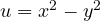
Example.  , so
 and
 . In polar form
 : the modulus is squared and the angle doubled. The first quadrant becomes the upper half-plane.
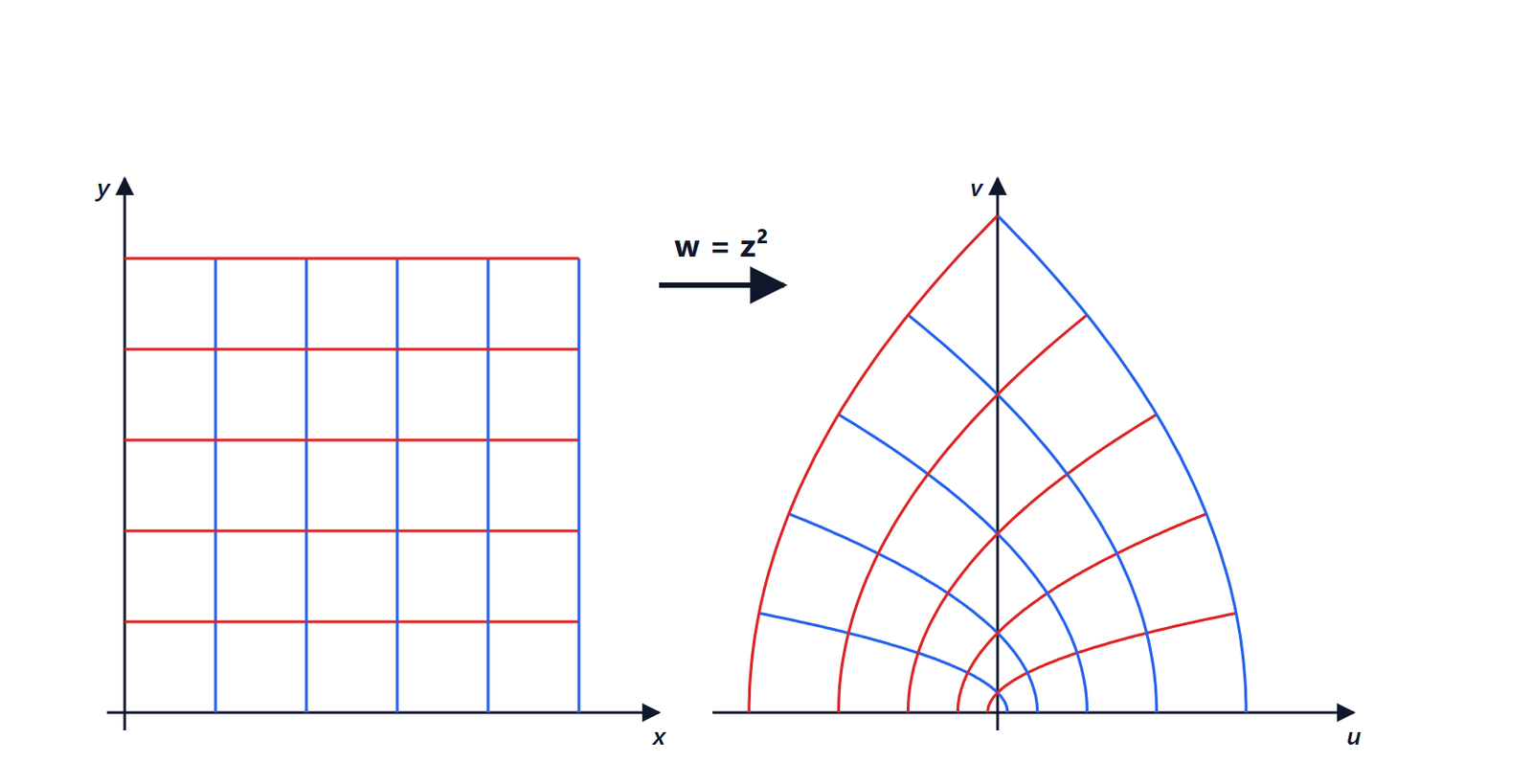
 maps the vertical (blue) and horizontal (red) lines of the plane into two families of parabolas in the plane. The mapped curves still meet at right angles: holomorphic functions preserve angles.
The complex derivative
The definition is the same as in the real case:

but now  is a complex number and can tend to zero from every direction in the plane. The limit must be the same for all of them: a much stronger requirement than real differentiability. A function differentiable at every point of an open set is called holomorphic (or analytic).
A counterexample.  . With real the difference quotient is
 , with purely imaginary it is
 . The limit exists nowhere: conjugation, a very simple function and a perfectly “smooth” mapping of the plane, is not complex-differentiable.
The Cauchy-Riemann equations
Proof
If  is differentiable at
 , compute the limit along two particular directions. With real:
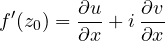
With  purely imaginary:

The two results must match. Equating real and imaginary parts gives the Cauchy-Riemann equations:
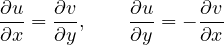
The converse also holds: if and have continuous partial derivatives satisfying these equations,  is holomorphic.
Check on  :
 ,
 . On
 :
 ,
 . They differ, as expected.
Harmonic functions
Differentiating the first equation with respect to  , the second with respect to
 and adding, the mixed terms cancel (Schwarz’s theorem):
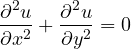
The real part (and likewise the imaginary part) of a holomorphic function satisfies Laplace’s equation: it is a harmonic function. It is the equation of the electrostatic potential in a charge-free region, of steady-state temperature, of the velocity potential of an ideal fluid. That is why holomorphic functions are a classic tool for computing fields in plane geometries: find a mapping that takes the hard geometry into a simple one, solve there and map back.
The curves  and
 are orthogonal to each other: in electrostatics one set are the equipotentials, the other the field lines.
Conformal mappings
Where  , a holomorphic function behaves locally like multiplication by the complex number
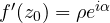 : it scales by
 and rotates by
 . So it preserves angles between curves, as the figure shows: it is a conformal mapping. Mercator maps and the Smith chart used for impedance matching in radio-frequency circuits are conformal mappings.
Elementary functions
The exponential.  , from Euler’s formula. It is holomorphic everywhere, with
 . But, unlike the real case, it is periodic with period
 :
 . And it is never zero.
Sine and cosine. 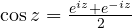 ,
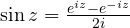 . In the complex field they are not bounded:
 grows without limit. An equation such as
 , impossible among the reals, has complex solutions.
The logarithm. We look for with  . Writing
 :

The complex logarithm is multivalued, because the argument is defined only up to multiples of  . To get a true function you choose a branch, for example with
 (principal branch), and cut the plane along the negative real axis: crossing the cut the function jumps by . Example:
 on the principal branch, that is
 .
Powers.  , in general multivalued too. For example
 (principal branch): a real number.