Optics: reflection, refraction, interference and diffraction
Refractive index, Snell's law proved with Fermat's principle, total internal reflection and optical fibres, lenses, Young's experiment, gratings and the diffraction limit.
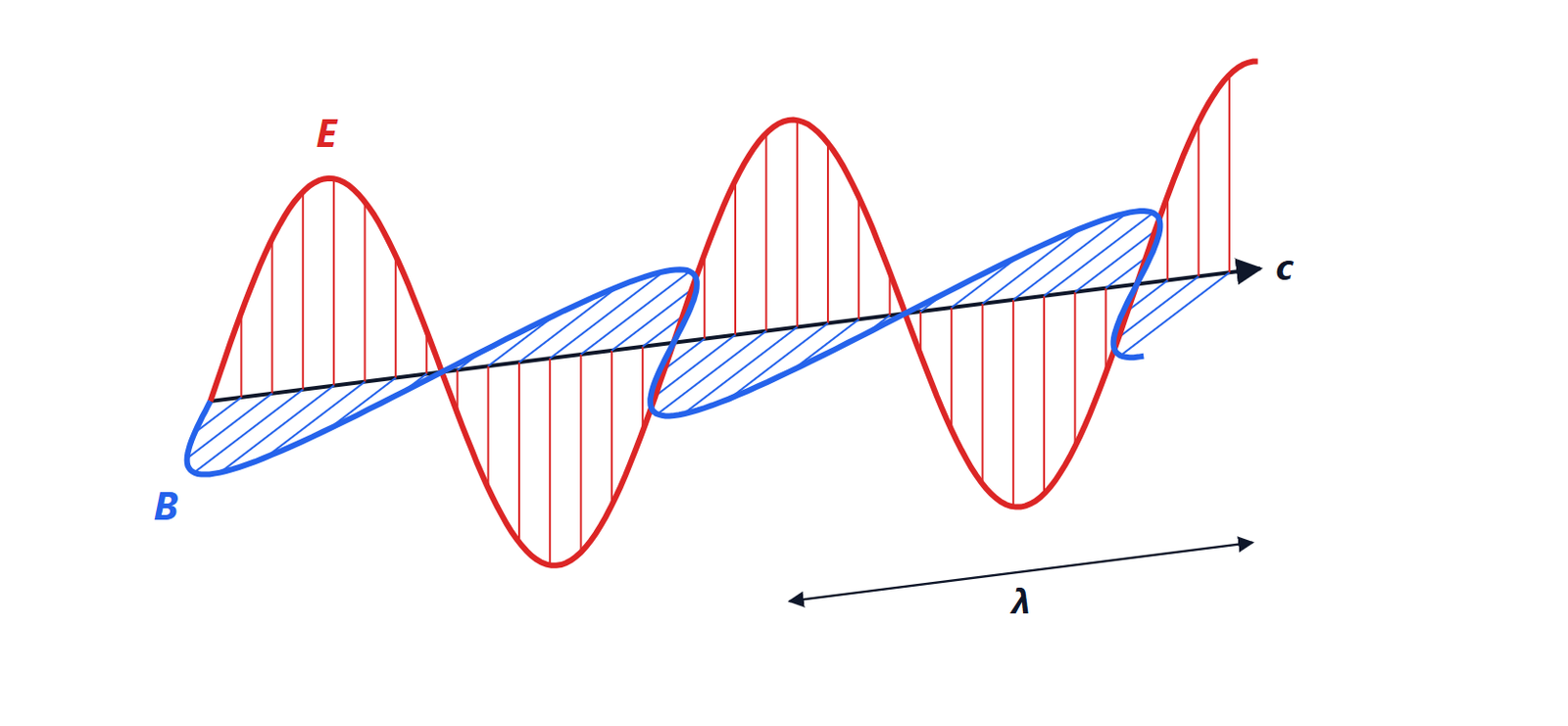
Light is an electromagnetic wave with a wavelength between 380 and 780 nm. When objects are much larger than the wavelength, light can be described with straight rays (geometrical optics); when sizes are comparable, wave effects appear, interference and diffraction (wave optics). In this lesson we cover reflection and refraction, total internal reflection and optical fibres, lenses, Young’s interference and diffraction.
Refractive index
In transparent materials light travels more slowly than in vacuum. The refractive index is the ratio

It is about 1.0003 for air, 1.33 for water, 1.5 for glass, 1.46 for the silica of optical fibres, 2.42 for diamond. Going from one medium to another the frequency stays the same, while the wavelength shrinks to  .
Reflection and refraction
When light meets the boundary between two media, part is reflected and part goes through, changing direction.
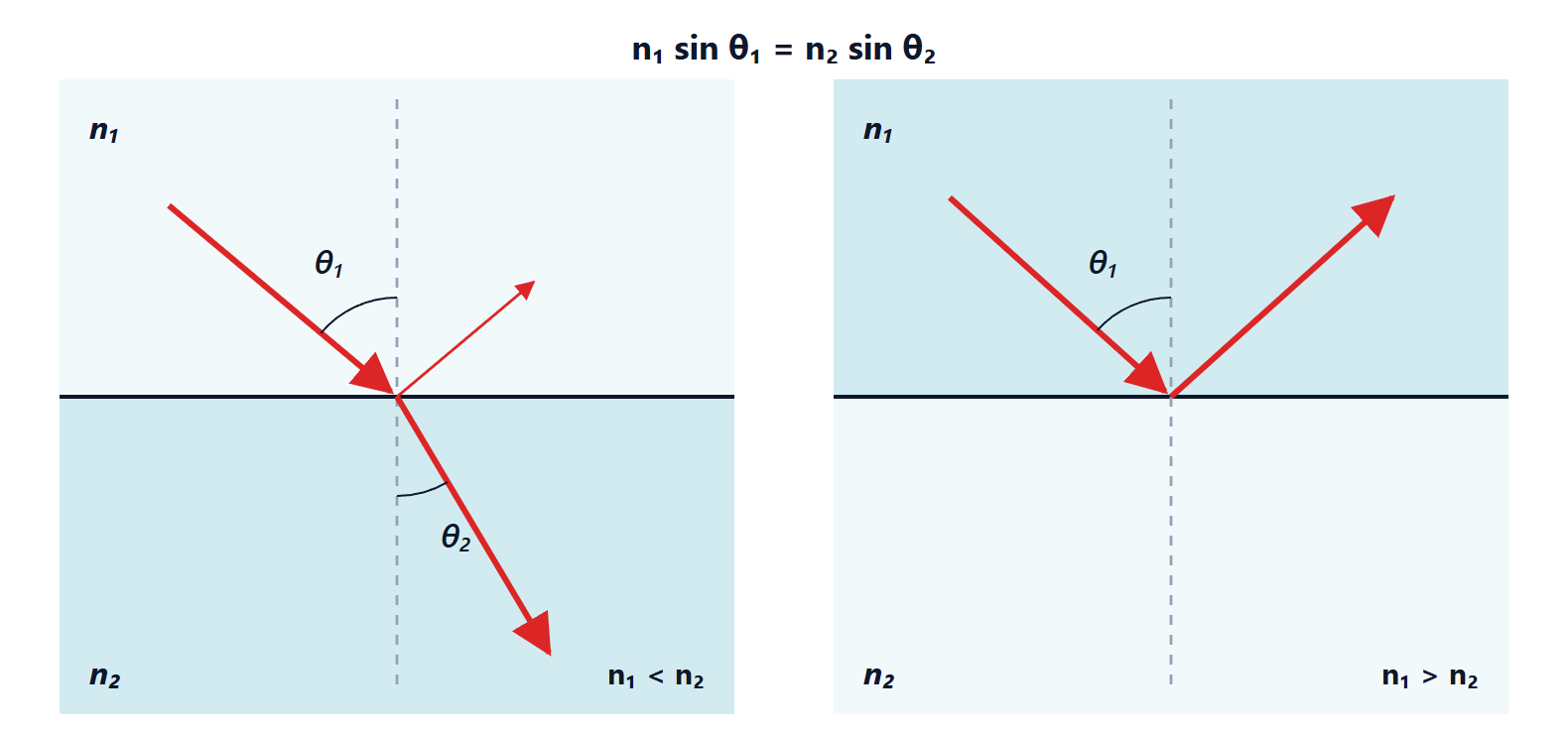
- Reflection: the angle of reflection equals the angle of incidence, both measured from the normal to the surface.
- Refraction (Snell’s law):

Proof with Fermat’s principle
Light goes from a point A in medium 1 to a point B in medium 2 along the path that takes the least time. Let A be at height  above the surface, B at depth
 below, a horizontal distance
 away, and let
 be where the ray crosses the surface. The time is

Setting  :

and multiplying by  gives Snell’s law. It is the same reasoning as a lifeguard running to someone drowning: it pays to run further on the sand and swim less.
Total internal reflection and optical fibres
Going from a denser to a less dense medium ( ) the ray bends away from the normal. Beyond the critical angle

Snell’s law has no solution and the light is totally reflected, with no loss. For glass in air  .
An optical fibre uses exactly this: a silica core with an index slightly higher than the cladding around it guides the light by repeated total internal reflections. At a wavelength of 1550 nm the attenuation is about 0.2 dB/km: after 100 km, 1% of the light still arrives. Fibres carry almost all the Internet traffic between continents, and over short distances they link servers and switches in data centres.
Lenses
A thin converging lens of focal length  forms the image of an object at distance
 at a distance
 given by the thin lens equation:

with magnification  . The power of a lens is measured in dioptres,
 with in metres. It is the optics of cameras, microscopes, projectors and of the lenses in optical drives and image sensors.
Interference: Young’s experiment
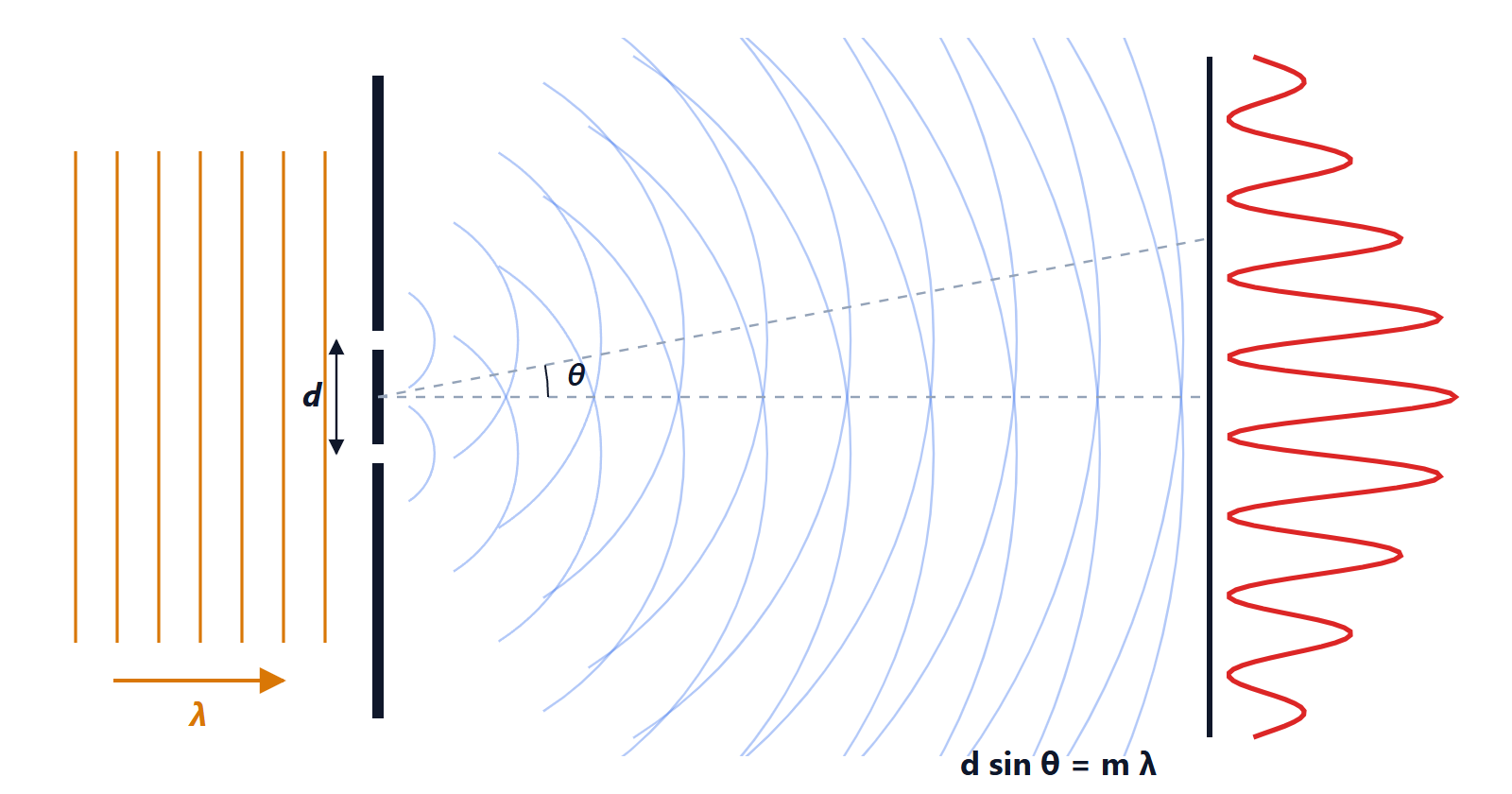
If light is a wave, two coherent sources must interfere: where crests coincide they reinforce, where a crest meets a trough they cancel. Young showed it in 1801 with two narrow slits.
Proof of the condition for maxima
At a point on the screen seen at an angle  , far away compared with , the two rays travel paths that differ by
 . The waves arrive in phase, giving a maximum, if this difference is a whole number of wavelengths:

There is a minimum if the difference is an odd number of half wavelengths. For small angles, on a screen at distance  , the bright fringes are equally spaced,
 apart. Example: with a 650 nm red laser, slits 0.25 mm apart and a screen 2 m away,
 mm. Measuring the fringes measures the wavelength with a ruler.
With many equally spaced slits (a diffraction grating) the maxima become very sharp lines, and since their position depends on  , the grating separates colours: the heart of spectrometers. The iridescence of a CD is the same effect.
Diffraction and its limits
A wave passing through an opening of width spreads out: the first minimum is at  . The smaller the opening, the more the beam spreads. A fundamental limit follows: no optical instrument can resolve details much smaller than the wavelength (Rayleigh criterion,
 for a circular aperture of diameter
 ).
That is why the semiconductor industry has moved to ever shorter wavelengths to print integrated circuits: from 193 nm ultraviolet to 13.5 nm extreme ultraviolet, which can define the details of the most advanced chips. The same limit applies to antennas: a narrow beam needs an antenna that is large compared with the wavelength, like radio telescope dishes or 5G antenna arrays.