Vector spaces: subspaces, linear independence, bases and dimension
Definition and examples, subspaces, linear combinations and spans, linear dependence, bases and coordinates, dimension and Grassmann's formula.
So far we have worked with vectors in the plane and in space. Linear algebra takes a step of abstraction: it takes the properties of vector addition and multiplication by a number, and calls “vector space” any set that respects them. That way the same theorems hold for triples of numbers, for polynomials, for matrices and for signals. In this lesson we cover spaces and subspaces, linear combinations, linear dependence, bases and dimension.
Vector spaces
A real vector space is a set  with an addition
 and a multiplication by scalars
 that satisfy the properties we are used to: addition is associative and commutative, there is a zero vector
 , every vector has an opposite, and
 ,
 ,
 ,
 .
Examples:
 , the
 -tuples of real numbers;
 , polynomials of degree at most
 ;
 , the
 matrices;
- continuous functions on an interval, with pointwise addition. The signals in a circuit live in spaces of this kind.
Subspaces
A subset  of is a subspace if it is itself a vector space with the same operations. Three checks are enough:
 ; if
 then
 ; if
 then
 .
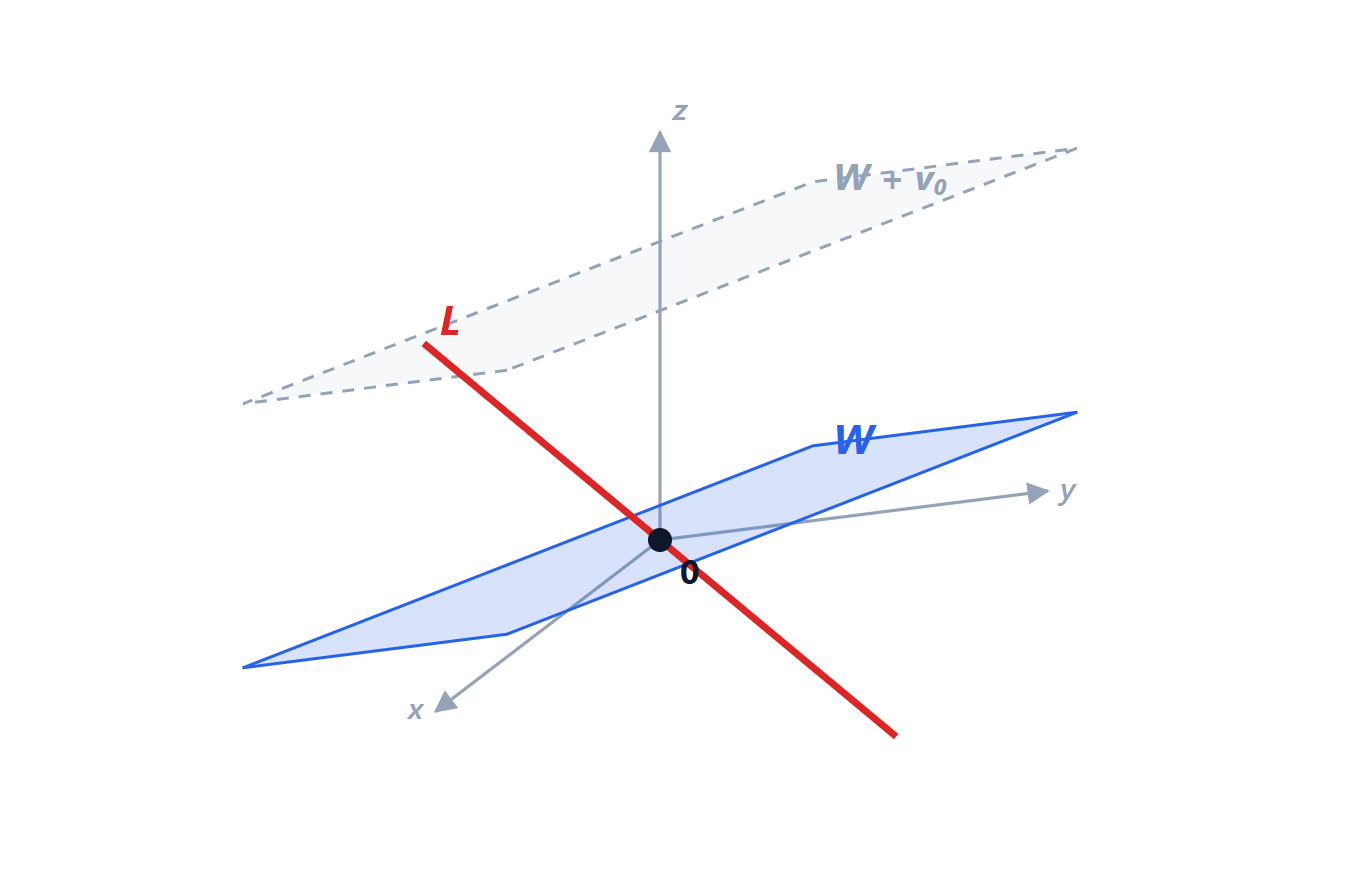
 the subspaces are the origin, the lines and planes through the origin (
 and ) and the whole space. The shifted plane
 is not a subspace: it does not contain .
Examples. The solutions of a homogeneous system  form a subspace of : if
 and
 then
 and
 . The solutions of a non-homogeneous system are not (they do not contain ): they form a shifted subspace, like the grey plane in the figure. The plane
 is a subspace, the plane
 is not.
Linear combinations and spanning sets
A linear combination of the vectors  is a vector of the form
 . The set of all linear combinations is called the span and is written
 . It is the smallest subspace containing those vectors. Two non-parallel vectors of span a plane through the origin; three non-coplanar vectors span the whole of .
Linear dependence and independence
The vectors are linearly independent if the only linear combination giving the zero vector is the one with all coefficients zero:

Otherwise they are dependent, and at least one of them can be written as a combination of the others: it is “redundant”, it adds no new direction.
How to check. Put the vectors as columns of a matrix and solve the homogeneous system: they are independent if the only solution is zero, that is if the echelon form has a pivot in every column. In , vectors are independent if and only if the determinant of the matrix with them as columns is non-zero.
Example.  ,
 ,
 : the determinant is
 . They are dependent, and indeed
 .
Bases and coordinates
A basis of is a set of linearly independent vectors that span . Every vector can then be written as a combination of the basis vectors in exactly one way: the coefficients are its coordinates.
Proof: coordinates are unique
If  , subtracting gives
 . By independence all coefficients are zero, so
 for every
 . This is where independence is needed: with dependent vectors the same vector would have infinitely many expressions.
Standard bases: in the vectors  , …,
 ; in polynomials of degree at most the monomials
 . The coordinates of the polynomial
 are
 : with a basis, a polynomial becomes a triple of numbers and can be handled like a vector of .
Dimension
Theorem. All bases of a vector space have the same number of elements. This number is the dimension of ,  .
The idea of the proof (Steinitz exchange lemma): if is spanned by  vectors, then any set of more than vectors is dependent. Applying this both ways to two bases, they have the same number of elements.
 ,
 ,
 . The space of all continuous functions, on the other hand, is infinite-dimensional.
Practical consequences, in a space of dimension :
- more than vectors are always dependent;
- fewer than vectors cannot span the whole space;
- independent vectors automatically form a basis (and so do spanning vectors).
Sum and intersection of subspaces
If  and are subspaces, so are
 and
 . Grassmann’s formula links their dimensions:

Two distinct planes through the origin in :  , so
 . They meet in a line, as expected. If
 the sum is called direct,
 , and every vector of the sum splits in a unique way.