Analytic geometry in the plane: lines and conics
Lines in parametric and Cartesian form, parallelism and point-line distance, ellipse, hyperbola and parabola as loci, classifying conics with eigenvalues.
Analytic geometry turns geometric problems into equations: a point is a pair of numbers, a line a first-degree equation, a conic a second-degree equation. In this lesson we cover lines in the plane (equations, parallelism, distances) and conics, with their definitions as loci and the classification that uses eigenvalues.
Lines in the plane
A line can be described in two ways.
- Parametric form: through
 with direction vector
 :
 .
- Cartesian form:
 . The vector
 is perpendicular to the line.
Why  is normal
If  and
 are on the line,
 and
 . Subtracting,
 , that is
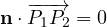 : the vector is orthogonal to every vector along the line. A direction vector is therefore
 , and the slope is
 .
Relative position. Two lines are parallel if their normal vectors are proportional, perpendicular if the normals are orthogonal ( , or with slopes,
 ). Otherwise they meet at one point, found by solving the system: the lesson on linear systems seen through geometry.
Distance from a point to a line
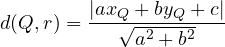
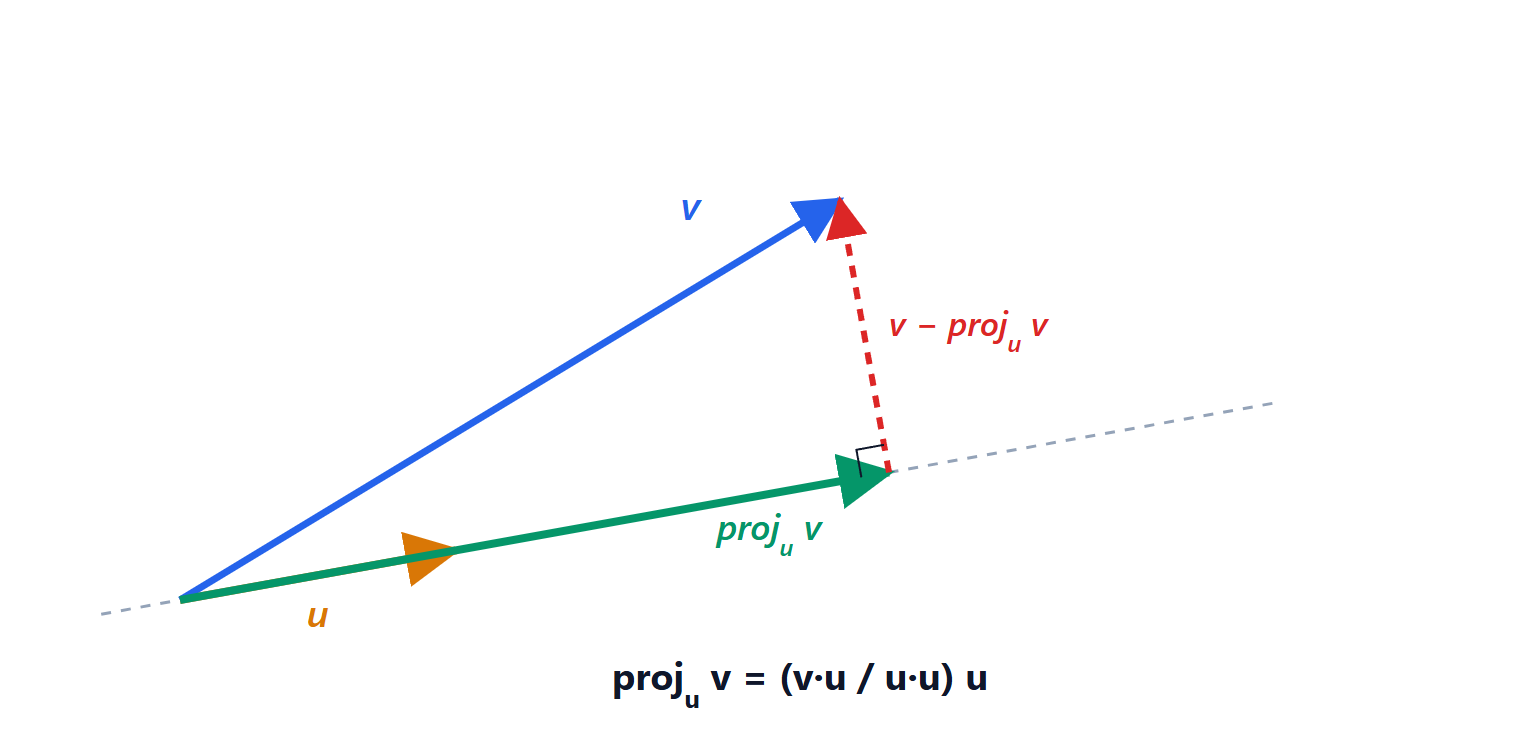
Proof. Let  be any point on the line. The distance is the magnitude of the projection of
 onto the normal direction
 :

because  . Example: the distance of
 from
 is
 .
Conics as loci
Circle. The points at distance  from the centre
 :
 .
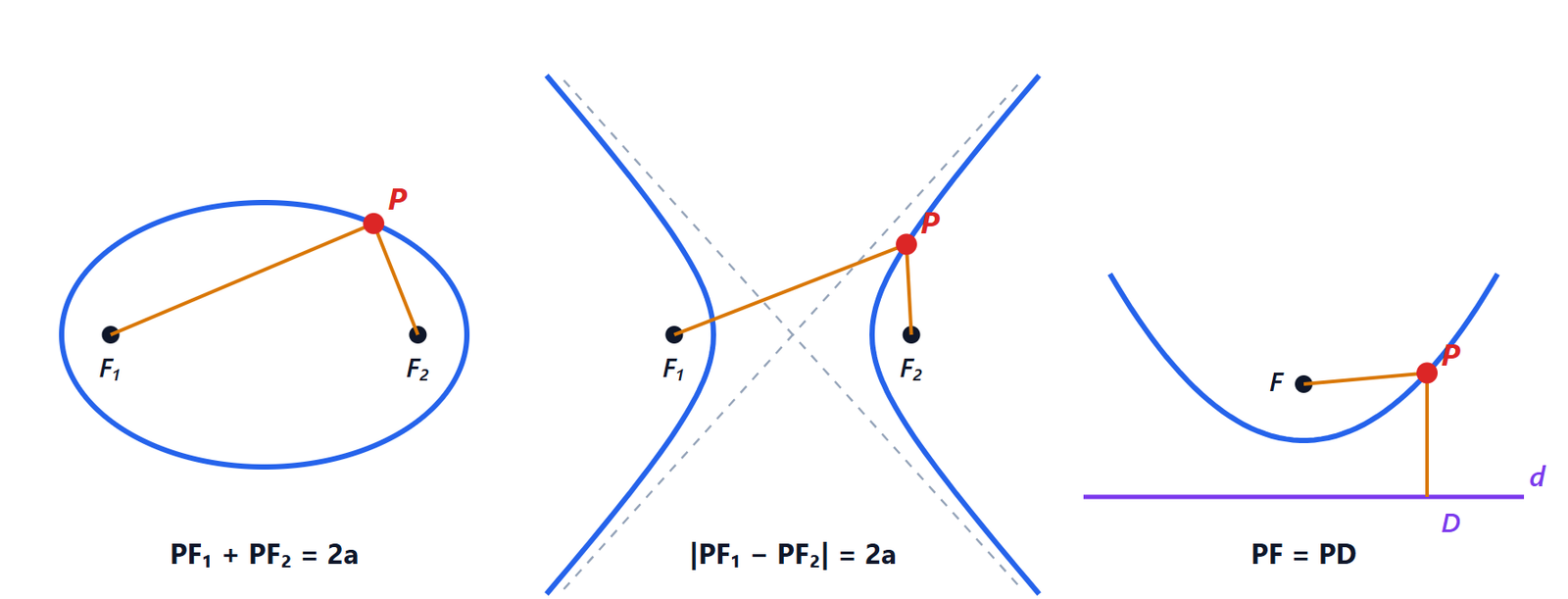
Ellipse. The points with  . With foci at
 and
 :
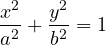
The eccentricity  lies between 0 (circle) and 1. The Earth’s orbit has
 , almost a circle; Halley’s comet
 .
Hyperbola. The points with  . With foci at and
 :

The LORAN navigation system used hyperbolas: the difference in arrival times of the signals from two stations places the receiver on a hyperbola with the stations as foci.
Parabola. The points equidistant from the focus  and the directrix
 :

Its optical property is famous: rays parallel to the axis are all reflected into the focus. That is why satellite dishes have the receiver (LNB) at the focus, and car headlights have the bulb at the focus of a parabolic mirror.
Proof: the equation of the ellipse
With  , the condition is
 . Isolating one root and squaring:

Squaring again and simplifying:  . With and dividing by
 you get the standard equation.
Classifying conics with eigenvalues
A general second-degree equation

can be written with a symmetric matrix: the quadratic part is  with
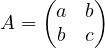 . By the spectral theorem there is a rotation of the axes that makes
 diagonal: in the new frame the mixed term
 disappears and the quadratic part becomes
 . The type of conic depends on the signs of the eigenvalues, that is on the determinant:
 (eigenvalues of the same sign): ellipse;
 (opposite signs): hyperbola;
 (one zero eigenvalue): parabola.
(Apart from degenerate cases, such as pairs of lines or a single point, which are recognised from the determinant of the full 3×3 matrix.)
Example.  .
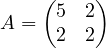 , characteristic polynomial
 , eigenvalues 6 and 1. In the eigenvector frame,
 for 6 and
 for 1, the equation is
 , that is
 : an ellipse with semi-axes 1 and
 , rotated by
 .