Vectors in space: dot, cross and triple products
Free vectors and components, the dot product with the Cauchy-Schwarz inequality, the cross product and areas, the triple product, volumes and coplanarity, with a worked example.
The Geometry and Algebra course starts with vectors in space, because they are the concrete model from which all of linear algebra grows: first you learn to work with arrows in the plane and in space, then you discover that the same rules hold for polynomials, signals and matrices. In this lesson we cover vectors, components, the dot product, the cross product and the scalar triple product, with their geometric meaning: lengths, angles, areas and volumes.
Bound and free vectors
A directed segment  has a starting point, a length, a direction and a sense. Two directed segments that can be obtained from each other by a translation represent the same free vector. Once an origin O is fixed, every vector can be placed at O and corresponds to a single point P: this is why, in space with a Cartesian frame, vectors are identified with triples of numbers,

Operations are done component by component:  ,
 . The vector from A to B is a difference,
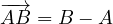 , and the midpoint of AB is
 .
Parallel vectors. Two non-zero vectors are parallel if one is a multiple of the other,  . Three points A, B, C are collinear if and
 are parallel.
Dot product: lengths and angles

The two forms are equivalent (the proof with orthonormal unit vectors is in the Physics 1 lesson on quantities and vectors). From here:
- norm:
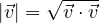 ; the distance between two points is
 ;
- angle:
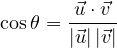 ;
- orthogonality:
 .
Proof: the Cauchy-Schwarz inequality
 . For every real
 we have
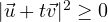 , that is

A quadratic that is never negative has a discriminant less than or equal to zero:  , which is the claim. The proof uses only the properties of the dot product, not components: this is why it will also hold in abstract spaces. The triangle inequality
 follows.
Cross product: areas

The result is a vector perpendicular to both  and
 , with sense given by the right-hand rule and magnitude
 , which is the area of the parallelogram built on the two vectors. The area of triangle ABC is therefore
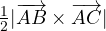 .
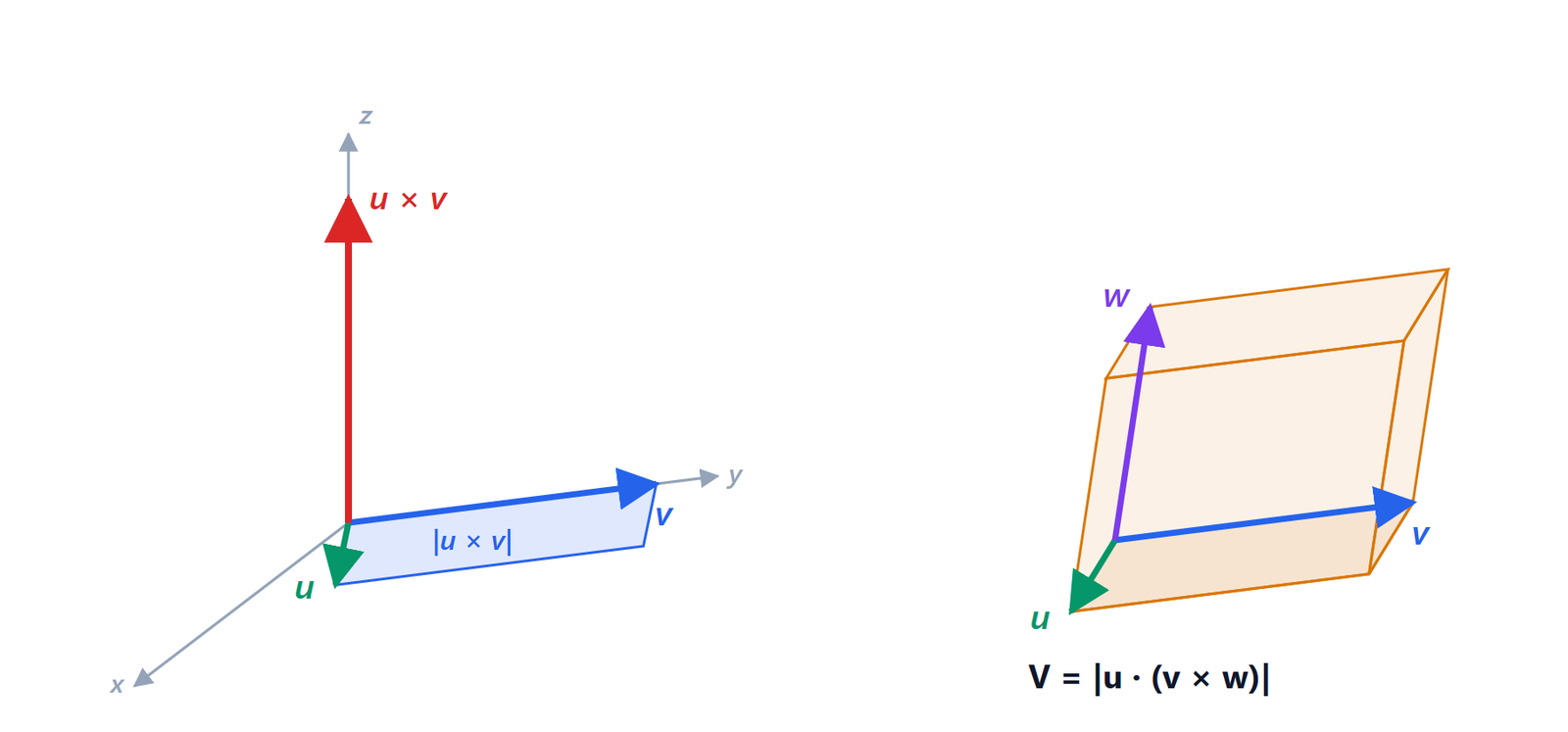
 is perpendicular to the plane of and and its magnitude is the area of the parallelogram. Right: the absolute value of the scalar triple product is the volume of the parallelepiped built on three vectors.
Properties worth remembering:  (anticommutative);
 if and only if the vectors are parallel; it is not associative.
Proof: the magnitude is the area
Expanding the squares one checks Lagrange’s identity,  . Substituting
 :

and  is exactly the height of the parallelogram with base
 .
Scalar triple product: volumes and coplanarity
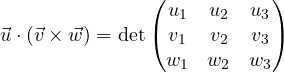
Its absolute value is the volume of the parallelepiped built on the three vectors:  is the area of the base and
 (with
 the angle between and the normal to the base) is the height. The sign tells whether the triple is oriented like the axes (right-handed) or not.
A key consequence: three vectors are coplanar if and only if their triple product is zero, that is if the determinant of their components vanishes. It is the first meeting with an idea that will come back throughout the course: a zero determinant means that something “collapses” into one dimension less.
Worked example
Given  ,
 ,
 ,
 : find the area of triangle ABC and the volume of tetrahedron ABCD.
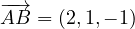 ,
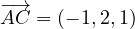 ,
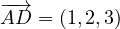 .
 .
- Area of ABC:
 .
- Triple product:
 .
- The tetrahedron is one sixth of the parallelepiped: volume
 .
Had the triple product been zero, the four points would have been on the same plane.