Electric charge and Coulomb's law
Properties of charge, conductors and insulators, electrostatic induction, Coulomb's law and superposition with an example, comparison with gravity and electrostatic discharge.
Physics 2 is electromagnetism: the part of physics on which all of electronics rests. It starts from the simplest quantity, electric charge, and from the force between two charges, Coulomb’s law. In this lesson we look at the properties of charge, Coulomb’s law with the superposition principle, and the comparison with gravity.
Electric charge
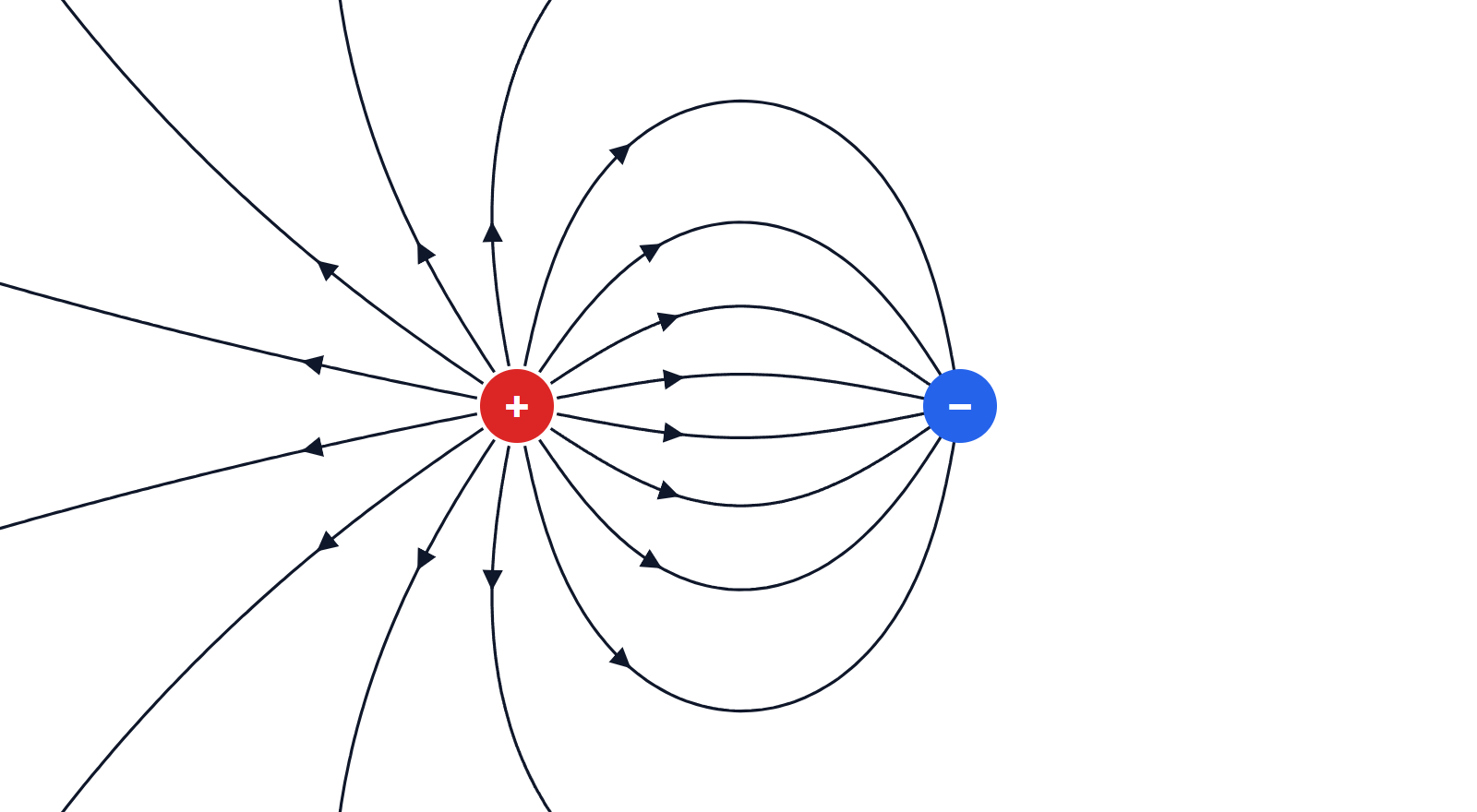
Rub a plastic rod with a woollen cloth and the rod attracts bits of paper. There are two kinds of charge, conventionally called positive and negative: like charges repel, unlike charges attract. The basic properties:
- charge is conserved: in an isolated system the total charge does not change. Rubbing does not create charge, it moves electrons from one body to another;
- charge is quantised: every charge is an integer multiple of the elementary charge
 C. The electron has charge
 , the proton
 ;
- the unit is the coulomb (C), the charge carried in one second by a current of one ampere. In electrostatics a coulomb is huge: about
 electrons.
Conductors and insulators
In conductors (metals, ionic solutions) some charges are free to move: in metals they are the conduction electrons, about one per atom in copper. In insulators (glass, plastic, dry air) charges stay bound to atoms. Semiconductors sit in between, and the number of free charges is controlled by doping and temperature: the basis of diodes and transistors.
Electrostatic induction. Bringing a charged rod near a neutral conductor, the free electrons move: the near side takes the opposite charge and the far side the same charge. The conductor stays neutral but is attracted, because the opposite charge is closer. It is also why a rubbed balloon sticks to a wall.
Coulomb’s law
Two point charges  and
 a distance
 apart exert on each other a force along the line joining them, of magnitude

where  F/m is the permittivity of free space.
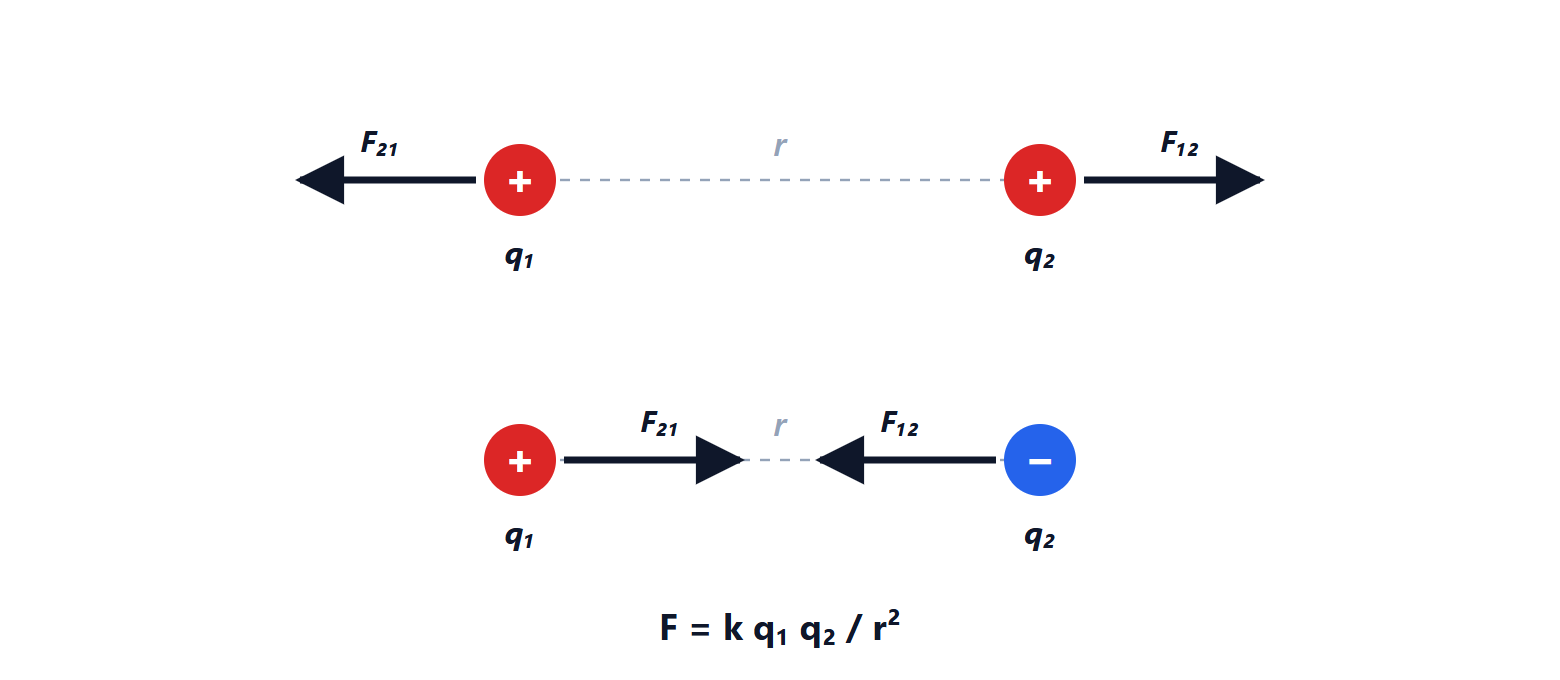
In vector form, the force exerts on is
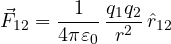
with  the unit vector from to . If
 the force is repulsive, if negative attractive. The
 dependence is the same as gravitation, and like gravitation it has been tested with extreme precision: the exponent is 2 to within one part in
 .
The superposition principle
With several charges, the force on one of them is the vector sum of the forces exerted by the others, each computed as if the others were not there.
Example. Three charges along the  axis:
 µC at
 ,
 µC at
 m,
 µC at
 m. Force on
 :
- from (repulsive, to the right):
 mN;
- from (attractive, to the left):
 mN.
The resultant is about 22.5 mN to the left.
Electricity versus gravity
In the hydrogen atom, electron and proton are about  m apart. The electric force is about
 N, the gravitational force
 N: the ratio is about
 . Gravity rules the sky only because large bodies are almost perfectly neutral: positive and negative charges cancel. A tiny imbalance would produce enormous forces: two people a metre apart, each with 1% more electrons than protons, would repel each other with a force comparable to the weight of the Earth.
Continuous charge distributions
For extended charged bodies, split the charge into elements  and integrate. Depending on the geometry one uses a linear density
 (C/m, for a wire), a surface density
 (C/m², for a sheet) or a volume density
 (C/m³):
 ,
 or
 . The integrals are those of Analysis 2, and the choice of coordinates follows the symmetry of the body.
A practical note: electrostatic discharge
Walking on carpet can charge your body to a few kilovolts. Touching an integrated circuit, the discharge (ESD) crosses junctions and oxides only a few nanometres thick and damages them, sometimes with no visible effect at first. That is why labs use grounded wrist straps, dissipative mats and antistatic bags, and why chips have protection diodes on every pin.