The electric field and Gauss's law
Definition of the field, field lines, flux, proof of Gauss's law, field of a sphere, a wire and a plane, conductors in equilibrium, the Faraday cage and the point effect.
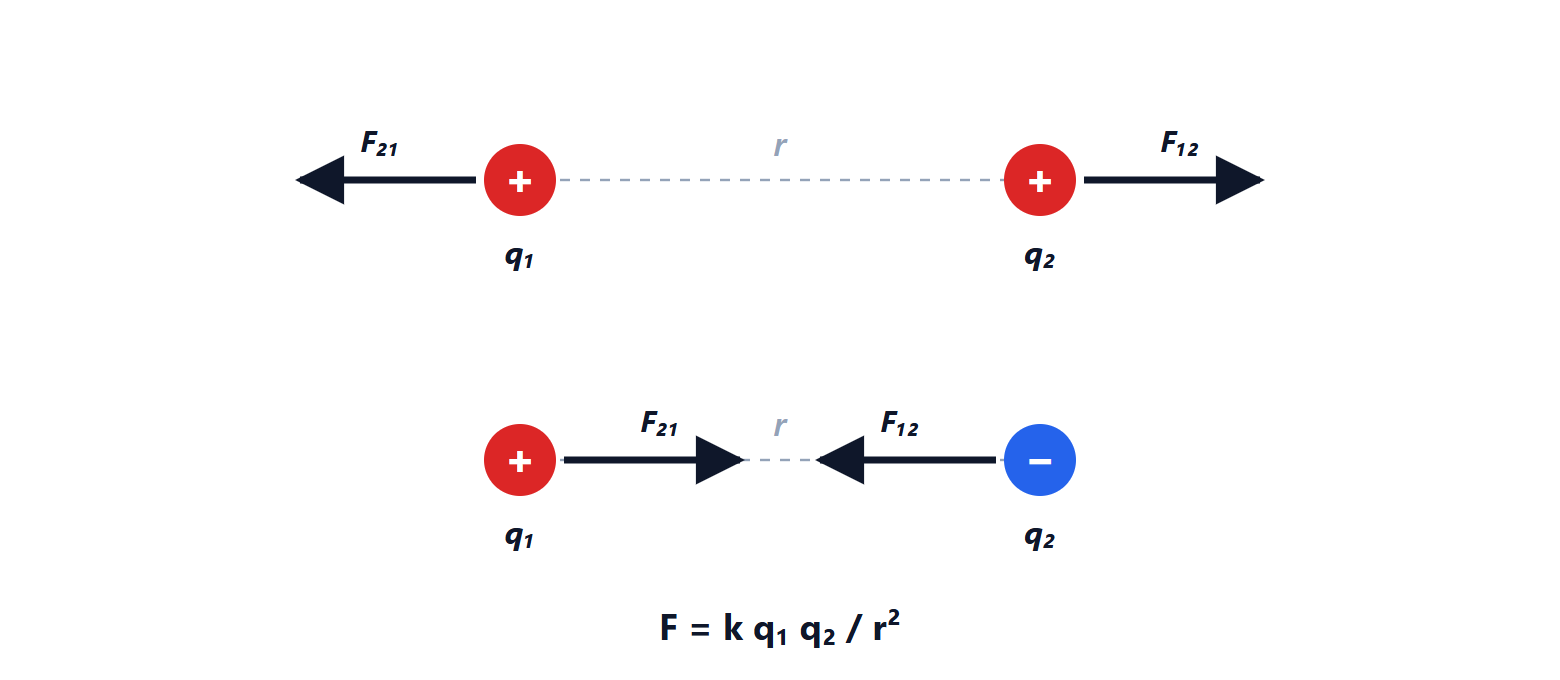
Coulomb’s law describes a force “at a distance” between two charges. The concept of field changes the point of view: every charge modifies the space around it, and another charge responds to the field at the point where it sits. It looks like just another way of saying the same thing, but it is the step that leads to electromagnetic waves. In this lesson we define the electric field, field lines and Gauss’s law, with its applications.
The electric field
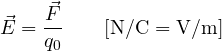
The electric field at a point is the force that would act on a positive test charge  placed there, divided by :
For a point charge  , from Coulomb’s law:
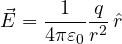
radial, outward if  , inward if
 . For several charges superposition holds: the fields add as vectors. A charge in a field
 feels the force
 .
Field lines
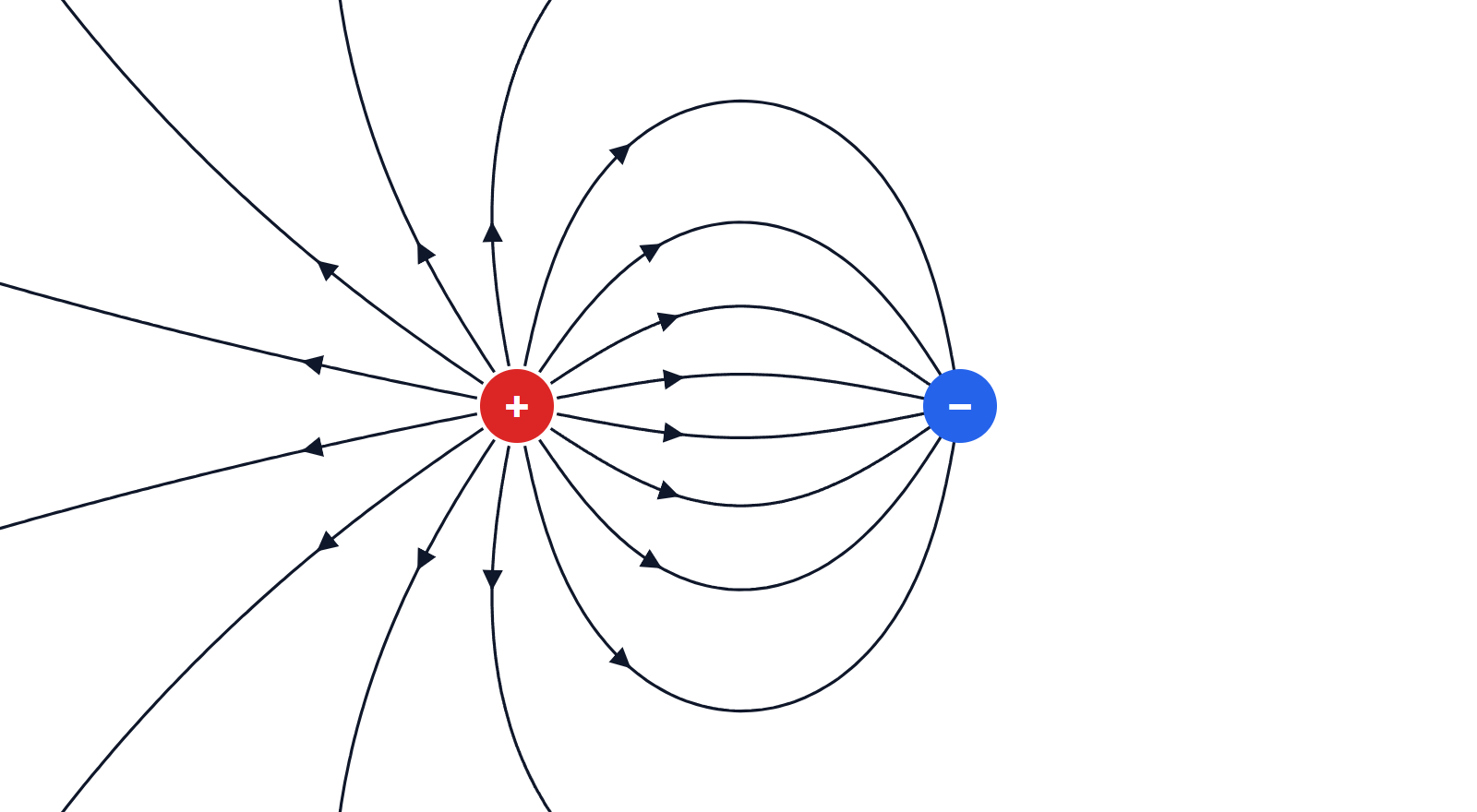
Field lines are curves tangent at every point to . They leave positive charges, end on negative ones, never cross, and are closer together where the field is stronger.
Electric flux
The flux of through a surface is  : it measures “how many field lines” cross the surface. For a closed surface the outward normal is used, so the flux is positive if the lines leave and negative if they enter.
Gauss’s law
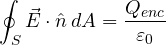
The flux of the electric field through any closed surface equals the enclosed charge divided by  :
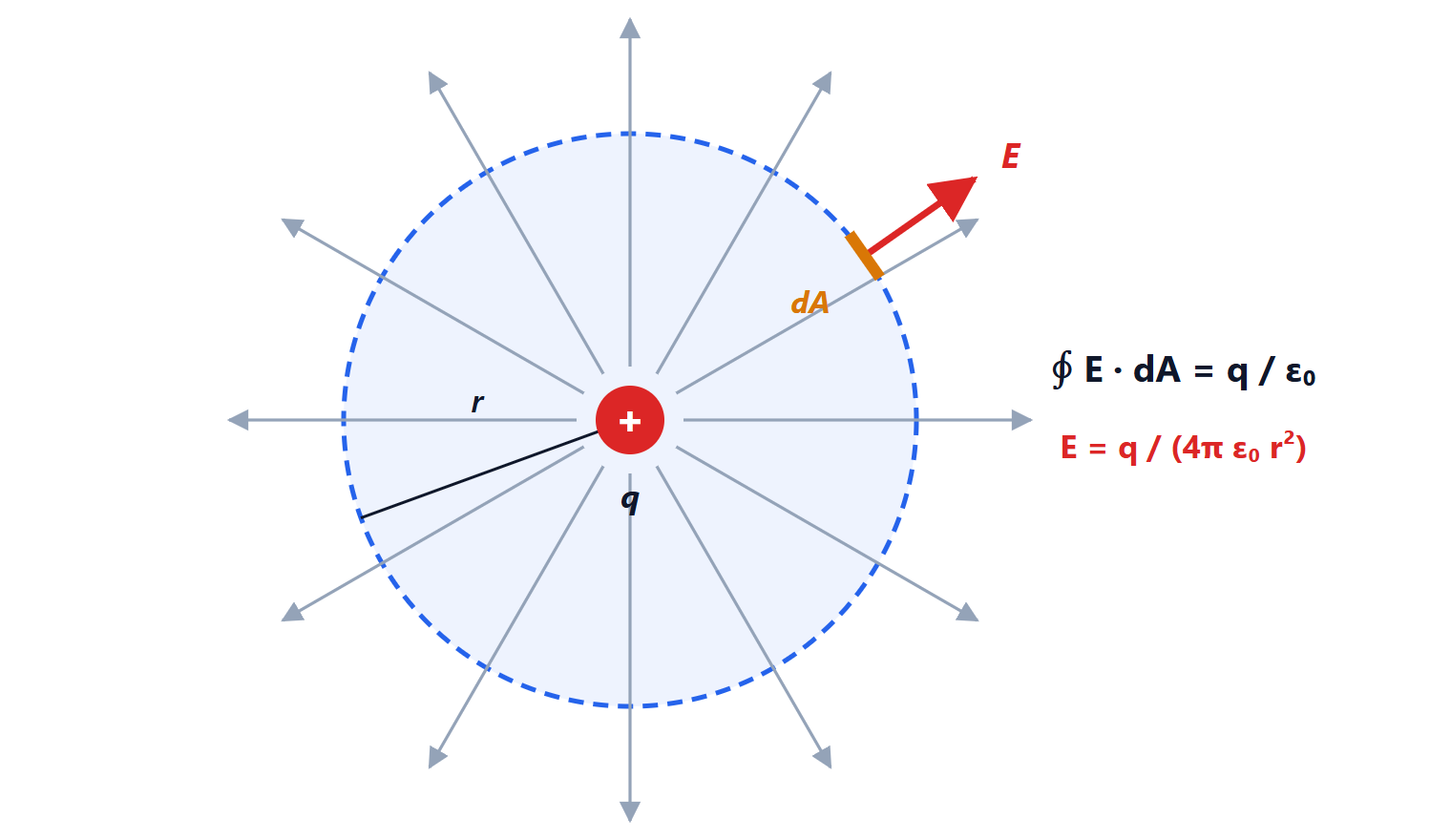
 centred on the charge: the field is radial, so parallel to the normal
 at every point, and has the same magnitude all over the sphere.
Proof for a point charge
Take a sphere of radius centred on the charge. At every point is radial, like the normal, with constant magnitude  . So

The radius cancels: the  dependence of the field exactly compensates the
 growth of the area. For any closed surface the result is the same, because the flux through a surface element depends only on the solid angle it subtends at the charge, and the total solid angle is always
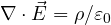
 . A charge outside gives zero flux: its lines go in and come out. Superposition gives the general case. In local form, with the divergence theorem of Analysis 2:
 .
How to use it: symmetry
Gauss’s law always holds, but it helps compute the field only when symmetry lets you choose a surface on which  is constant and parallel (or perpendicular) to the normal.
Uniformly charged sphere (charge  , radius
 ). Outside: with a sphere of radius
 ,
 , so the field is the same as a point charge. Inside: the enclosed charge is
 , and
 , which grows linearly from the centre.
Infinite wire with linear density  . Surface: a coaxial cylinder of radius and length
 . Flux passes only through the side:
 , so

The field falls as  , not .
Infinite plane with surface density  . Surface: a small cylinder crossing the plane, with end faces of area
 . Flux passes only through the two ends:
 , so

independent of distance. With two parallel planes of opposite charge the fields add between the planes and cancel outside:  inside. It is the parallel-plate capacitor of the lesson on capacitors.
Conductors in equilibrium
In a conductor in equilibrium the charges are at rest, so the field inside is zero (otherwise the electrons would move). Gauss’s law, applied to a surface just inside the conductor, shows that all the charge sits on the surface. Just outside, the field is perpendicular to the surface and equals  .
Two practical consequences:
- the Faraday cage: inside a closed conducting shell the external electric field does not get in. It is the principle of metal shields on radio-frequency circuits, of shielded cables, and the reason you are safe from lightning inside a car;
- the point effect: charge density, and so the field, is highest where the surface is most curved. At sharp points the field can ionise the air: the principle of the lightning rod.