Three-phase systems: star, delta and power
The balanced set and its zero sum, star and delta connections, phase and line voltages, three-phase power, constant instantaneous power and the rotating field.
Electrical energy is produced, transmitted and distributed almost everywhere in three-phase form: three sinusoidal voltages of the same amplitude and frequency, 120° apart from each other. Household sockets are single phase, but they are just one of the three phases of the neighbourhood grid. In this lesson we see why three-phase pays off, star and delta connections, the relations between phase and line quantities, and power.
The balanced set
A three-phase generator (an alternator with three windings at 120° on the stator) produces three voltages:

With phasors, setting  :
 ,
 ,
 .
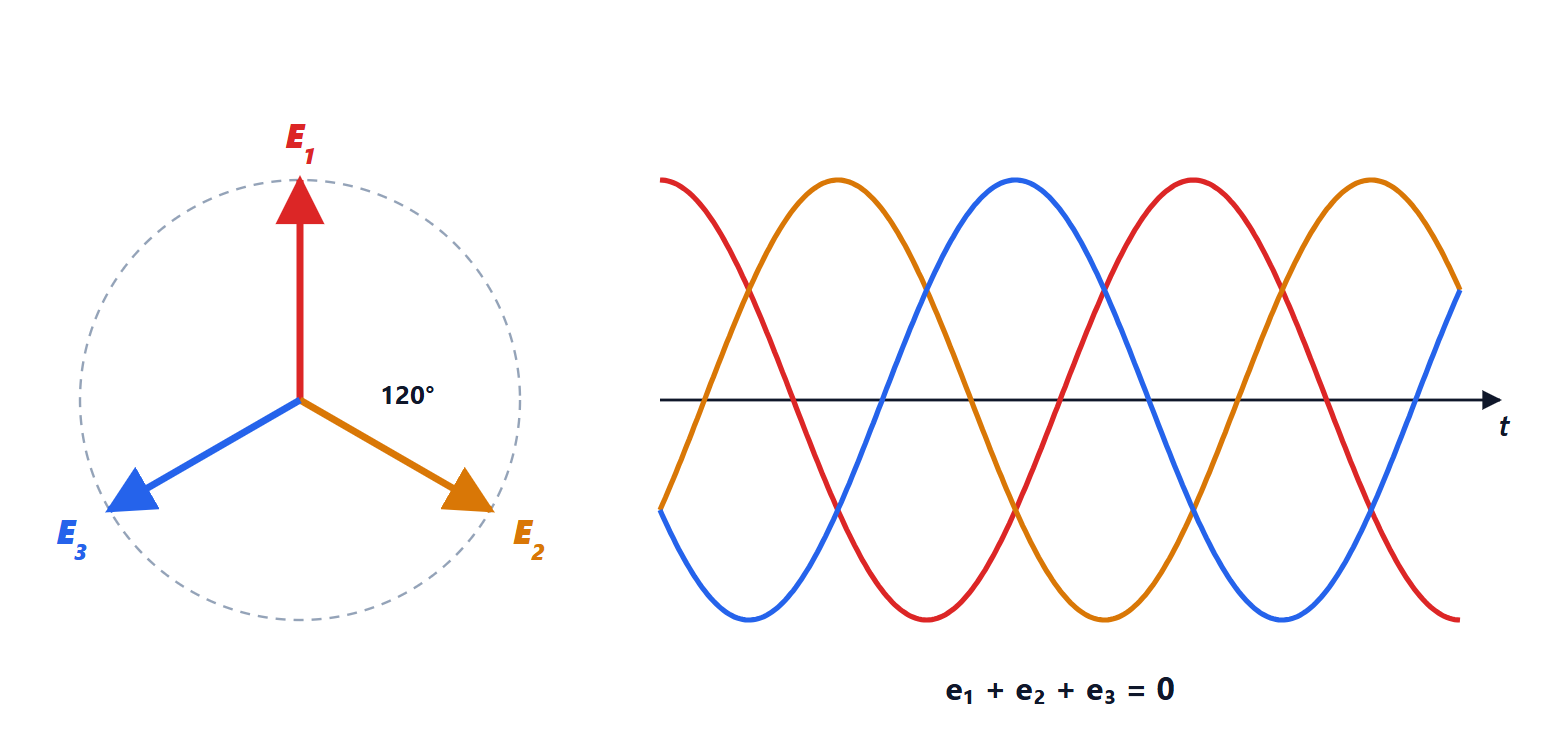
Theorem. The sum of the three voltages of a balanced set is zero at every instant.
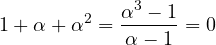
Proof. It is enough to show it for the phasors:  . Since
 and
 ,
Geometrically: three equal vectors at 120° form a closed equilateral triangle. ∎
The star connection
The three windings share one end, the star point (connected to the neutral), and the other three ends go to the line conductors. We distinguish:
- the phase voltages, between each line and neutral:
 ;
- the line voltages, between two lines:
 .
Working it out:  . So

This is where the European grid’s pair of numbers comes from: 230 V between phase and neutral,  V between two phases. In star, the line current equals the phase current.
If the load is balanced (three equal impedances), the three currents also form a balanced set and their sum, that is the neutral current, is zero: the neutral could be removed. In low voltage distribution it is needed anyway, because the single-phase loads of homes are never perfectly balanced across the phases.
The delta connection
The three windings (or the three load impedances) are connected in a ring and the three corners go to the lines. Now each element sees the line voltage, and the line current is the difference of two phase currents: with the same calculation,

A balanced delta load of impedance  is equivalent to a star load with

This gives star-delta starting of motors: started in star, each winding gets  of the voltage and the line current drops to one third; once running, the motor is switched to delta.
Three-phase power
For a balanced load the power is three times that of one phase. In terms of line quantities, which are the measurable ones, it holds for both star and delta:

Example. A 15 kW motor at 400 V with  draws
 A per line. Single phase at 230 V, the same power would need 76.7 A.
Why three-phase
Constant instantaneous power. In one phase the instantaneous power is  , where
 is 0°, 240° and 480° (that is 120°) for the three phases. The three oscillating terms are 120° apart: they form a balanced set, and by the theorem above their sum is zero. What remains is

which is constant. A three-phase motor gets a constant torque and does not vibrate, unlike a single-phase one, whose power pulses at 100 Hz.
Less copper. For the same transmitted power, voltage between conductors and losses, a three-phase line without neutral uses 75% of the copper of a single-phase one.
Rotating field. Three coils at 120° fed by the balanced set produce a magnetic field of constant magnitude that rotates at grid frequency: it is the principle of the induction motor, the most widespread electric motor in the world, rugged and brushless. Swapping two phases makes the field rotate the other way and the motor reverses.