The magnetic field and the Lorentz force
The Lorentz force, circular motion and cyclotron frequency, spectrometer and velocity selector, the Hall effect, force on a wire, torque on a loop and the electric motor.
Magnets and the compass needle have been known for millennia, but the link between magnetism and electricity was found only in 1820, when Ørsted saw a needle deflected by the current in a wire. The magnetic field acts on moving charges, and it underlies motors, loudspeakers, hard disks and sensors. In this lesson we cover the Lorentz force, the motion of charges in the field, the force on a wire and the torque on a loop.
The Lorentz force
A charge  moving with velocity
 in a magnetic field
 feels the force
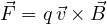
Its magnitude is  , its direction perpendicular to both and , its sense given by the right-hand rule (reversed for negative charges). The unit of
 is the tesla:
 . The Earth’s field is about 50 µT, a neodymium fridge magnet about 0.1 to 0.5 T near its surface, an MRI scanner 1.5 to 3 T.
With an electric field as well, the total force is  .
The magnetic force does no work. It is always perpendicular to the velocity, so  : it can change the direction of motion, but not the speed or the kinetic energy.
Motion of a charge in a uniform field
Proof: the radius and the cyclotron frequency
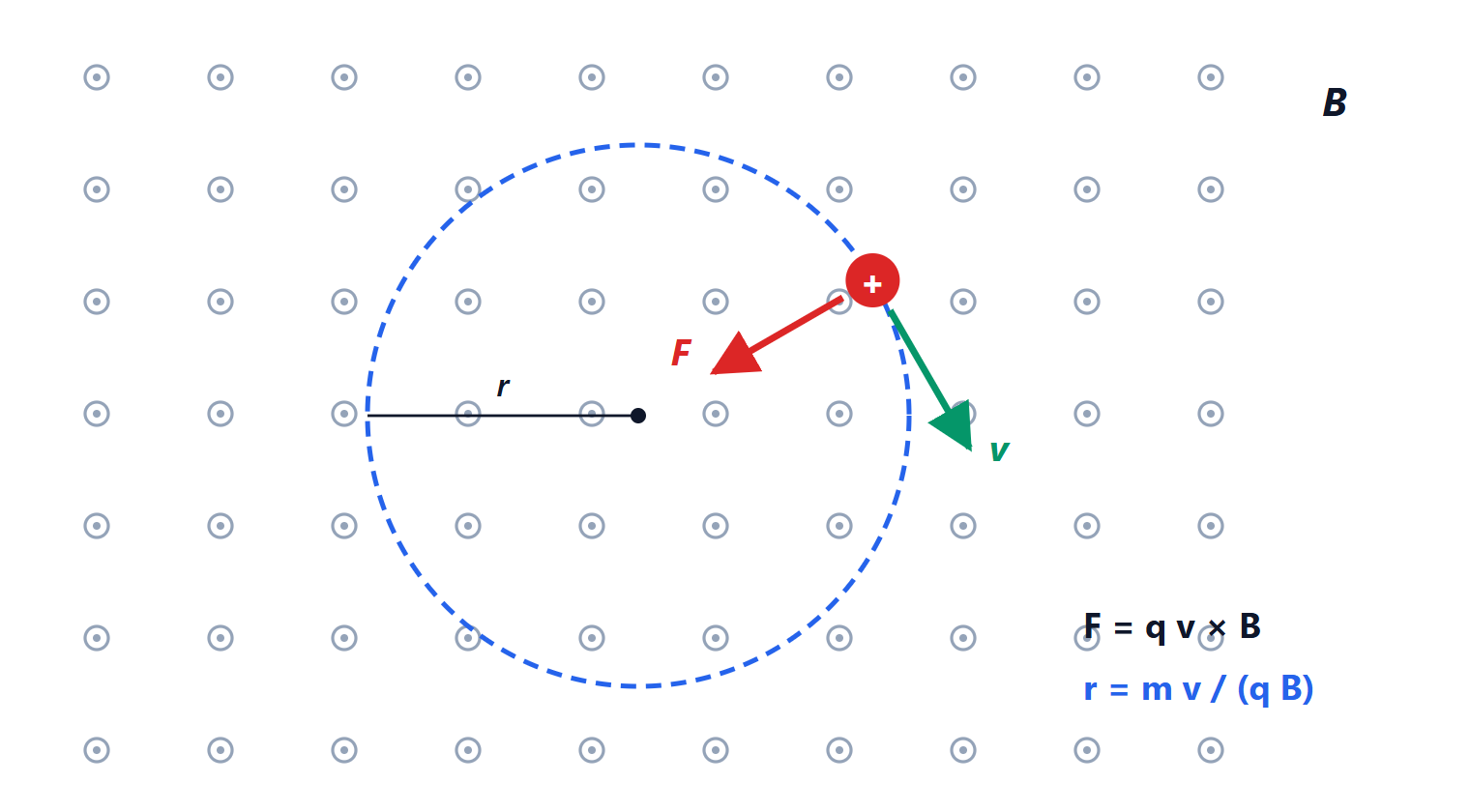
If is perpendicular to , the force has constant magnitude  and is always perpendicular to the velocity: it is the centripetal force of uniform circular motion. Setting them equal:

The cyclotron frequency  does not depend on speed: faster particles make larger circles in the same time. It is the principle of the cyclotron, the circular accelerator. If the velocity also has a component along , that component does not change and the path becomes a helix: this is how solar wind particles are guided by the Earth’s field towards the poles, producing the aurora.
The mass spectrometer. Ions with the same charge and speed, in a field , move in circles with radius proportional to their mass: measuring where they land separates isotopes.
The velocity selector. With  and perpendicular, a particle passes undeflected if
 , that is if
 , whatever its charge or mass.
The Hall effect
In a conductor carrying a current in a perpendicular field , the Lorentz force pushes the charge carriers to one side. Charge builds up until the transverse electric field balances the magnetic force, and the Hall voltage  appears across the sides, with
 the thickness. The sign of
 reveals the sign of the carriers (this is how it was found that in p-type semiconductors positive “holes” carry the current), and its value lets you measure . Hall sensors are everywhere: they read the shaft position in brushless motors, measure current in chargers and detect the lid closing on laptops.
The force on a current-carrying wire
A wire element  carrying current
 contains moving charges, and the sum of the forces on them is

For a straight wire of length  in a uniform field,
 . With 1 T, 10 A and 10 cm the force is 1 N. It is the principle of the loudspeaker: a coil carrying the audio signal current sits in the radial field of a magnet and pushes the cone back and forth.
Torque on a loop: the electric motor
A rectangular loop of area  carrying current , in a uniform field , feels opposite forces on two sides, which form a couple:

 is the loop’s magnetic moment, perpendicular to its plane. The loop tends to rotate until lines up with , like a compass needle. In a DC motor the commutator reverses the current every half turn, so the torque always has the same sense and rotation continues. In the brushless motors of drones and electric cars the same job is done by electronics, switching the currents according to the position read by Hall sensors.