Robotaxis in China in 2026: Baidu Apollo Go, Pony.ai and WeRide
How big the Chinese robotaxi fleets are, how a driverless taxi differs from a car with NOA, the role of remote assistance, and what still slows them down.
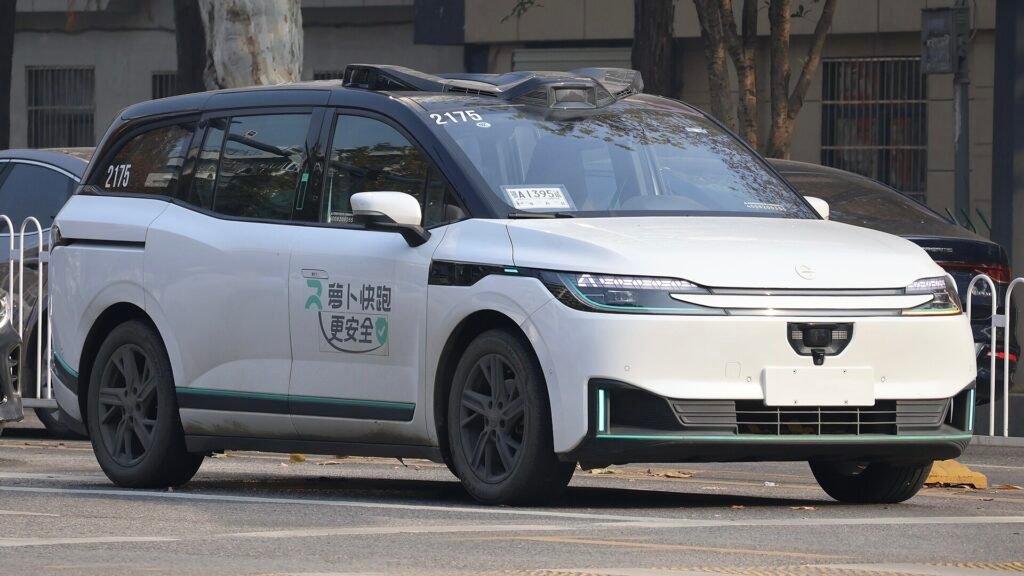
Questo articolo per ora è disponibile solo in inglese. La versione italiana è in preparazione.
Assisted driving in private cars and robotaxis are often mixed up, but they are two different businesses with two different technical problems. A NOA system in a private car must work almost everywhere, with a driver as backup. A robotaxi has no driver at all, but it only has to work inside an area that the operator has mapped, tested and got permission for. In 2026 China is where both are growing fastest. This article looks at the robotaxi side: who operates, how big the fleets are, and what still holds them back.
The three main operators
Baidu Apollo Go is the largest by number of rides. In its results for the first quarter of 2026 Baidu reported 3.2 million fully driverless rides in the quarter, with weekly peaks above 350,000 in March, and more than 22 million rides in total since the start of the service (Baidu). Wuhan is its showcase city, with Beijing and others behind, and the service has started to expand abroad, including Hong Kong and the Middle East.
Pony.ai has focused on fleet size and cost per vehicle. Reports in 2026 put its fleet above 1,700 robotaxis, with a target of more than 3,500 by the end of the year, and quarterly robotaxi revenue in the tens of millions of yuan (iEVChina). Its seventh generation vehicles were designed together with Toyota, GAC and BAIC with the explicit goal of cutting the cost of the self-driving kit.
WeRide runs robotaxis, robobuses and robo-sweepers, and has been especially active outside China, in the Gulf states and Europe. Fleet figures differ between sources, somewhere between 1,300 and 1,800 robotaxis worldwide in spring 2026 (iEVChina).
For scale: these are thousands of vehicles, not hundreds of thousands. A single big city has tens of thousands of taxis and ride hailing cars. The service is real and growing quickly, but it is still a small share of urban transport.
How a robotaxi differs from a NOA car
| Private car with NOA | Robotaxi | |
|---|---|---|
| Level | 2 (driver supervises) | 4 (no driver inside) |
| Where | almost anywhere | inside an approved area |
| Sensors | cameras, sometimes one lidar | several lidars, cameras, radars, redundant computers |
| Backup | the driver | remote assistance centre and a safe stop manoeuvre |
| Cost of the system | a few hundred to a few thousand dollars | tens of thousands of dollars, falling |
The redundancy is the key word. With nobody to take over, the vehicle must be able to detect its own failures (a sensor that stops responding, a computer that freezes, a brake actuator with a fault) and bring itself to a safe stop. That is why robotaxis carry duplicated power supplies, steering and braking control paths, and why their bill of materials is still much higher than a NOA car’s.
The remote operator
“Driverless” does not mean that no human is involved. Every operator has a remote assistance centre. When a car gets stuck, for example in front of a road closure that is not on the map or a traffic police officer giving hand signals, it can ask a remote assistant for guidance: the human suggests a path or confirms that the car may pass, and the car executes it on its own. Remote assistants do not normally drive with a joystick; network delay would make that dangerous. The number of vehicles each assistant can follow is one of the most watched figures in the business, because it decides whether the service can ever make money.
What still holds them back
- Permits city by city. Each city decides where and how robotaxis can operate, often starting with safety drivers on board, then without, then with paid rides, then airport and highway access. Every step needs months of data.
- Public acceptance. Robotaxis drive cautiously, and traffic jams caused by a hesitant car get onto social media quickly. In Wuhan the arrival of cheap robotaxi rides also caused protests from taxi drivers.
- Economics. Fares in China are low. To be profitable a robotaxi has to be cheap to build, last many years, and need very little remote help. The new generations of vehicles from Baidu, Pony.ai and WeRide are all designed around that goal.
- The long tail. Each new city brings situations the system has never seen. The training methods based on world models and reinforcement learning, which I describe in this article, are as important for robotaxis as for private cars.
Two roads that are getting closer
Until recently, robotaxi companies and NOA suppliers used different methods: the former relied on detailed maps and many sensors, the latter on cameras and huge amounts of fleet data. In 2026 the two are converging. Robotaxi companies use end to end models trained on large datasets, while carmakers such as BYD talk openly about Level 3 and Level 4 for private cars. The first Level 3 permits for private cars, granted in December 2025, are described in the article on China’s new rules.




