Self-driving cars: the first UN rules for ADS
The UNECE WP.29 forum adopted a UN Regulation and a GTR on automated driving systems. What they require, and why safety cannot be proven on the road alone.
https://www.electronics-engineering.com/en/un-ece-first-un-rules-automated-driving-systems-2026/
On 24 June 2026, in Geneva, the UNECE World Forum for Harmonization of Vehicle Regulations (WP.29) adopted the first international rules for automated driving systems (ADS), including fully driverless vehicles. For those who design sensors, control units and software for cars this is a change of perspective: it is no longer enough for a function to pass a test; one must demonstrate, with data and methods, that the system remains safe for the whole life of the vehicle.

What happened
WP.29 met in its 199th session from 23 to 26 June 2026. The rules adopted are actually two parallel texts, prepared by the GRVA working group: a new UN Regulation on automated driving systems, indicated by several sources as UN Regulation No. 185, and a new Global Technical Regulation (GTR No. 26). Two texts are needed because there are two different international agreements:
- The 1958 Agreement: UN Regulations are the basis of type approval. A vehicle approved under a regulation is recognised by the other countries that apply it. According to the law firm Bennett Jones, these include the European Union, Japan and South Korea, among others.
- The 1998 Agreement: GTRs are a harmonised reference that each country transposes into its own laws. It is the route for countries such as the United States and Canada, which use manufacturer self-certification instead of prior approval.
The text is supported by Canada, China, the European Union, Japan, the United Kingdom and the United States. Together, WP.29 amended about ninety existing UN Regulations so that they also apply to vehicles with an ADS, including those without traditional controls such as a steering wheel and pedals.
The main requirements
- Safety case: the manufacturer must demonstrate, with arguments and evidence, that the system does not present an unreasonable risk.
- Safety management system subject to audit, covering the whole life cycle of the system and the supply chain.
- A level of safety at least equal to that of a competent and attentive human driver.
- Complete dynamic driving task: steering, acceleration, braking, lights and signalling, in compliance with the traffic rules.
- Validation on several pillars: simulation in validated virtual environments, track tests and road tests.
- In-service monitoring with reporting of critical events and a data recording system (DSSAD, Data Storage System for Automated Driving).
According to the Bennett Jones summary, the framework covers automation levels 3, 4 and 5, also requires cybersecurity controls and a procedure for software updates, and excludes software that changes its own behaviour by itself during use.
Why it matters: safety is not proven by driving alone
“At least as safe as a good driver” sounds like a simple requirement. The problem is statistical: serious accidents are rare events. In the United States, in 2023, NHTSA recorded 1.26 deaths per 100 million miles travelled. Suppose a fleet of automated cars drives  kilometres without any fatal accident, and that accidents are independent random events (Poisson model) with frequency
 per kilometre. The probability of observing none is

To be able to say, with confidence  , that the true frequency does not exceed the human one, this probability must be at most
 . It follows the so-called “rule of three”:

With the NHTSA figure,  per mile: about 240 million miles are needed, that is about 380 million kilometres, without even one fatal accident, just to say that the system is not worse than a human being. To prove that it is better, even greater distances are needed.
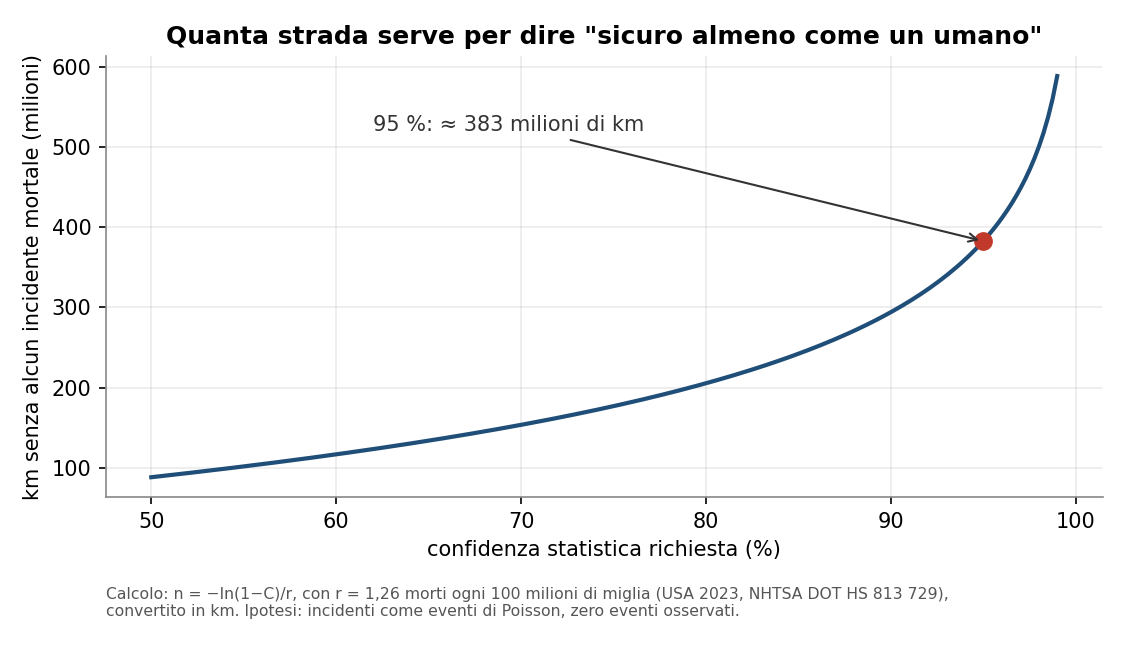
It is the same conclusion as the RAND study “Driving to Safety” of 2016: automated cars would have to drive hundreds of millions, sometimes hundreds of billions of miles to demonstrate their safety through driving alone, and even with aggressive testing assumptions the existing fleets would take decades or centuries. That is why the regulation does not ask for a number of kilometres, but for a safety case: a structured argument that combines validated simulations, track tests, road tests and data collected in service.
What changes for those who design electronics
- Traceability: every safety requirement must be linked to evidence and data, from the sensor architecture down to the software.
- Credible simulation: a virtual environment counts only if it is validated. Sensor, scenario and vehicle models must be compared with real measurements.
- Data recording: the DSSAD requires memory, time stamping and data integrity in the control units, with a direct impact on the hardware.
- Updates: every version of the software must fall within the safety case, so controlled and documented update processes are needed.
- In-service data: the fleet becomes a measuring instrument. Critical events must be detected and reported, and systems must be designed to do so.
How to read the news
“First global rules” does not mean that from tomorrow driverless cars will run everywhere. The GTR does not automatically change national laws: each country of the 1998 Agreement decides whether and how to transpose it, and the Sidley law firm already observed in March that the United States is unlikely to copy the UN text word for word. The UN Regulation, instead, enters the type-approval system of the countries that apply it, and the European Union will have to include it in its own rules. Even the sources on the date of entry into force do not entirely agree: UN News spoke of about a month, other sources of a wider application in 2027. The FIA, which represents motorists, described the text as “the beginning of an evolving regulatory framework”, not as the final validation of the technology.
What to follow
In the coming months, the guidance and interpretation document expected from UNECE should be followed, along with the transposition into European type approval, the national rules for levels 3 and 4 that China is preparing on the basis of the UN text, and the work of Transport Canada and NHTSA. For those working in the sector, the practical message is already clear: the safety of an automatic system is designed together with the tools to demonstrate it.
Sources
- Connected Automated Driving, “UNECE adopts first-ever global rules allowing fully autonomous vehicles”: connectedautomateddriving.eu
- UN News, 24 June 2026: news.un.org
- GlobalAutoRegs, documents of the 199th WP.29 session on the UN Regulation and the GTR for ADS: globalautoregs.com
- Bennett Jones, “First Global Regulatory Framework For Autonomous Vehicles” (August 2026): bennettjones.com
- Sidley, the ADS GTR and the United States (March 2026): sidley.com
- FIA, “First UN Global Regulations on Automated Driving Systems Adopted”: fia.com
- NHTSA, DOT HS 813 729 (May 2025), fatality rate 2023: crashstats.nhtsa.dot.gov
- RAND, Kalra and Paddock, “Driving to Safety” (2016): rand.org