Riemann hypothesis: at least 67% of the zeros lie on the line
An Anthropic model raised the share of zeta zeros proven to lie on the critical line from 41.6% to 67.2%. What it means, and why the hypothesis remains open.
https://www.electronics-engineering.com/en/riemann-hypothesis-at-least-67-percent-zeros-on-critical-line/
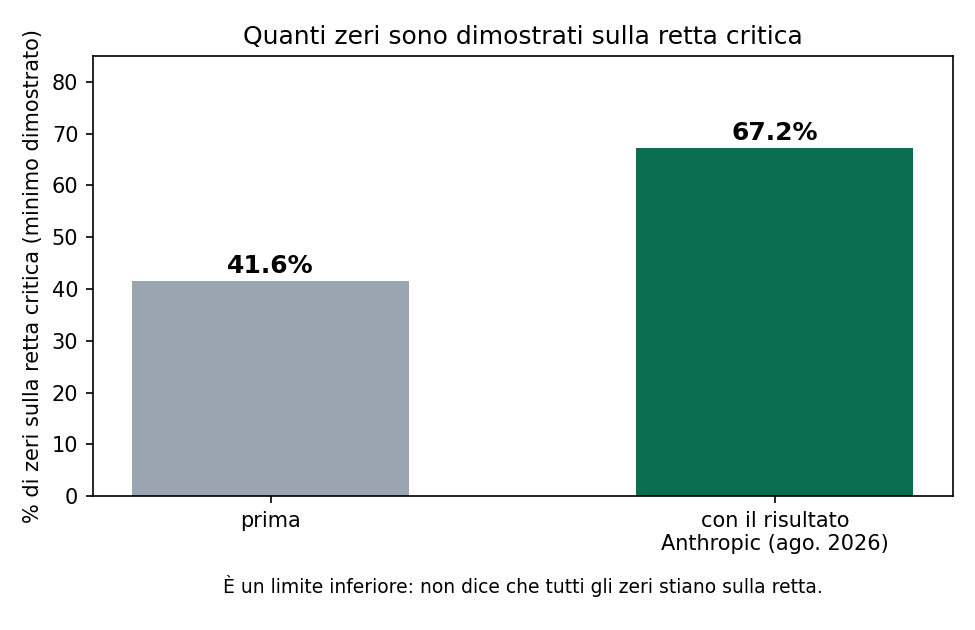
On 10 August 2026 Anthropic published a result that went around the world: an unreleased research version of its Claude model, set to work on the most famous problem in number theory, the Riemann hypothesis, did not prove it. It did, however, raise considerably a bound that mathematicians had known for a long time: the minimum share of zeros of the zeta function that we know lie on the critical line, which rose from 41.6% to 67.2%. It is a real step forward, and a mathematician has already taken it up and re-proved it more simply, but it is not the solution of the problem. In this article I explain why the problem matters, how we got here and what was done at a high level, without going into the details a mathematician needs to check a proof.
How many prime numbers are there?
Prime numbers are the numbers that have only two divisors: 1 and themselves. They are the building blocks of all other numbers, and the cryptography we use every day for payments and communications rests on the difficulty of factoring large numbers into their prime factors. A simple question has concerned them forever: how many are there up to a given number  ? We call it
 .
No simple exact formula exists, but around 1800 Gauss and Legendre noticed that grows roughly like  . The graph shows the true curve of the primes, the estimate and the logarithmic integral
 , a more precise estimate.
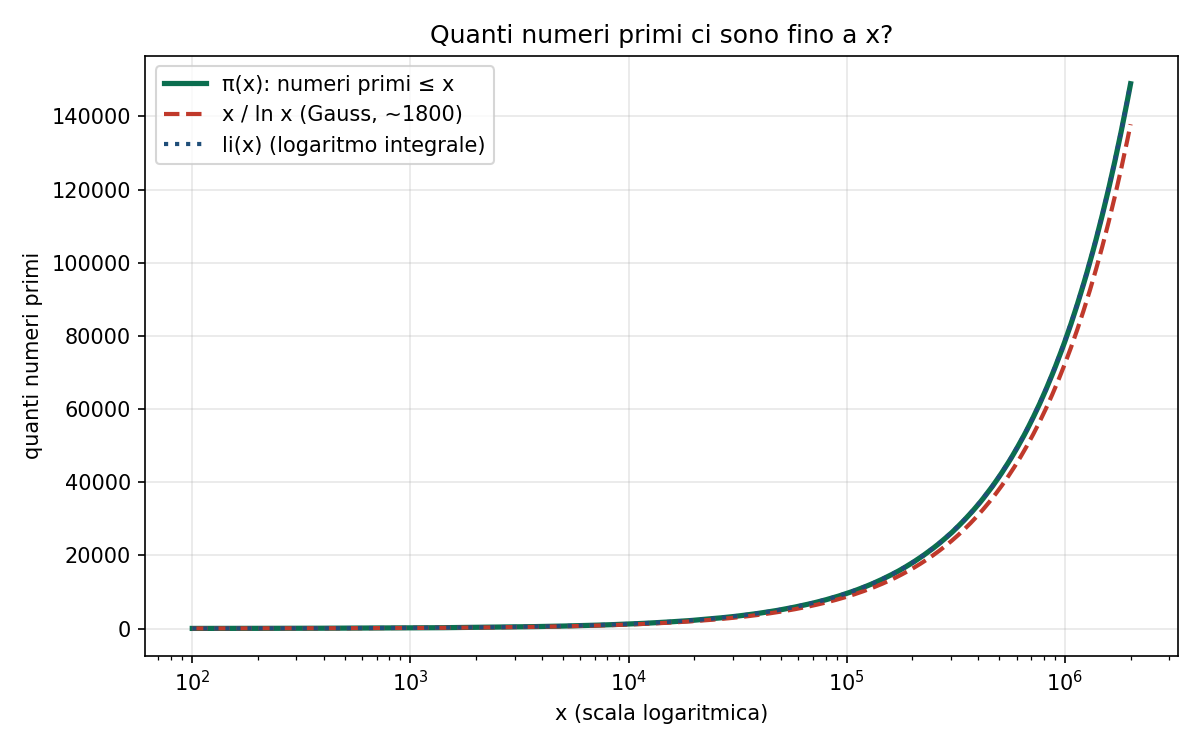 , computed with the sieve of Eratosthenes up to two million. The estimate is always a bit below; the logarithmic integral is much closer.
With  there are 78,498 prime numbers: gives 72,382, the logarithmic integral 78,628. The result proved in 1896 by Hadamard and de la Vallée Poussin, the prime number theorem, says that the estimate is right in the sense that the ratio between the two quantities tends to 1 as grows:
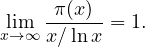
But it does not say how wrong the estimate is for a specific . And it is precisely the error, the difference 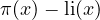 , that hides the deeper question.
Riemann’s move: connecting the primes to a function
In 1859 Bernhard Riemann, in a paper of only a few pages, took a step that changed mathematics. He studied the zeta function, defined for complex numbers  with real part greater than 1 by
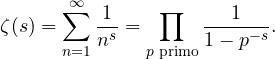
The equality between the sum and the product, which Euler had already discovered, links every prime number to the function: expanding each factor of the product as a geometric series and multiplying, every integer appears exactly once, thanks to the unique factorisation into primes. Riemann showed that  can be extended to the whole complex plane (except the point
 ) and that it vanishes for certain precise values, the zeros. The “trivial” zeros are the negative even numbers. All the others lie in the strip between 0 and 1, and the information about the primes is encoded in their position.
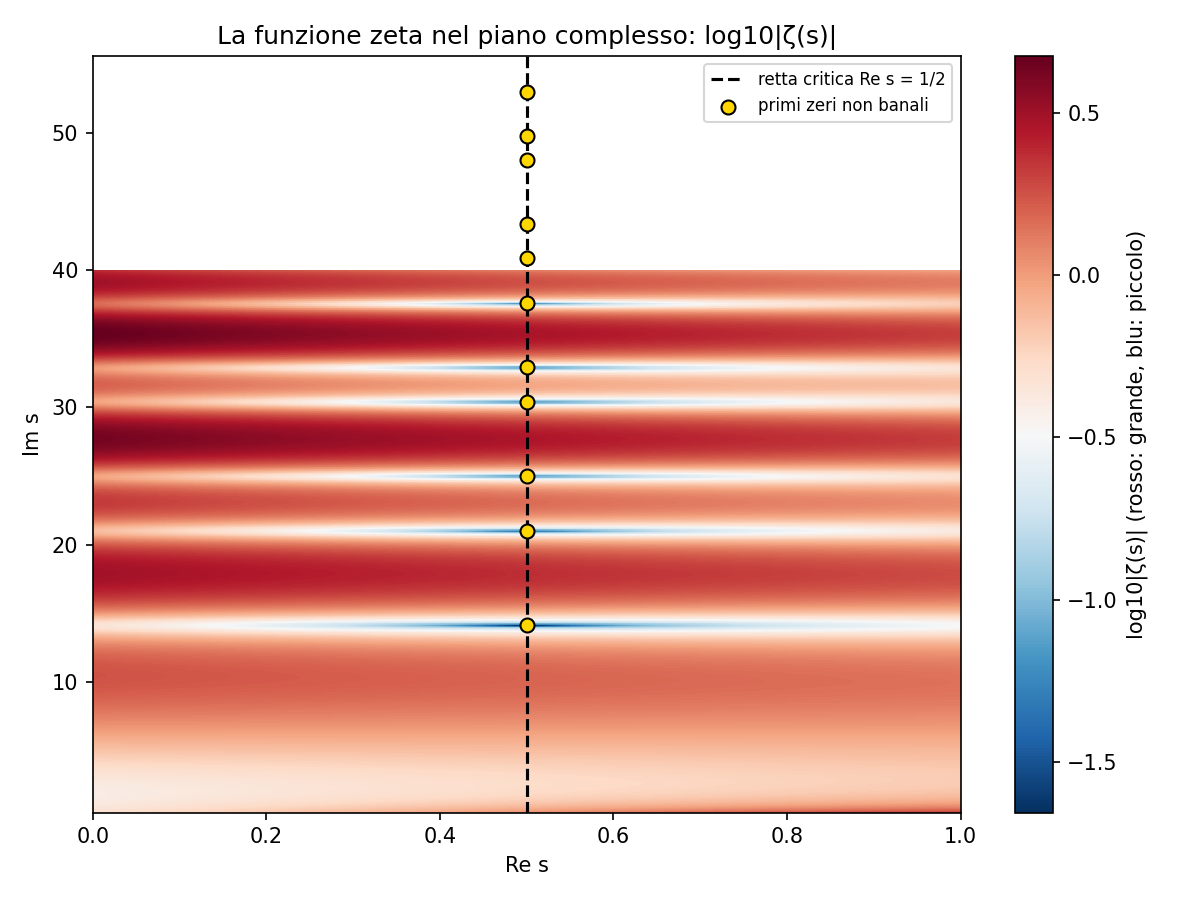
 . The colour shows
 : red where the function is large, blue near the zeros. The golden spheres are the first zeros, all on the line
 .
The graph makes the question visible. The zeta function is defined in the half-plane  with the series above, and in the whole plane by analytic continuation. In the critical strip
 its size behaves in a complicated way, and the zeros are the points where the colour drops towards
 . Riemann’s question is whether all these points lie on the dashed line.
The Riemann hypothesis
Riemann conjectured that all the non-trivial zeros have real part equal to  : they all lie on the critical line
 . If the conjecture were true, the distribution of the primes would be as regular as possible. In 1901 von Koch in fact showed that the hypothesis is equivalent to an estimate of the error:

That is why the Riemann hypothesis is one of the seven Millennium Problems of the Clay Mathematics Institute, with a prize of one million dollars for whoever proves it. For more than 160 years nobody has managed it.
The calculations, however, are all on its side. In 2021 Dave Platt and Tim Trudgian verified with interval arithmetic, that is with controlled rounding errors, that the first 12,363,153,437,138 non-trivial zeros, up to height  , all lie on the line and are all simple. The problem is to prove it for all the infinitely many zeros: no calculation, however large, can do that.
For the critical line there is a real function, known as Hardy’s Z function:  is the value of
 , corrected by a phase factor, and it is always real. Its zeros are exactly the zeros of zeta on the line. The graph shows that changes sign precisely at those points. Counting the sign changes of is the simplest way to find zeros on the line, and it was the idea with which Hardy, in 1914, proved that there are infinitely many of them.
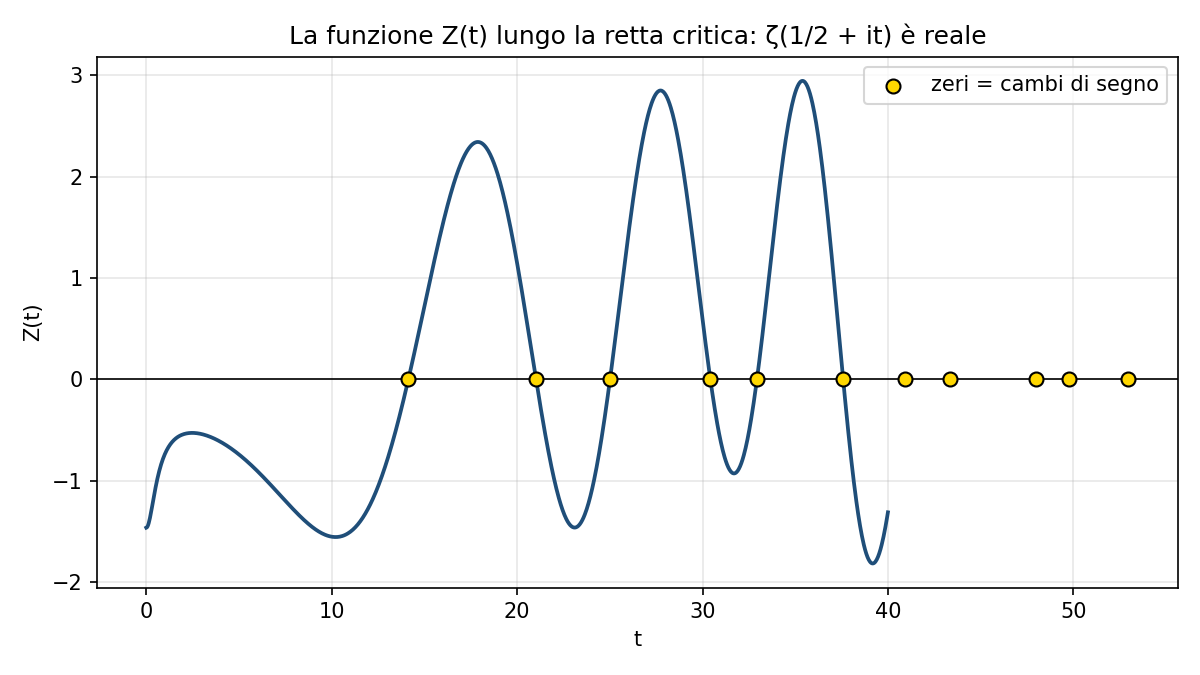 along the critical line. Each sign change corresponds to a zero of zeta. The first ones are at
 ,
 ,
 ,
 ,
 .
Two standard formulas give an idea of how many zeros to expect and how they are linked to the primes. The number of zeros with imaginary part between 0 and  is about
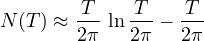
The link with the primes is Riemann’s explicit formula, in simplified form: the function  , which adds the logarithm of the primes and of their powers up to , is given by

where the sum runs over the non-trivial zeros  . Each zero contributes a wave of amplitude
 . If all the zeros have real part , each contribution is of order
 , and the error in the distribution of the primes is at most of order
 . For an engineer the analogy is natural: the primes are a signal, the zeros are its frequencies, and the Riemann hypothesis says that no “harmonic” has an amplitude that grows more than necessary.
How many zeros do we know lie on the line?
Unable to prove that all the zeros lie on the line, mathematicians have tried to prove that at least a certain fraction of them do. If  counts the zeros on the critical line with imaginary part between 0 and , the quantity of interest is
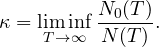
The Riemann hypothesis implies  . Proving a lower bound for
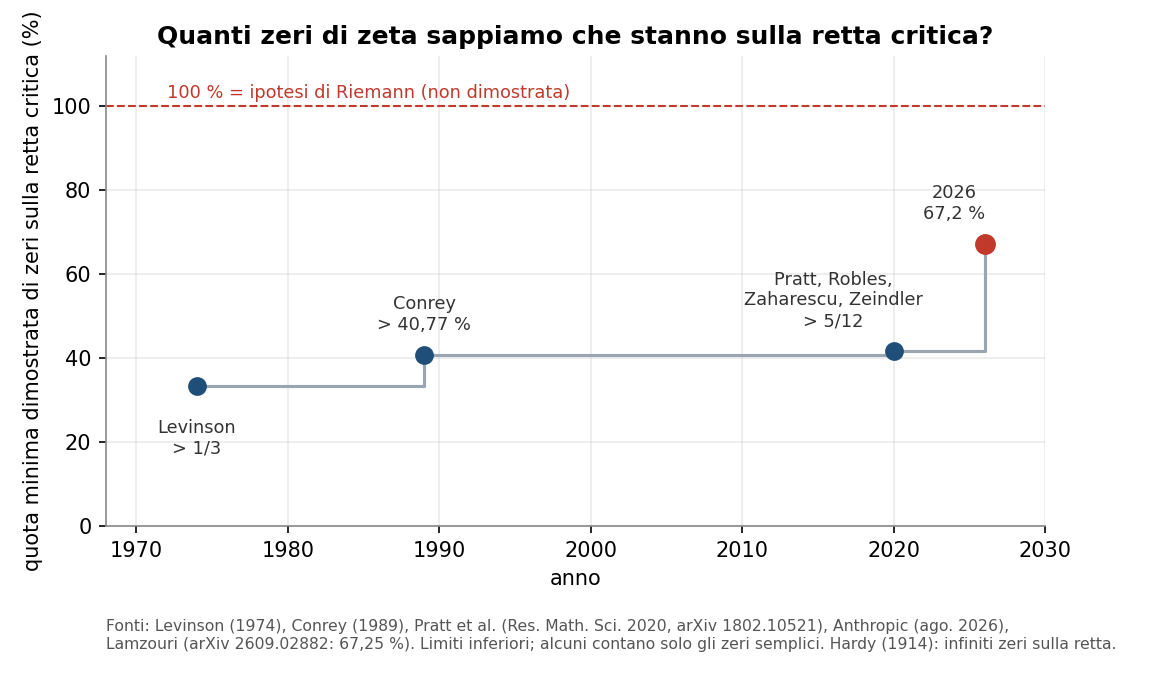
 says nothing about the remaining zeros: a limit of 67% does not mean that the other 33% lie off the line, it only means that for that 33% we do not know yet. In 1942 Selberg proved that is positive. In 1974 Levinson showed that it is at least one third; in 1989 Conrey reached over 40.77%; in 2018 Kyle Pratt, Nicolas Robles, Alexandru Zaharescu and Dirk Zeindler slightly exceeded five twelfths, about 41.7% (work published in 2020). In almost fifty years, with ever more refined techniques, the bound had risen by less than ten points.
What happened in 2026
According to Anthropic’s account, Jarred Sumner, an employee of the company who is not a mathematician, asked a research version of Claude to “really try” the Riemann hypothesis, then intervened almost only with encouragement. The work took place in two sessions. In the first, the model explored about 650 ideas, none of which worked. In the second, lasting about a day and a half, it coordinated some sixty sub-agents, ran about 2,400 commands and wrote hundreds of Python scripts. In total, the two sessions produced about 31 million tokens. The result is not the conjecture but a new lower bound: from 41.6% to 67.2% of the zeros on the critical line.
The declared checks are of three kinds. The sub-agents reviewed the proofs, looked for counterexamples, compared the work with 54 arXiv papers to rule out that it was already known, and re-proved the result independently. Two Anthropic mathematicians, Levent Alpöge and Ralph Furman, studied and validated the paper and wrote an explanatory note. Eric Easley produced a formalisation in Lean, a language that checks proofs automatically, which goes beyond the comparison tool used to verify it. Brian Conrey and Dan Goldston, two specialists in the field, examined the paper at short notice: Anthropic thanks them, but the page does not say that they gave a formal approval. The company itself recommends that the results be validated by a number theorist. The text was updated on 13 August 2026 with a clearer version of the proof.
How it worked, at a high level
The method did not come out of nothing. In 1973 Hugh Montgomery studied the “pair correlation” of the zeros, that is how the distances between neighbouring zeros are distributed, but assuming the Riemann hypothesis. Later works, by Aryan and then by Baluyot, Goldston, Suriajaya and Turnage-Butterbaugh, obtained versions of these techniques that work without assuming it. The 2026 contribution was to combine these results and exploit them in a new way. Anthropic’s popular text describes the method in words; the precise formulas are in the full paper, which an expert must read line by line. In summary:
- A space of functions with a quadratic form. One considers a set of functions linked to the zeros of zeta, with a quadratic form introduced by Weil, that is a rule that assigns a number to each function.
- Sign of the form. The zeros on the critical line generate subspaces where the form is positive, those off the line subspaces where it is negative. Bounding the dimension of the negative part gives a minimum on the number of zeros on the line.
- Estimate of the rank. The rank of the form is bounded using information about the first and second moments, that is the mean and the spread of certain quantities linked to the zeros.
- The new step. According to Anthropic, the key was to treat the space as a whole and allow a non-diagonal quadratic form, instead of estimating one piece at a time.
An engineering idea helps to understand the third point. If you know only the mean and the variance of a set of numbers, you can already say how many of them can be far from the mean (this is the logic of Chebyshev’s inequality). Something similar happens here: the moments of the pair correlation limit how many zeros can behave “badly”, and therefore how many must lie on the line.
Lamzouri’s confirmation and the later work
On 2 September 2026 Youness Lamzouri published on arXiv (paper 2609.02882) “a new proof that more than 2/3 of the zeros of the Riemann zeta function are simple and on the critical line”. In the abstract he states it explicitly: the bounds for simple zeros on the line and for distinct zeros were obtained for the first time by an internal research version of Claude and verified by Alpöge and Furman. Lamzouri’s contribution is a simpler proof: instead of a framework with finite-dimensional matrices, it uses a single inequality in a Hilbert space, which allows the unconditional form of Montgomery’s pair-correlation theorem by Baluyot, Goldston, Suriajaya and Turnage-Butterbaugh to be applied directly. He thus obtains over 67.25% of simple zeros on the line, at least 83.62% of distinct zeros and two new results, including that at least 88.76% of the zeros are simple or on the line.
So this is not a confirmation “from a completely different route”: the two proofs rest on the same foundations. But a second proof, shorter and written by a specialist, makes the result much easier for the community to check. In October 2026 Cristian Cobeli and Alexandru Zaharescu then proved (arXiv 2610.23467) that more than 8/9 of the zeros are simple or on the critical line. Pay attention to the connective: “simple or on the line” is a weaker statement than “on the line”, and must not be read as 89% of zeros on the critical line.
How to read the news
- It is not a proof of the Riemann hypothesis. Anthropic states this clearly and adds that it does not expect the techniques used to lead to a proof.
- It is a lower bound. The 67.2% says how many zeros we know for certain lie on the line, not how many there are.
- 41.6% or 41.7%? The previous bound is “a little more than 5/12”, that is about 41.67%; Anthropic gives it as 41.6%. They are the same result written with different rounding.
- Human checking. The Lean formalisation and Lamzouri’s simpler new proof are strong signals, but final acceptance goes through journal refereeing and the work of the community.
Between “67.2% of the zeros are proven to lie on the line” and “all zeros lie on the line” there remains a mathematical abyss. But the leap from less than 42% to over two thirds, after decades of small steps, is nonetheless remarkable.
Why it matters anyway
The result is interesting for two reasons. The first is mathematical: a higher bound is new information about the behaviour of the zeros, and therefore of the primes, and the technique has already generated other results within a few weeks. The second concerns artificial intelligence: it is one of the first documented cases in which a model contributes a new result in pure mathematics, with a verifiable formalisation and the control of experts. Here too caution applies: Anthropic published the paper, the note, the formalisation and the transcripts precisely so that others can check them.
What to follow
The next steps are the publication of the works in journals, with referee review, and possible improvements of the bound with the same ideas. Also worth following is the formalisation: a public Lean archive allows anyone to check that every step is correct, provided that the starting statements faithfully translate the known results used as a basis.
To go further
- The announcement and the paper from Anthropic: anthropic.com/research/riemann-zeta
- The Lean formalisation: github.com/anthropics/zeta-23-lean
- Y. Lamzouri, “A new proof that more than 2/3 of the zeros of the Riemann zeta function are simple and on the critical line”, arXiv 2609.02882: arxiv.org
- K. Pratt, N. Robles, A. Zaharescu, D. Zeindler, “More than five-twelfths of the zeros of ζ are on the critical line”, arXiv 1802.10521: arxiv.org
- D. Platt, T. Trudgian, “The Riemann hypothesis is true up to 3·10^12”, arXiv 2004.09765: arxiv.org
- C. Cobeli, A. Zaharescu, “More than 8/9 zeros of the Riemann zeta function are simple or on the critical line”, arXiv 2610.23467: arxiv.org
- The Millennium Problem on the Riemann hypothesis, Clay Mathematics Institute: claymath.org
- On this site, the lesson on the distribution of prime numbers and the zeta function in the Analysis course.