6G, the 3GPP timetable: Release 21 and the first radio choices
3GPP has set the dates for Release 21, the first to include 6G: specifications by the end of 2028. Waveform, bandwidth up to 400 MHz and compatibility with 5G.
https://www.electronics-engineering.com/en/6g-3gpp-standardisation-timetable-release-21/
6G does not exist yet, but since June 2026 it has a timetable. At the 3GPP plenary meetings in Singapore the programme of Release 21 was approved, the first that will contain the 6G specifications, and the first decisions on the radio interface were taken. For those who study telecommunications, the most useful news is this: 6G is born very close to 5G, and understanding why helps to understand how a standard is designed.
What happened
3GPP is the consortium that writes the specifications of mobile networks, from 3G to 5G. The work is divided into “releases”, packages of specifications frozen on fixed dates. According to the 3GPP website, the timetable for the first 6G specifications was agreed on 10 June 2026 at the TSG #112 meeting in Singapore, together with the approval of the technical report TR 38.914 and a common vocabulary: 6GR for the radio, 6G RAN for the access network, 6GC for the core network, 6GS for the complete system.
The dates
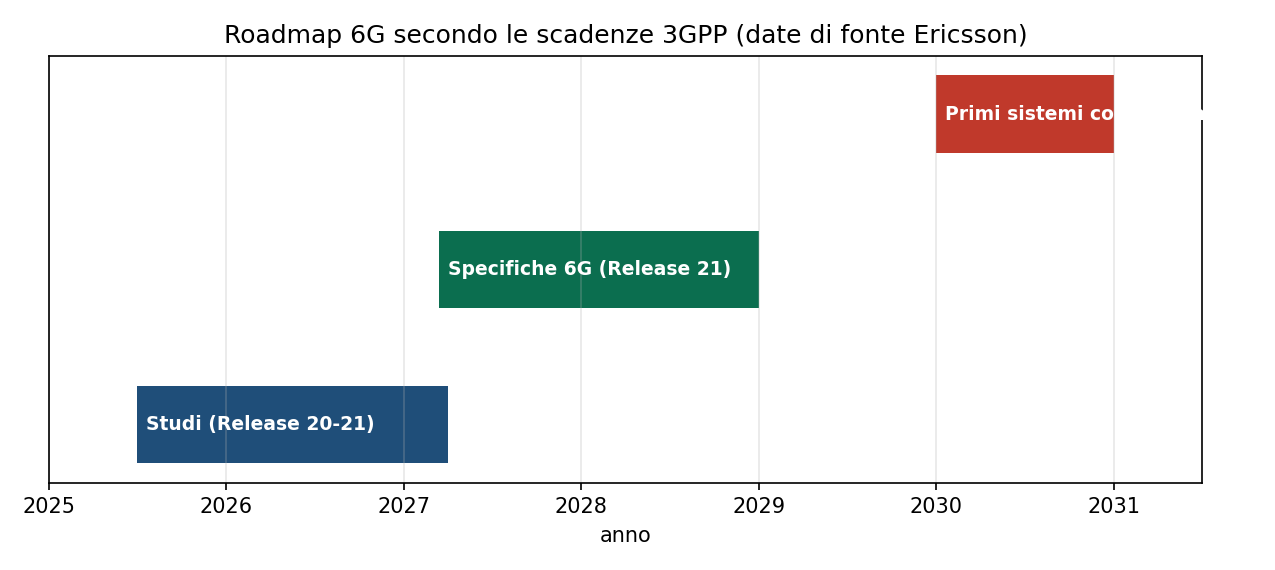
- Studies (Release 20): started in mid-2025, continuing until the first or second quarter of 2027, depending on the area.
- Release 21 specifications: from March 2027 to the end of 2028, followed by about a quarter of review.
- First complete specifications: expected at the beginning of 2029.
- First commercial systems: Ericsson foresees them in 2030.
The decisions on the radio interface
- Waveform: CP-OFDM in downlink; in uplink CP-OFDM and DFT-s-OFDM, the latter now also supported with MIMO in uplink.
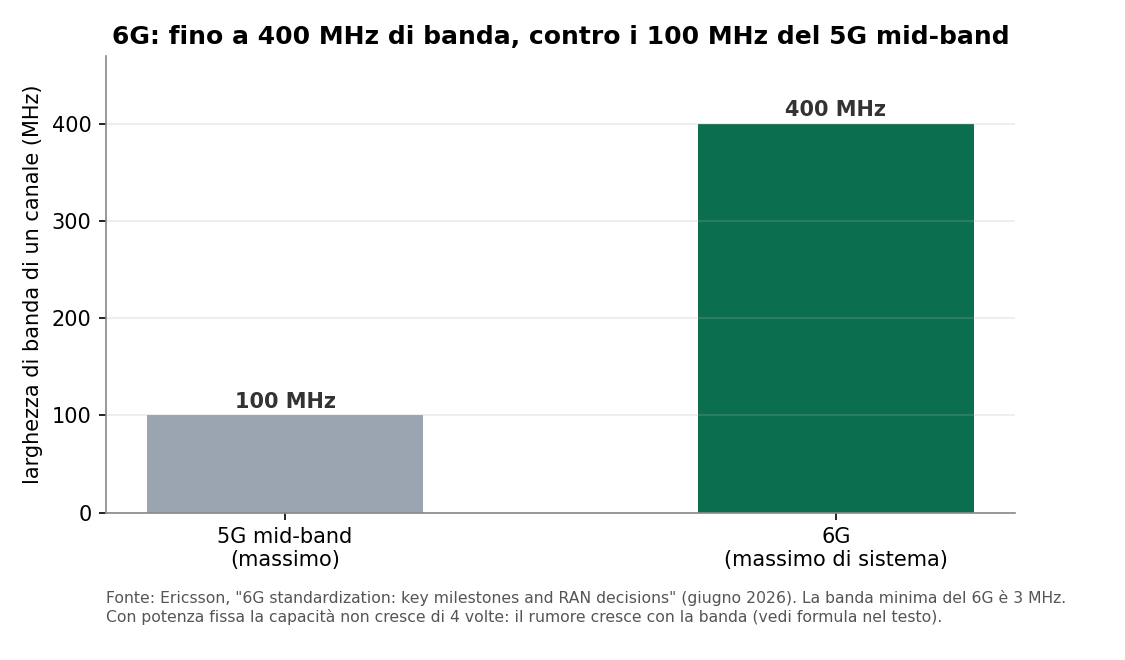
- System bandwidth: from 3 MHz in some bands up to 400 MHz. For comparison, the widest 5G channel in the mid band is 100 MHz.
- Channel codes: largely those of 5G, with some improvements in data coding; the changes for control information are still under discussion.
- Modulation: uniform QAM as the base; variants are being studied, especially for fixed wireless access.
- Frame structure: very similar to that of 5G, to allow spectrum sharing between the two generations.
- Architecture: the reference is a standalone 6G, without dual connectivity to 5G; the base station can be a single unit or split between a distributed unit and a central unit.
Why it matters: the basic choices explained
Why two waveforms in uplink
OFDM divides the channel into many narrow subcarriers, each modulated independently. It is robust against multipath and easy to equalise, but the sum of many subcarriers produces power peaks much higher than the average: a high peak-to-average power ratio (PAPR). For a phone this is a problem, because the power amplifier must work far from saturation and consumes more. DFT-s-OFDM “precodes” the symbols with a discrete Fourier transform before OFDM: the resulting signal resembles a single carrier and has a lower PAPR. It is useful at the cell edge, where the terminal transmits at maximum power. 5G already had both waveforms; 6G keeps them and extends them.
Why a wider band is not enough
Moving from 100 to 400 MHz seems to promise four times the speed. The Shannon formula for the capacity of a channel with white noise says something more precise:
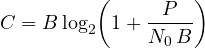
where  is the bandwidth,
 the received power and
 the spectral density of the noise. The total noise
 grows with the bandwidth: if the power stays the same, widening the band lowers the signal-to-noise ratio. A numerical example: with a signal-to-noise ratio of 20 dB (that is 100) over 100 MHz, the capacity is about
 Mbit/s. With the same power over 400 MHz the ratio falls to 25 and the capacity becomes about
 Mbit/s: about 2.8 times, not 4. To exploit wide bands, more power, more antennas and frequencies where there is free spectrum are therefore also needed.
Why a frame similar to 5G
In 5G the subcarrier spacing is scalable according to the “numerology”  :

with frames of 10 ms and slots of 14 symbols. A compatible time-frequency grid makes it possible for 5G and 6G to coexist in the same band, dynamically allocating resources to one or the other. For an operator this means being able to introduce 6G without switching off 5G or freeing new frequencies first. Ericsson reports that longer periods for the reference signals are also being studied, so that base stations can switch off parts of the radio when traffic is low: a concrete way to reduce network consumption.
How to read the dates
3GPP does not work alone. The ITU, the United Nations agency for telecommunications, approved the IMT-2030 framework in November 2023 (Recommendation ITU-R M.2160), with objectives such as peak speeds from 50 to 200 Gbit/s, latencies from 0.1 to 1 ms and new capabilities such as integrated sensing and positioning with accuracy from 1 to 10 cm. Proposals of candidate technologies will be collected by the ITU between February 2027 and February 2029. The 3GPP 6G will in all probability be one of these proposals, but “6G” in the official sense means conforming to IMT-2030.
The dates remain targets: in past generations 3GPP has sometimes moved the freezes by a few months. “First commercial systems in 2030” is an Ericsson forecast, not a 3GPP decision. Some industry sources give different details on the intermediate milestones, so it is always wise to compare them with the official Release 21 timetable page.
What to follow
The next steps are the closing of the 6G radio studies in 2027, the start of the Release 21 work items and the work of the O-RAN Alliance, which began its 6G studies in February 2026 and, according to Ericsson, could follow 3GPP with a three- to six-month delay. Also worth watching are the decisions on frequency bands, which are taken within the ITU and by national authorities and determine how much of that 400 MHz band will really be available.
Sources
- Ericsson, “6G standardization: key milestones and RAN decisions” (2026): ericsson.com
- 3GPP, news on the timetable for the first 6G specifications (TSG #112, 10 June 2026): 3gpp.org
- ITU-R, IMT-2030 page (Recommendation M.2160 and timetable): itu.int
- IEEE ComSoc Technology Blog, “3GPP approves timelines for Release 21” (16 June 2026): techblog.comsoc.org