4D radar for cars: 8x8 chips and ranges over 350 m
TI, Infineon and BYD bring 4D radars with 8 transmitters and 8 receivers on one chip. The radar equation, resolution and MIMO channels to read the ranges correctly.
https://www.electronics-engineering.com/en/4d-radar-cars-2026-8x8-chips-ranges-over-350-m/
In 2026 three chipmakers brought car radars to market with 8 transmitters and 8 receivers on a single chip, and declared ranges between 350 and over 400 metres. These are the “4D” radars: they measure distance, speed, horizontal angle and also the height of objects. For those who study electronics they are an excellent example of how radar physics, MIMO channels and signal processing combine in a single integrated circuit.
What happened
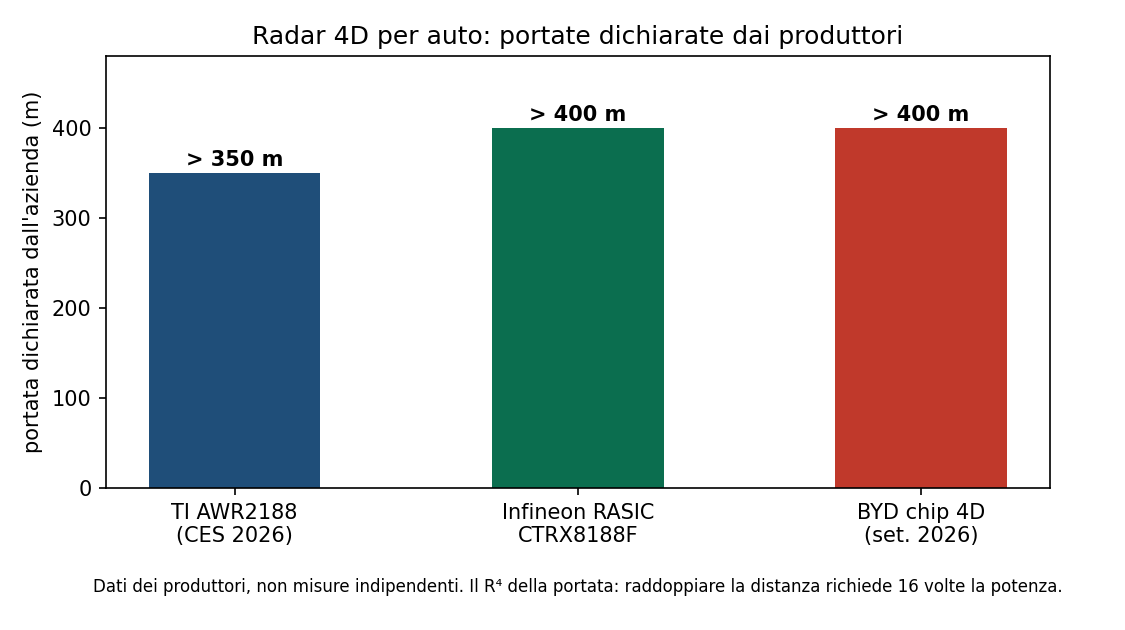
- Texas Instruments presented at CES 2026 (Las Vegas, January) the AWR2188, a transceiver with 8 TX and 8 RX in the 76-81 GHz band, up to 4.5 GHz of continuous chirp bandwidth, 45 nm RFCMOS technology and about 2.8 W of consumption for the front end. TI declares the detection of objects beyond 350 metres and data processing of the converter and chirp generator 30% faster than available solutions.
- Infineon announced on 24 June 2026 the start of production of the RASIC CTRX8188F, which the company defines as the first 8Tx8Rx radar MMIC ready for production. According to Infineon it detects vehicles and vulnerable road users, such as pedestrians and cyclists, up to 400 metres, and can be cascaded to over 32 TX × 32 RX.
- BYD Semiconductor announced on 2 September 2026 the mass production of a 4D radar chip at 28 nm, again 8 TX and 8 RX, with a declared range of over 400 metres, horizontal angular resolution of 0.8°, range resolution of 0.05 m for parking, junction temperature from −40 to 150 °C, ASIL B and AEC-Q100 compliance, for functions from Level 2 to Level 4.
There is also an architectural change. Infineon is pushing “centralised” radars: the sensor sends raw data to the central computer of the vehicle instead of processing it on site. According to the company this reduces the cost of the system; “centralised architectures are redefining the way radars are designed”, said Frank Findeis, head of Infineon’s RF line. The chips remain flexible: the CTRX8188F can also work with edge processing together with an AURIX TC45 microcontroller, TI declares support for “satellite” and edge architectures, and BYD pairs its radar with the central driving chip Xuanji A3.
Why it matters: three formulas to understand a radar
The range grows with difficulty
With a target of radar cross-section  , transmitted power
 , antenna gain
 , wavelength
 and minimum detectable signal
 , the maximum range follows the radar equation:
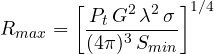
The signal travels the distance twice and is attenuated as  in each direction: that is why the fourth power appears. Doubling the range requires sixteen times the signal-to-noise ratio. Even moving from 350 to 400 metres is not little:
 , that is about 70% more margin. Progress comes from the coherent gain of the MIMO channels, from the lower noise of the receiver (the AWR2188 declares a noise figure of 11 dB) and from longer integration times, more than from power alone.
Range resolution depends on the bandwidth
Car radars use FMCW chirps: linear frequency ramps. Two objects at different distances are separated if the difference of their round-trip times exceeds the inverse of the swept bandwidth  :

With the 4.5 GHz declared by TI,  cm. This is the same order of magnitude as the 5 cm declared by BYD for parking. On the motorway, chirps with less bandwidth and more range are used instead: the total band is limited by regulation to 76-81 GHz, and the choices are a compromise between range, resolution and amount of data.
Angles depend on the virtual channels
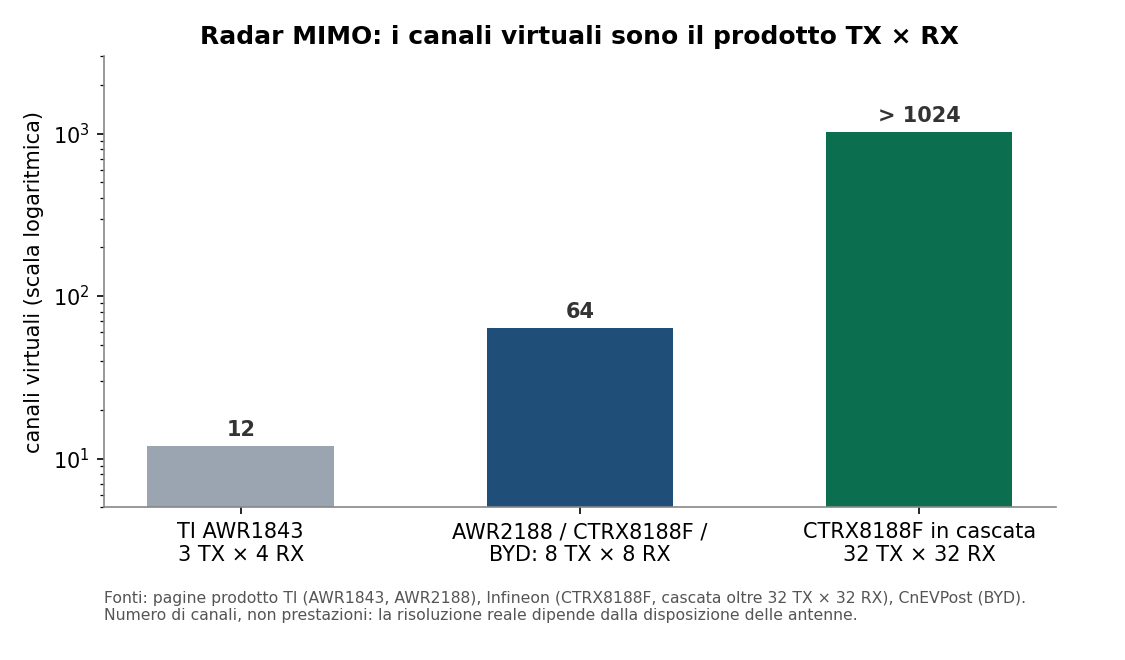
In a MIMO radar each transmitter-receiver pair behaves like a “virtual” antenna in a different position. The number of virtual channels is the product:

An 8 × 8 chip gives 64 virtual channels, against the 12 of a previous-generation radar such as the TI AWR1843 (3 TX, 4 RX). If all 64 elements were in a single row, the theoretical angular resolution would be about  rad, a little under 2°. But a 4D radar must also measure height, so the virtual antennas must be distributed both horizontally and vertically, often with sparse arrays and high-resolution algorithms. For this reason the number of channels is not enough to predict the declared resolution: how they are arranged matters.
The fourth dimension, speed, comes from the Doppler effect: an object approaching with radial velocity  shifts the frequency by
 . At 77 GHz, with
 mm, a car at 100 km/h produces a shift of about 14 kHz, easy to measure with a series of chirps.
How to read the figures
- The range is a catalogue figure. It holds under reference conditions, for a certain target and a certain probability of detection and false alarm. A car has a radar cross-section that varies a lot with the viewing angle, a pedestrian a much smaller one, and rain attenuates the signal.
- “Up to” and “over” are not the same thing. Infineon says “up to 400 m”, BYD “over 400 m”, TI “over 350 m”: without the detection curves it cannot be said who sees further.
- “First” is a company definition. Infineon speaks of the first 8Tx8Rx MMIC ready for production, but TI had presented an 8 × 8 chip already in January: the date of mass production counts, not the slogan.
- The declared resolutions (0.8° and 0.05 m for BYD) depend on the operating mode: fine resolution and maximum range are usually not obtained with the same chirp.
Anyone evaluating a radar for a project should ask for the detection probability curves as a function of distance for standard targets, the noise figure and the actual output power, and the test data in rain. This information is usually in the full datasheets, sometimes available only under a confidentiality agreement.
What to follow
To watch: the first production vehicles that will fit these chips, independent performance comparisons, and the evolution of centralised radars, which move the computing load and the bandwidth of the data links towards the central computer of the vehicle. In China regulation also matters: Infineon declares that its chip meets the RF requirements of the Chinese GB standard for Level 2 driving assistance.
Sources
- RF Wireless World, TI 4D imaging radar launch: rfwireless-world.com
- EE Journal, Infineon RASIC CTRX8188F in production: eejournal.com
- CnEVPost, BYD mass production 4D radar chip (Sept. 2026): cnevpost.com
- Texas Instruments, AWR2188 product page: ti.com
- Texas Instruments, CES 2026 press release “TI accelerates the shift toward autonomous vehicles”: nasdaq.com
- Texas Instruments, AWR1843 product page: ti.com
- Infineon, CTRX8188F product page: infineon.com