The second law of thermodynamics: heat engines, the Carnot cycle and entropy
Heat engine efficiency, the Kelvin and Clausius statements, proof of the Carnot efficiency, refrigerators and heat pumps, entropy and its microscopic meaning.
The first law says that energy is conserved, but it does not say which way things go. A cup of coffee cools down in a room; it never warms up on its own by taking heat from the cooler air, even though energy would still be conserved. The second law is the law that sets this direction. It explains why no engine can turn all the heat it receives into work, and it introduces one of the deepest quantities in physics, entropy.
Heat engines and efficiency
A heat engine works in a cycle: it absorbs heat  from a hot reservoir, turns part of it into work
 and gives the rest,
 , to a cold reservoir. At the end of the cycle it is back in its initial state, so
 and by the first law
 . The efficiency is the fraction of heat turned into work:
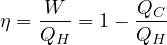
A petrol engine has a real efficiency of around 25 to 35%, a combined-cycle power plant reaches 60%.
Statements of the second law
- Kelvin-Planck: no process is possible whose sole result is to turn into work heat taken from a single reservoir. Every heat engine must give some heat to a colder reservoir:
 .
- Clausius: no process is possible whose sole result is to move heat from a colder body to a hotter one. A refrigerator does it, but by consuming work.
The two statements are equivalent. If a machine violating Kelvin existed, its work could drive a refrigerator, and the pair would move heat from cold to hot with no other effect, violating Clausius. The reverse argument works the same way.
The Carnot cycle
In 1824 Sadi Carnot asked what the highest efficiency of an engine working between two temperatures  and
 could be. The answer is an ideal, reversible cycle made of four processes:
- A → B: isothermal expansion at , the gas absorbs ;
- B → C: adiabatic expansion, the gas cools from to ;
- C → D: isothermal compression at , the gas gives off ;
- D → A: adiabatic compression, the gas returns to .
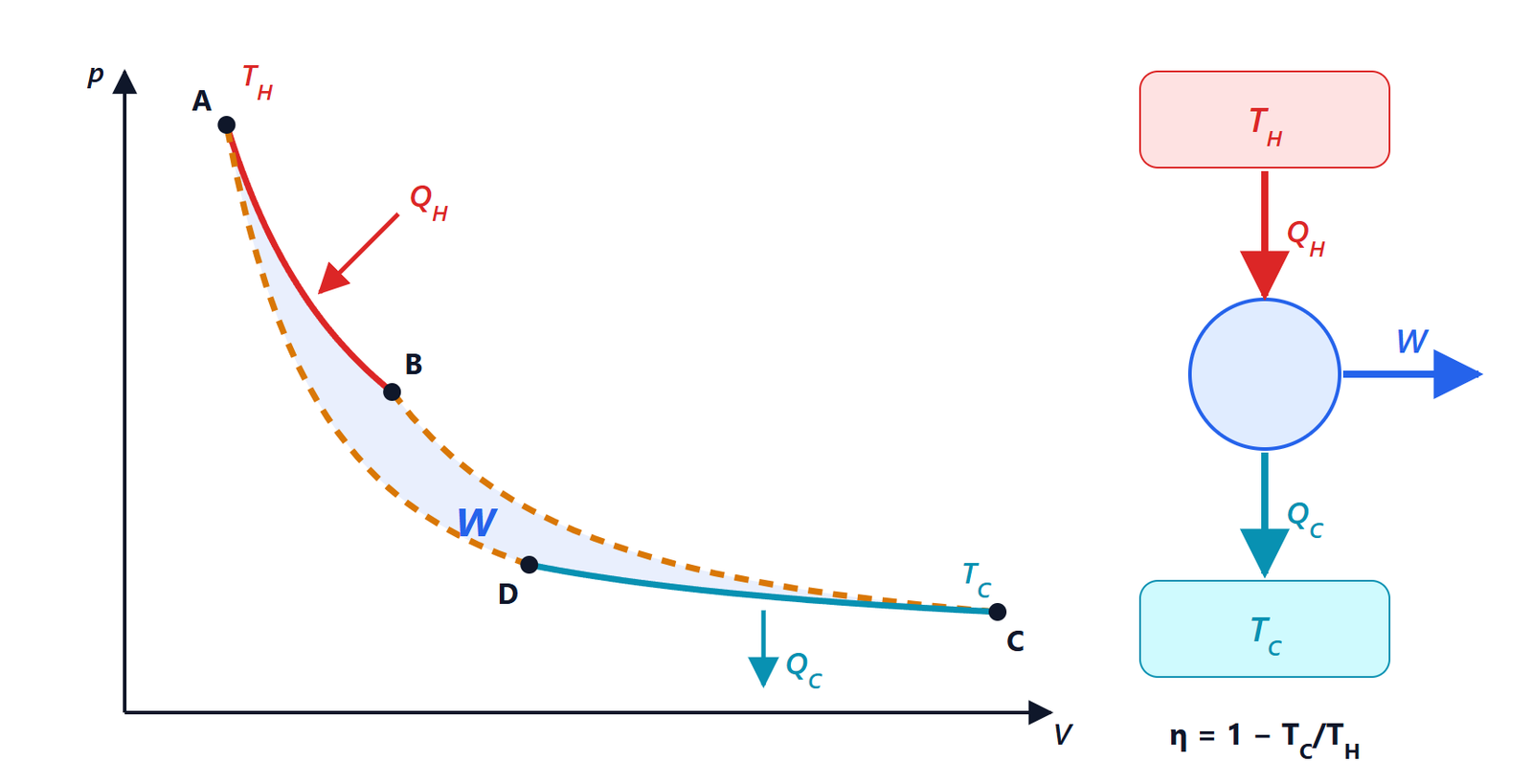 , light blue at ) and two adiabats (dashed). The enclosed area is the work produced in one cycle. Right, the scheme of every heat engine: heat from the hot reservoir, work out, heat to the cold reservoir.
Proof: the Carnot efficiency
With an ideal gas, along the isotherms and heat equals work (previous lesson):

Along the adiabats  (it follows from constant
 with
 ):

Dividing one by the other,  , so
 : the two logarithms are equal and cancel.

Temperatures must be in kelvin. Carnot’s theorem states that no engine working between the same two temperatures can be more efficient, and that all reversible engines have this same efficiency, whatever substance they use.
Example. A steam turbine with steam at 550 °C (823 K) and a condenser at 30 °C (303 K) has  . Real plants reach about 40%: friction, heat transfer across finite temperature differences and other irreversibilities eat up the rest. To improve efficiency the only fundamental route is to raise or lower .
Refrigerators and heat pumps
Running the cycle backwards spends work to move heat from cold to hot. Performance is measured by the coefficient of performance (COP):

A heat pump warming a house to 20 °C by taking heat from outside air at 0 °C has an ideal COP of  ; real ones reach 3 to 4. That still means each kWh of electricity puts 3 to 4 kWh of heat into the house, while an electric heater gives exactly one.
Entropy
From the Carnot cycle we found  . Counting heats with their sign (positive when they enter), the sum of
 around the reversible cycle is zero. Clausius extended this result to any reversible cycle,
 , and concluded that there is a state function, entropy
 :
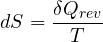
To compute  between two states you pick any reversible process connecting them: since it is a state function, the result does not depend on the path.
Proof: entropy of an ideal gas
For a reversible process, the first law gives  . Dividing by
 and using
 :

Free expansion. A gas is shut in half of an insulated container, the other half is empty. The partition is removed: the gas fills the whole volume, doing no work and exchanging no heat, so its temperature does not change. Yet entropy grows:  . The process never reverses on its own; nobody has ever seen a gas gather by itself in half of a room.
The principle of increasing entropy
For an isolated system entropy cannot decrease:

It is zero only for reversible processes, which are an ideal limiting case. All real processes (friction, heat flowing between bodies at different temperatures, mixing, free expansion) increase the entropy of the universe. This is what gives time a direction.
Example. 1 kg of water at 80 °C is mixed with 1 kg at 20 °C. The final temperature is 50 °C (323 K). With  : the hot water loses
 J/K, the cold water gains
 J/K. The total is
 J/K: the entropy of the universe has increased, and the process is irreversible.
The microscopic meaning
Boltzmann gave entropy a statistical meaning:

where  is the number of microscopic configurations compatible with the observed macroscopic state. A gas spread through the whole room can be arranged in vastly more ways than one squeezed into a corner: the second law simply says that systems evolve towards the most probable states. The same formula, with a base-2 logarithm, underlies Shannon’s information theory, and the entropy of a signal in bits measures its information content.