Thermodynamics: temperature, heat and the first law
System and state variables, temperature and the ideal gas, specific heat and calorimetry, work on the p-V diagram, the first law, Mayer's relation, isotherms and adiabats, heat transfer.
Thermodynamics studies heat, work and how one turns into the other. It was born with steam engines, but today it is as useful for sizing a processor’s heat sink as for understanding an engine. In this lesson we define the basic concepts (system, state, temperature, heat) and arrive at the first law, applied to the processes of ideal gases.
System, surroundings and state variables
A thermodynamic system is the part of the universe under study: the gas in a cylinder, the water in a pan, a chip. Everything else is the surroundings. The system is closed if it exchanges no matter with the surroundings, isolated if it exchanges no energy either.
The state of a system in equilibrium is described by a few state variables: pressure  , volume
 , temperature
 , amount of substance
 . Quantities such as internal energy, which depend only on the state and not on how it was reached, are called state functions. Heat and work are not: they depend on the process.
Temperature and the zeroth law
Two bodies in contact exchange energy until they reach thermal equilibrium. The zeroth law says that if A is in thermal equilibrium with C and so is B, then A and B are in equilibrium with each other. This is what makes the thermometer possible: C is the thermometer, and temperature is the quantity that bodies in equilibrium share.
In the SI temperature is measured in kelvin. The scale starts at absolute zero:  . A difference of 1 K is the same as a difference of 1 °C.
The ideal gas
A dilute gas, far from condensing, follows quite closely the equation of state

One mole of gas at 0 °C and 1 atm takes up 22.4 litres. Microscopically, temperature measures the average kinetic energy of the molecules: for a monatomic gas 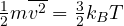 , with
 J/K. At room temperature nitrogen molecules travel at about 500 m/s.
Heat, specific heat and changes of phase
Heat  is energy passing from one body to another because of a temperature difference. To warm a mass
 by
 you need

where  is the specific heat: 4186 J/(kg·K) for water, about 900 for aluminium, 385 for copper. Water has one of the highest specific heats of all, which is why it is used as a coolant.
During a change of phase the temperature stays constant and the heat goes into breaking bonds:  , with
 the latent heat. Melting ice takes 334 kJ/kg, boiling water at 100 °C a hefty 2257 kJ/kg.
Calorimetry example. A 0.2 kg copper block at 150 °C is dropped into 0.5 kg of water at 20 °C. The heat given up by the copper equals the heat absorbed by the water:  . Solving,
 °C. The copper drops by 125 degrees, the water rises by less than 5.
The work done by a gas
A gas in a cylinder with a piston of area  pushes with force
 . If the piston moves by
 , the gas does work
 . For a finite process:
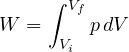
On the – diagram the work is the area under the curve of the process. It is positive if the gas expands (does work on the surroundings), negative if it is compressed.
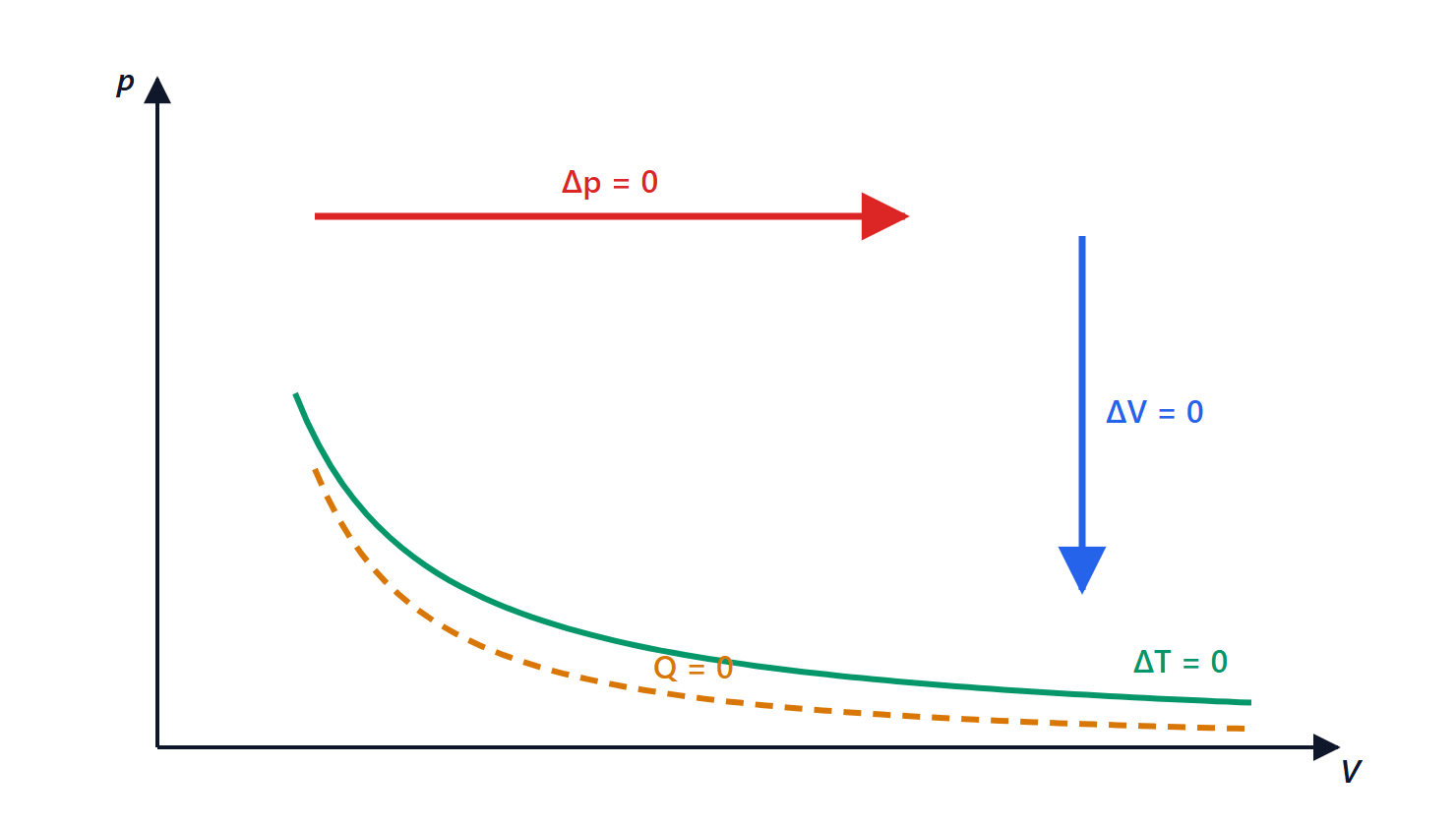 – diagram: isobaric (constant pressure, red), isochoric (constant volume, blue), isothermal (constant temperature, green) and adiabatic (no heat exchange, dashed orange), steeper than the isotherm.
The first law of thermodynamics
The system has an internal energy  , the sum of the kinetic and potential energies of its molecules. It can change in two ways: by receiving heat or by doing work. With the convention that is positive when it enters the system and
 is positive when done by the system:

It is energy conservation extended to heat. Joule showed it experimentally around 1845, turning a paddle wheel in water with a falling weight: the mechanical work warmed the water in exact proportion. The law rules out perpetual motion of the first kind, a machine producing work out of nothing.
Internal energy and specific heats of the ideal gas
For an ideal gas the internal energy depends only on temperature. For a monatomic gas  , for a diatomic gas such as air at room temperature
 . In general
 , where
 is the molar specific heat at constant volume.
Proof: Mayer’s relation
At constant volume the gas does no work, so all the heat goes into internal energy:  . At constant pressure the gas expands and does work
 (from the equation of state). The heat needed is therefore

The ratio  is 5/3 for monatomic gases and 7/5 = 1.4 for air.
Processes of the ideal gas
| Process | Constant | Work | Heat |
|---|---|---|---|
| isochoric | |  |  |
| isobaric | |  |  |
| isothermal | |  |  |
| adiabatic |  |  | |
Proof: work in the isothermal process
At constant temperature  , so : all the heat received becomes work. With
 :

Proof: the adiabatic equation
With no heat exchange,  , that is
 . Differentiating the equation of state,
 . Take
 from the first and substitute:

Since  , dividing by
 and integrating:

Because  , the adiabat is steeper than the isotherm, as the figure shows. A bicycle pump warms up because fast compression is nearly adiabatic: the work done on the gas raises its temperature. Diesel engines ignite their fuel exactly this way, without a spark plug: compressing air about 18 times takes it above 500 °C.
How heat travels
- Conduction: through a material, with no bulk motion. In a slab of thickness
 , area and conductivity
 the heat flow is
 (Fourier’s law). Copper has
 W/(m·K), air 0.026: that is why thermal paste between a processor and its heat sink is essential, it replaces the air in the microscopic gaps.
- Convection: the heated fluid moves and carries the heat away; natural if density differences move it, forced if there is a fan.
- Radiation: every body emits electromagnetic waves with power
 (Stefan-Boltzmann law). It works in a vacuum too: it is how the Sun warms the Earth.
For electronics people the analogy with Ohm’s law is useful: temperature difference plays the role of voltage, heat flow that of current, and the ratio 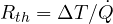 (in K/W) is a thermal resistance. A MOSFET dissipating 10 W with a total junction-to-ambient resistance of 5 K/W, in 40 °C surroundings, has its junction at
 °C. Thermal resistances in series add up, just like electrical ones.