Power cycles: Brayton, Rankine and the combined cycle
The Carnot limit, the gas-turbine Brayton cycle with proven efficiency, the steam-plant Rankine cycle, reheating, the combined cycle and cogeneration.
Almost all the world’s electricity comes from heat engines repeating a cycle: steam power stations (coal, nuclear, concentrated solar, geothermal) use the Rankine cycle, gas turbines and aircraft engines the Brayton cycle, modern power stations combine them. In this lesson we study them on the T-s diagram, derive the efficiency of the Brayton cycle and see why the combined cycle reaches 60%.
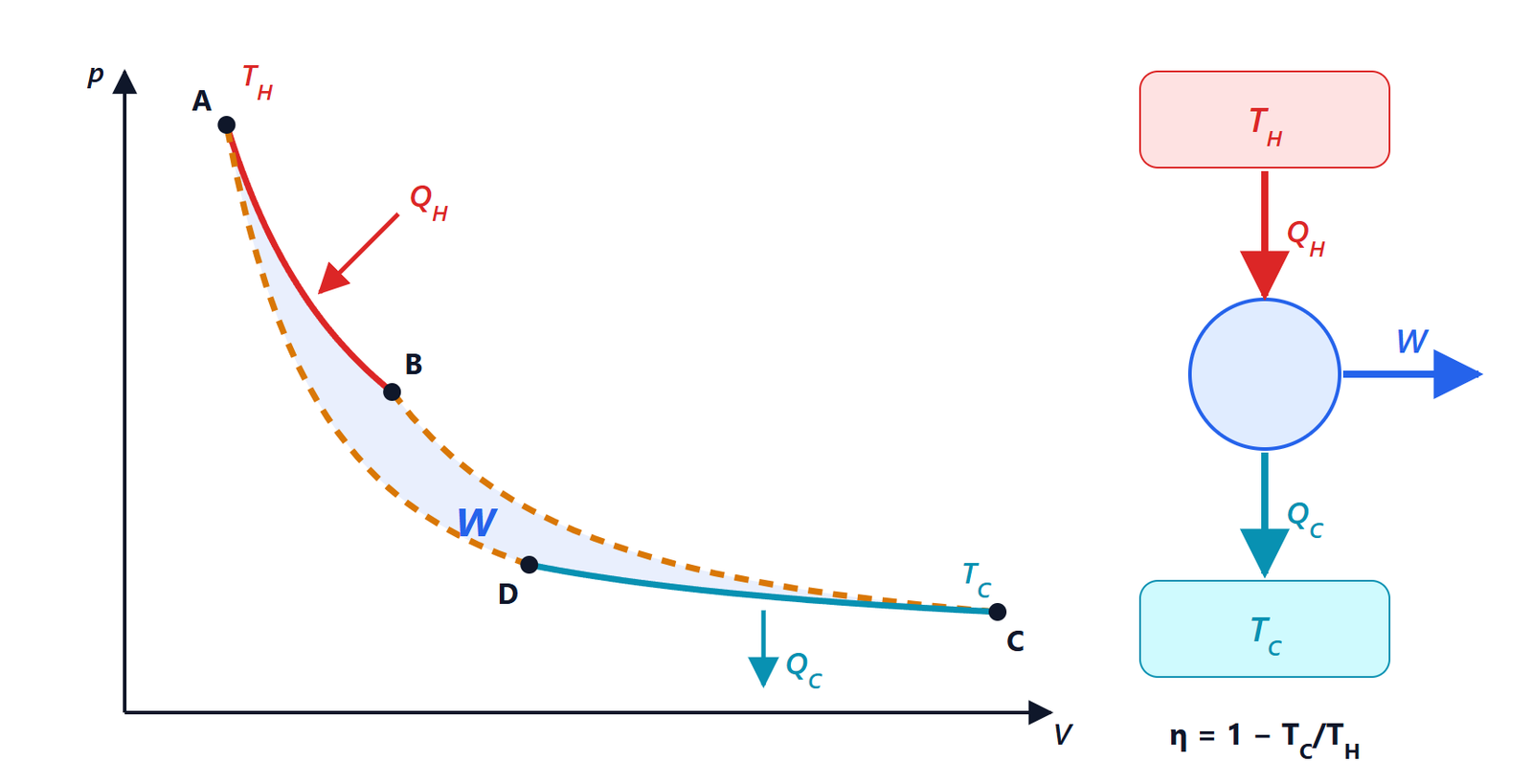
The Carnot limit
As seen in Physics 1, no engine working between a hot source at  and a cold one at
 can exceed the Carnot efficiency,
 . Two consequences drive the whole design of power stations: heat should be supplied at the highest possible temperature and rejected at the lowest possible one.
The Brayton cycle
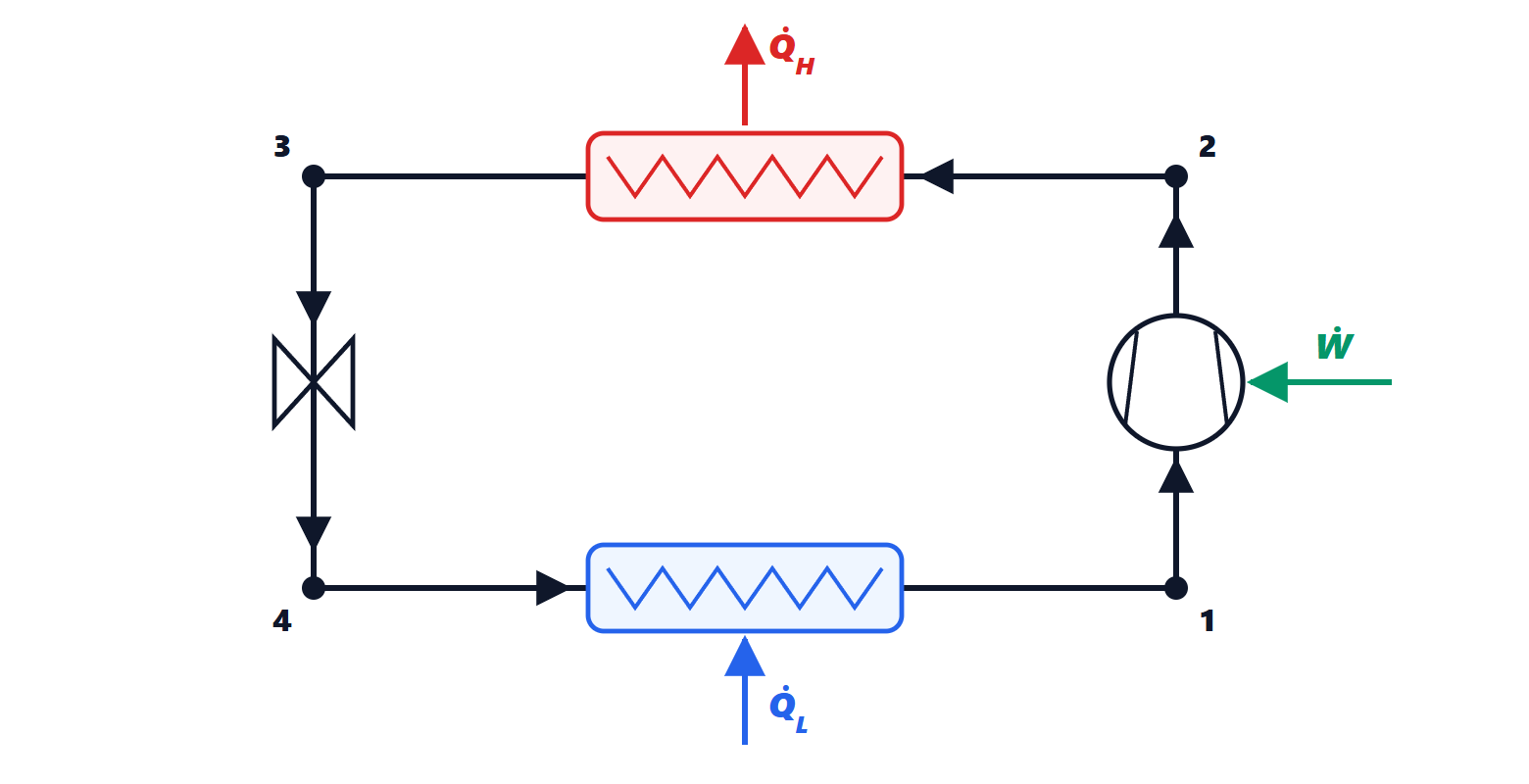
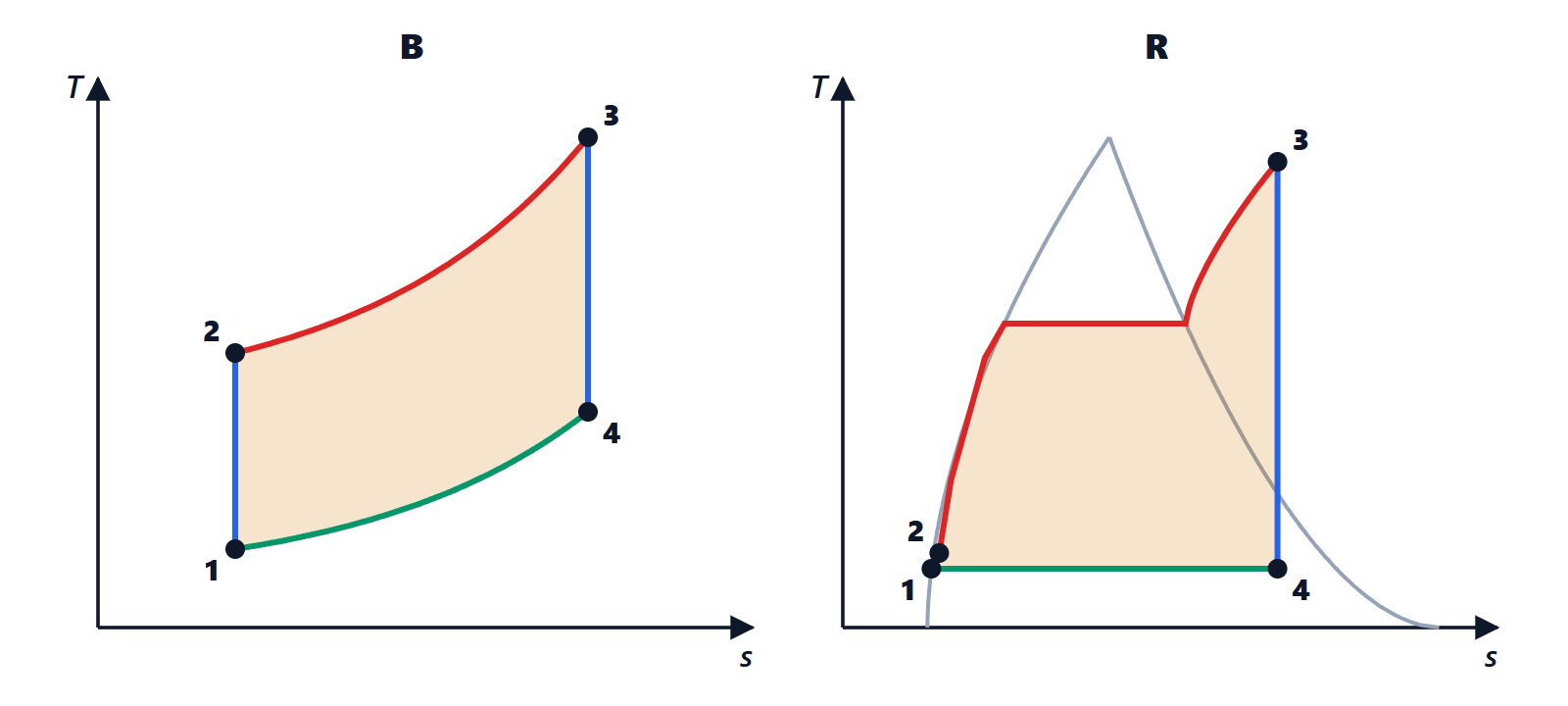
It is the cycle of gas turbines: a compressor draws in air and compresses it (1-2), fuel is burnt at constant pressure in the combustion chamber (2-3), the hot gases expand in the turbine (3-4), which also drives the compressor, and are discharged (4-1, ideally the cycle closes with constant-pressure cooling).
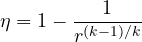
Theorem. For the ideal Brayton cycle with an ideal gas of constant specific heats and pressure ratio  :
Proof. Heat enters in 2-3 and leaves in 4-1, at constant pressure:  ,
 . Processes 1-2 and 3-4 are isentropic between the same pressures, so
 . Then

because  . With
 the formula follows. ∎
Example. Air ( ) with
 :
 ; with
 , 57.5%. Real machines get less, 35 to 40%, because of the isentropic efficiencies of compressor and turbine, and above all because the gases leave the turbine still very hot, at 500 to 600 °C.
The Rankine cycle
It is the cycle of steam power stations:
- a pump brings liquid water to boiler pressure (1-2), with little work because the liquid is almost incompressible;
- in the boiler the water heats up, evaporates and the steam is superheated (2-3);
- the steam expands in the turbine (3-4), producing work;
- in the condenser the steam turns back to liquid, giving heat to the cooling water (4-1).
The big advantage over Brayton: pumping a liquid takes minimal work, whereas compressing a gas takes a significant share of the turbine’s work. And condensation happens at a constant, low temperature, close to ambient (30 to 40 °C, at a pressure of a few hundredths of a bar). Typical efficiencies range from 33% for nuclear stations (steam at about 300 °C) to 45% for supercritical stations, which work above the critical point at 600 °C.
Two common refinements: reheating (the partly expanded steam goes back to the boiler and then finishes its expansion), which raises the mean temperature of heat addition and avoids water droplets eroding the blades; and regenerators, which preheat the water with steam bled from the turbine.
The combined cycle
The weakness of Brayton (very hot exhaust) and that of Rankine (maximum temperature limited by boiler materials) offset each other: the gas turbine exhaust, at 600 °C, raises steam in a heat recovery boiler for a Rankine cycle. Heat enters at high temperature in the gas turbine and leaves at low temperature from the steam cycle’s condenser. Combined-cycle power stations exceed 60% electrical efficiency, the highest value among heat engines.
Cogeneration
Even the best power station rejects more than a third of its energy as low-temperature heat. If an industry or a district heating network can use that heat, electricity and useful heat are produced together: this is cogeneration, which brings the overall use of the fuel to 80 to 90%.