Innovation management: S-curve, diffusion and patents
Incremental, radical and disruptive innovation, the S-curve, the Bass model with the peak time proved and an example, stage-gate, intellectual property.
For a technology company innovation is not a side activity: today’s products will be obsolete in a few years, and survival depends on the ability to replace them. In this lesson we look at the types of innovation, the S-curve of technologies, the Bass diffusion model with the proof of the time of peak sales and an example, the stage-gate development process, and the protection of intellectual property.
Types of innovation
- Incremental or radical: improving an existing product (a phone with a better camera) or introducing something new (the first touch-screen phone).
- Product or process: changing what is sold or how it is made.
- Sustaining or disruptive (Christensen): disruptive innovation starts out worse by the criteria of mainstream customers, but cheaper or more convenient, and first wins neglected segments; then it improves and displaces established companies, which had ignored it precisely because they listened to their best customers. It happened with ever smaller hard-disk formats, with digital photography, with electric cars.
The S-curve
A technology’s performance, as a function of cumulative research effort, often follows an S-curve: slow at first, fast once the principles are understood, then slowing down as physical limits are approached. When a technology flattens out, a new one, initially worse, may have a higher curve: the hard moment is deciding when to switch from one to the other.
Diffusion: the Bass model
The market’s adoption of a new product also follows an S-curve. The Bass model (1969) distinguishes two drives: innovators, who adopt spontaneously, with a coefficient  , and imitators, who adopt because others have done so, with a coefficient
 proportional to the fraction who have already adopted. With
 the fraction of the potential market that has adopted by time
 and
 :

i.e. the probability of adopting for those who have not yet done so grows with the number of those who have.
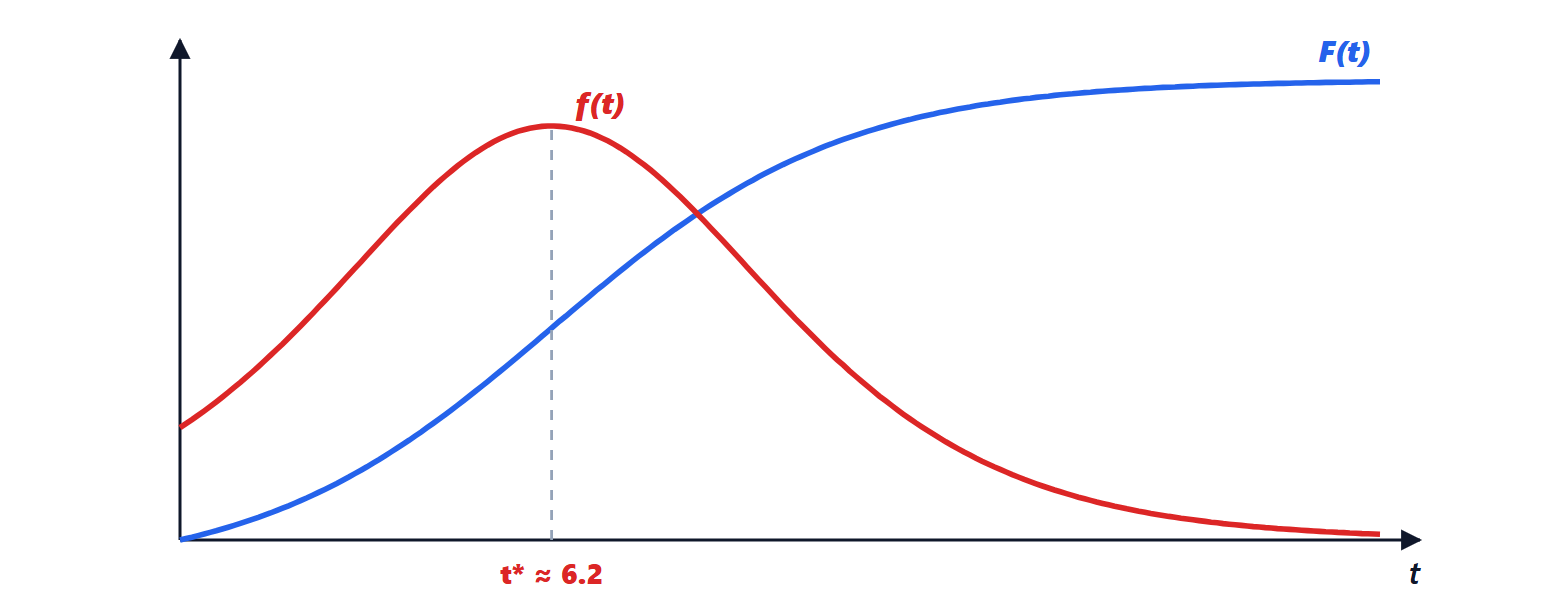
Theorem. Starting from  , sales per period are maximum at the time
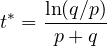
when the fraction of adopters is  .
Proof. Differentiating the equation:  . The maximum of
 is where this vanishes, i.e. at (which exists if
 ). To find the time, use the solution of the equation, which can be checked by substitution:

Setting  :
 , i.e.
 , hence
 and
 . ∎
Example. With typical values for durable goods,  and
 :
 years, when about 46 % of the market has adopted. After the peak, first-purchase sales fall even if the product is a success: this is when replacement, upgrades or a new product are needed. By estimating and from the first years of sales, or by analogy with similar products, future trends are forecast and production capacity is sized.
The development process
New product development is often organised in stages and gates (stage-gate): idea, feasibility study, development, testing, launch. At each gate a committee decides whether to continue, stop or modify the project, on explicit criteria. The value lies in stopping weak projects early, when they have spent little: it is the real option of the lesson on decisions. In software, and increasingly in hardware too, agile methods are used, with short cycles and prototypes tested early with customers.
Intellectual property
An innovation is worth something if its author manages to appropriate the benefits. The tools are:
- the patent: an exclusive right for 20 years on an invention that is new, inventive and industrially applicable, in exchange for its publication;
- the trade secret, for what cannot be seen from the product (processes, recipes, source code);
- the trademark and design;
- copyright, which also protects software;
- and above all lead-time advantages: arriving first, scaling quickly, accumulating experience (lesson on strategy).
In electronics many technologies are covered by standard-essential patents (for example those of cellular networks), licensed on fair, reasonable and non-discriminatory terms: innovators negotiate them, manufacturers pay the licences.