Decisions under uncertainty
Decision criteria, expected value, a decision tree with an example, the non-negative value of perfect information proved, utility, real options, cognitive biases.
Launching a product, building a new plant, investing in a technology that is not yet mature: important decisions are taken without knowing how things will go. Decision theory does not eliminate uncertainty, but makes it explicit and allows alternatives to be compared consistently. In this lesson we look at decision criteria, decision trees with an example, the value of perfect information with the proof that it is never negative, and the limits of expected value.
Criteria
A decision has alternatives  , uncertain states of the world
 and outcomes
 . Without probabilities, criteria such as maximin (choose the alternative whose worst outcome is best, the pessimist’s view) or minimax regret (minimise the maximum difference from the choice that would have been optimal in hindsight) are used. With estimated probabilities
 , the standard criterion is expected value:

and the alternative that maximises it is chosen.
The decision tree
Multi-stage decisions are represented by a tree: squares are decisions, circles chance events, leaves outcomes. It is solved backwards: at each chance node the expected value is computed, at each decision node the best branch is chosen.
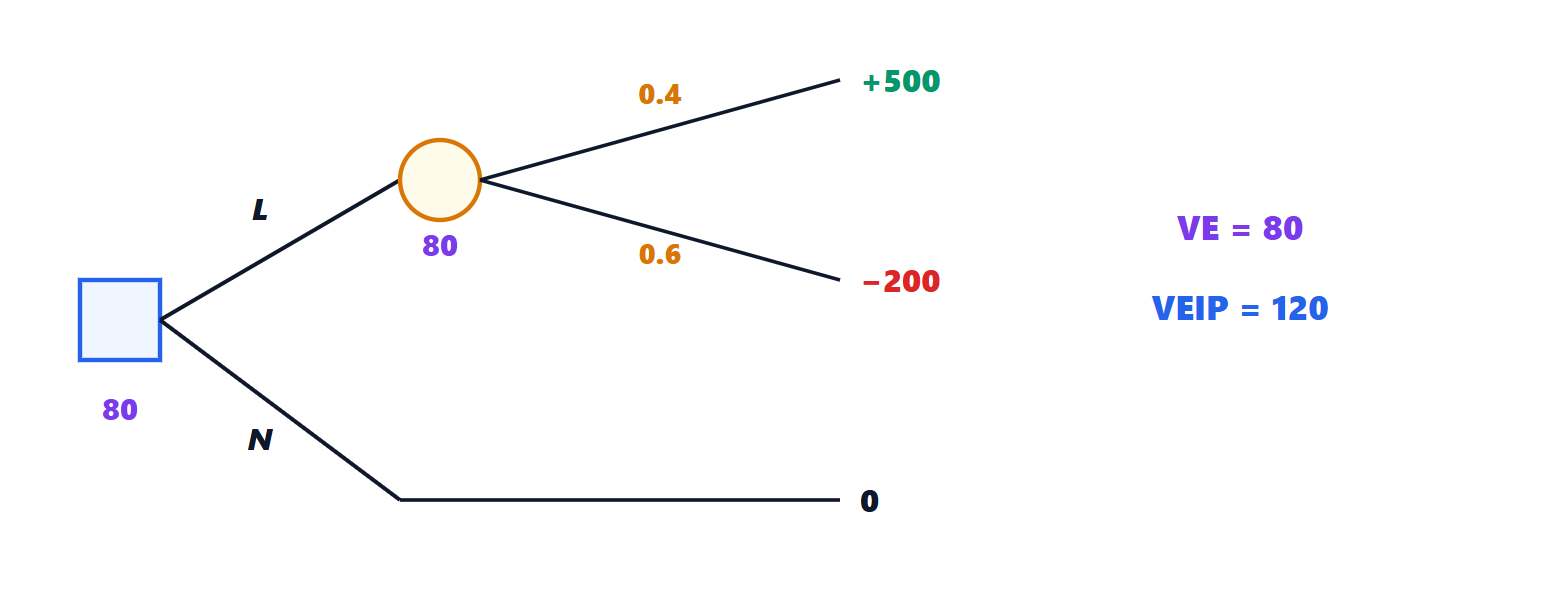
Example. Launching a product has a cost; with probability 0.4 it succeeds and brings a net result of +500 (thousand euros), with probability 0.6 it fails and brings  . Not launching is worth 0. The expected value of the launch is
 : launch.
The value of information
Market research could reduce uncertainty before deciding. How much is it worth? An upper bound is the value of perfect information: if the state of the world were known in advance, the best alternative would be chosen every time.

Theorem. The value of perfect information is never negative.
Proof. For every alternative and every state ,  . Multiplying by
 and summing over :
 for every , hence also for the alternative that maximises
 . The difference is therefore non-negative. ∎
Example. With perfect information one would launch only in case of success:  . The EVPI is
 : no market research can be worth more than 120 thousand euros. Real research is imperfect (sometimes it predicts success and the product fails); its value is computed with a larger tree, updating probabilities with Bayes’ theorem (Signal Theory lesson on probability) according to the research outcome, and it is always less than the EVPI.
Beyond expected value
Expected value is the right criterion for repeated decisions that are small relative to the size of the company: in the long run good and bad luck cancel out. For large, one-off decisions risk also matters: a project with positive expected value but a 10 % probability of bankrupting the company may be unacceptable. Then one uses:
- expected utility, with a concave utility function that weighs large losses more than proportionally (risk aversion);
- worst-case analysis and exposure limits;
- real options: in many projects one can decide in stages, investing little in a pilot phase and the rest only if things go well. The possibility of stopping has a value, which a simple net present value calculation (Business Economics lesson on investments) does not see.
There is also the human difficulty of estimating probabilities: people tend to overrate their own forecasts, to be influenced by the first number they hear (anchoring) and to continue losing projects so as not to admit the mistake (sunk costs). Making assumptions explicit in a tree helps to discuss them.