Strategy: five forces, competitive advantage and the experience curve
Porter's five forces, the value chain and generic strategies, the portfolio matrix, the experience-curve power law proved with an example.
Strategy is the set of choices that establish where a company competes and how it intends to win: which markets, which products, with what advantage over competitors. In this lesson we look at industry analysis with the five forces, the value chain and the generic strategies, the portfolio matrix, and the experience curve with the proof of its form and an example, which explains why market share matters so much in many sectors.
The industry: the five forces
Porter showed that an industry’s profitability depends on five forces:
- rivalry among existing competitors;
- the threat of new entrants, held back by entry barriers (economies of scale, patents, capital required, access to channels);
- the threat of substitute products, meeting the same need in another way;
- the bargaining power of suppliers, high if they are few and indispensable (for example the few advanced semiconductor foundries);
- the bargaining power of customers, high if they are few and large (a component supplier to the car industry).
An industry with weak forces leaves high margins; one with strong forces squeezes them, even if it grows fast.
Competitive advantage
The value chain breaks the company down into the activities that create value: primary (inbound logistics, operations, outbound logistics, marketing and sales, service) and support (procurement, technology development, human resources, infrastructure). Advantage arises from how these activities are performed and linked. The generic strategies are:
- cost leadership: producing at lower cost than competitors, through scale, experience, efficiency;
- differentiation: offering something customers pay more for (performance, quality, brand, service);
- focus: serving a niche better than anyone.
The product portfolio
A company with several businesses compares them on two dimensions, for example in the Boston Consulting Group matrix: market growth and relative share (compared with the leading competitor). Businesses with high share in mature markets generate cash (“cash cows”); those with high share in growing markets need investment to keep it (“stars”); those with low share in growing markets are bets (“question marks”); those with low share in stagnant markets are candidates for divestment. The underlying idea is to use the cash of the first to finance the second and third. Why does relative share matter so much? Because of the experience curve.
The experience curve
It is observed in very many industries, from aircraft to semiconductors to photovoltaic panels, that unit cost falls by a constant percentage every time cumulative output doubles: people learn to produce, processes and designs improve, scale is exploited.
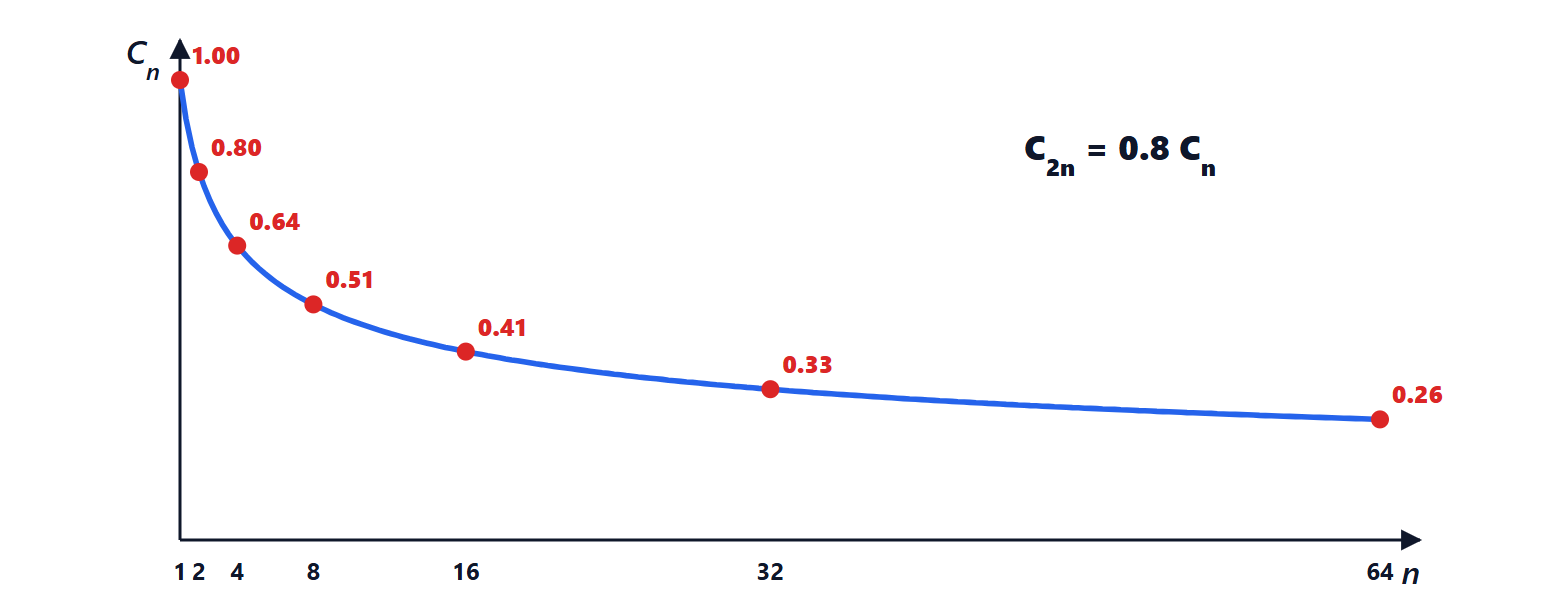
Theorem. If at every doubling of cumulative output the unit cost is multiplied by  (the learning rate), then

Proof. The power law satisfies the property:  , for every
 . Conversely, a continuous monotonic function with
 for every , plotted on a log-log scale,
 against
 , is a straight line, because each doubling moves by
 on the abscissa and by
 on the ordinate: the constant slope
 gives the power law. ∎
Example. With an 80 % curve ( ), the sixty-fourth unit costs
 times the first. If a company has produced twice as much as a competitor, its unit costs are about 20 % lower, and stay so as long as its share stays double: a self-reinforcing advantage, because it allows lower prices and hence even more share. In photovoltaic modules the observed learning rate has been around 80 % for decades, and prices have fallen by more than 99 % since 1976.
What to do
Strategic analysis does not give recipes, but questions: where the industry leaves margins, which advantage is defensible, which businesses to fund. In technology companies a decisive part of strategy is innovation management (lesson on innovation): when to invest in a new technology and when to abandon the old one, which may still be earning well.