Business organisation: structures, levels and processes
Division of labour and coordination, functional, divisional and matrix structures, the minimum number of hierarchical levels proved with an example, process management.
A company of ten people organises itself; one of ten thousand does not. Organisation establishes who does what, who decides and how information flows. In this lesson we look at division of labour and coordination, functional, divisional and matrix structures with their advantages, span of control with the proof of the minimum number of hierarchical levels and an example, and the role of processes.
Division of labour and coordination
Every organisation solves two opposite problems: dividing work into tasks, to exploit specialisation, and coordinating the tasks, so that the result is coherent. Mintzberg identifies the coordination mechanisms: mutual adjustment (people talk to each other, as in a small project team), direct supervision (a boss decides), standardisation of processes (procedures), of outputs (targets), of skills (professionals trained the same way, like doctors). Organisational structures are combinations of these mechanisms.
Structures
- Functional: the company is divided by function (research and development, production, sales, administration). It favours specialisation and economies of scale; but coordination between functions goes up to the top, which becomes overloaded, and nobody below the top is responsible for a product’s result.
- Divisional: the company is divided by products, markets or geographical areas, and each division has its own functions. Each division is responsible for its own result and reacts quickly to its market; the price is duplication of resources and loss of scale.
- Matrix: the two dimensions are superimposed. A person belongs to a function (which looks after their competence) and works on a project or product (which uses their time), with two bosses. It is typical of engineering companies working on contracts; it works if conflicts between the two bosses are managed explicitly.
Span of control and levels
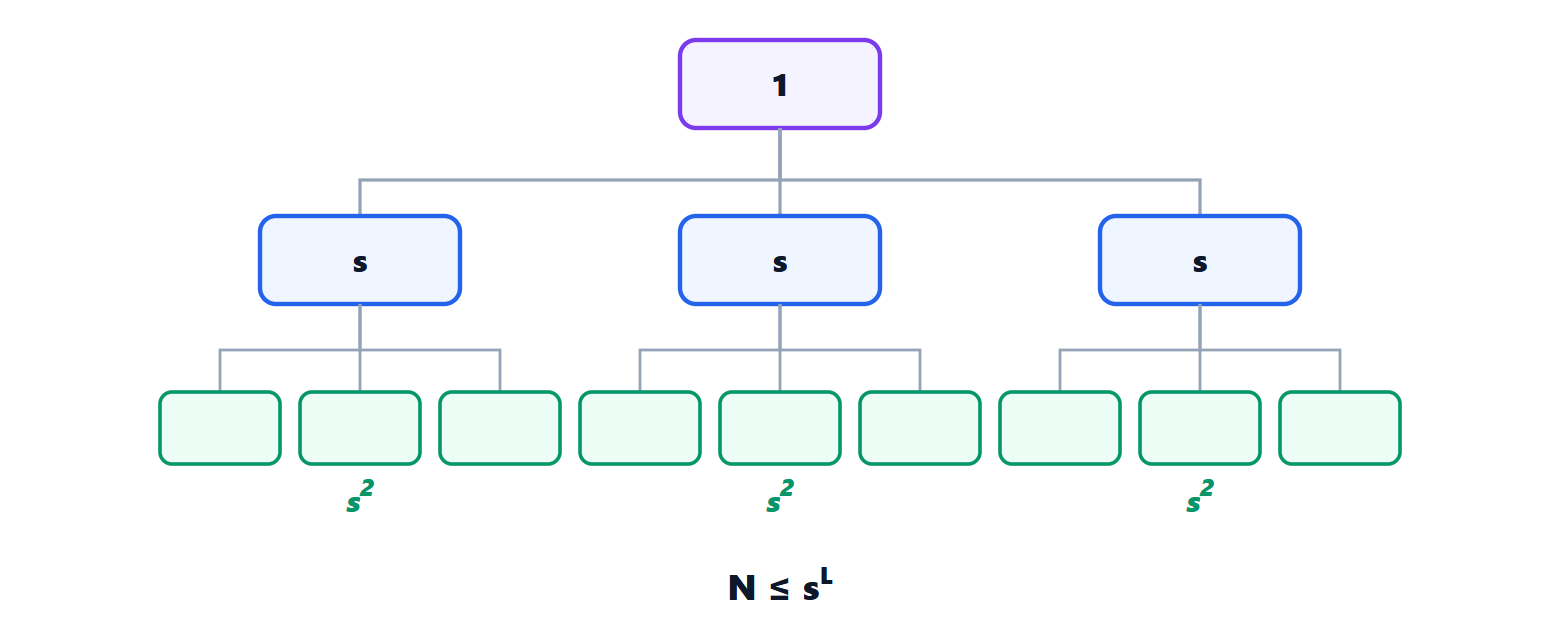
The span of control  is the number of direct reports of a manager. It depends on the work: a shop-floor supervisor with operators doing standard tasks can follow 20-30; a manager of engineers on complex projects 5-8.
Theorem. With span of control at most , organising  people at the operating level requires at least

hierarchical levels below the top.
Proof. The top has at most direct reports; each has at most , so at the second level there are at most  people, and by induction at level
 at most
 . To have people at the lowest level we need
 , i.e.
 , and
 is an integer. ∎
Example. 1000 operators with  :
 , so at least 5 levels. With
 3 suffice. Each extra level slows decisions and filters the information going up: this is why modern companies seek “flat” structures, with wide spans, made possible by autonomous staff and information systems that make results visible (Information Systems lesson on business information systems).
Processes
Structures divide the company vertically; but value for the customer arises from processes that cross them horizontally: from order to delivery, from idea to product, from fault to repair. Managing by processes means appointing an owner for each process, measuring its time, cost and quality from start to finish, and improving it by removing steps that add no value (lesson on lean production). Quality management system standards (ISO 9001) require exactly this approach.
No structure is perfect: the one that fits the strategy is chosen (lesson on strategy), and changed when the strategy changes. A company with a single product in a stable market is fine with a functional structure; a group with many product lines in different markets needs divisions.