Convection, radiation and cooling of electronic components
Newton's law and convection coefficients, dimensionless numbers, the Stefan-Boltzmann law and emissivity, junction temperature with a heat sink, heat exchangers.
A hot body also gives heat to its surroundings by convection, through the fluid flowing past it, and by radiation, emitting electromagnetic waves. Together with conduction, these are the mechanisms that decide the temperature of any electronic device. In this lesson we cover Newton’s law of cooling, dimensionless numbers, the Stefan-Boltzmann law and the thermal calculation of a component mounted on a heat sink.
Convection
Close to a solid surface the fluid is still in a thin layer (the boundary layer), crossed by conduction; further away the fluid’s motion carries the heat away. The overall result is described by Newton’s law:

The convection coefficient  is not a material property: it depends on the fluid, the velocity, the shape of the surface. Orders of magnitude in W/(m²·K):
| Situation | |
|---|---|
| air, natural convection | 2-25 |
| air, fan | 25-250 |
| water, forced convection | 100-20 000 |
| boiling water, condensing steam | 2 500-100 000 |
In natural convection the fluid moves by itself, because heated air expands and rises; in forced convection a fan or a pump moves it. Phase change is by far the most effective mechanism: that is why laptops use heat pipes, in which a liquid evaporates near the processor and condenses near the fins.
Dimensionless numbers
The coefficient comes from experimental correlations written with dimensionless numbers, which make results valid at any scale:
- Reynolds
 : ratio of inertial to viscous forces; it decides whether the flow is laminar or turbulent;
- Prandtl
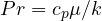 : ratio of momentum diffusion to heat diffusion (about 0.7 for air, 7 for water);
- Nusselt
 : how much convection improves on conduction alone in the fluid.
A typical correlation has the form  ; for natural convection the role of Reynolds is played by the Grashof number, which measures the buoyancy drive.
Radiation
Every body emits electromagnetic radiation depending on its temperature. An ideal black body emits per unit area

(the Stefan-Boltzmann law), with  in kelvin. A real body emits a fraction
 , the emissivity, between 0 and 1. A small surface at temperature
 in a large enclosure at
 exchanges

At temperatures close to ambient it is convenient to linearise:  with
 , about 5.5 W/(m²·K) at 300 K with
 . This is the same order as natural convection, so it is not negligible: a naked human body (1.8 m², skin at 33 °C, room at 20 °C) loses about 135 W by radiation, more than it produces at rest.
Emissivity matters a lot. A bright aluminium heat sink has  , a black anodised one about 0.85: for the same shape, the dark one sheds more heat in natural convection. Visible colour, however, has nothing to do with it: what counts is infrared emissivity, and even a light-coloured anodised finish is highly emissive.
Thermal calculation of a component
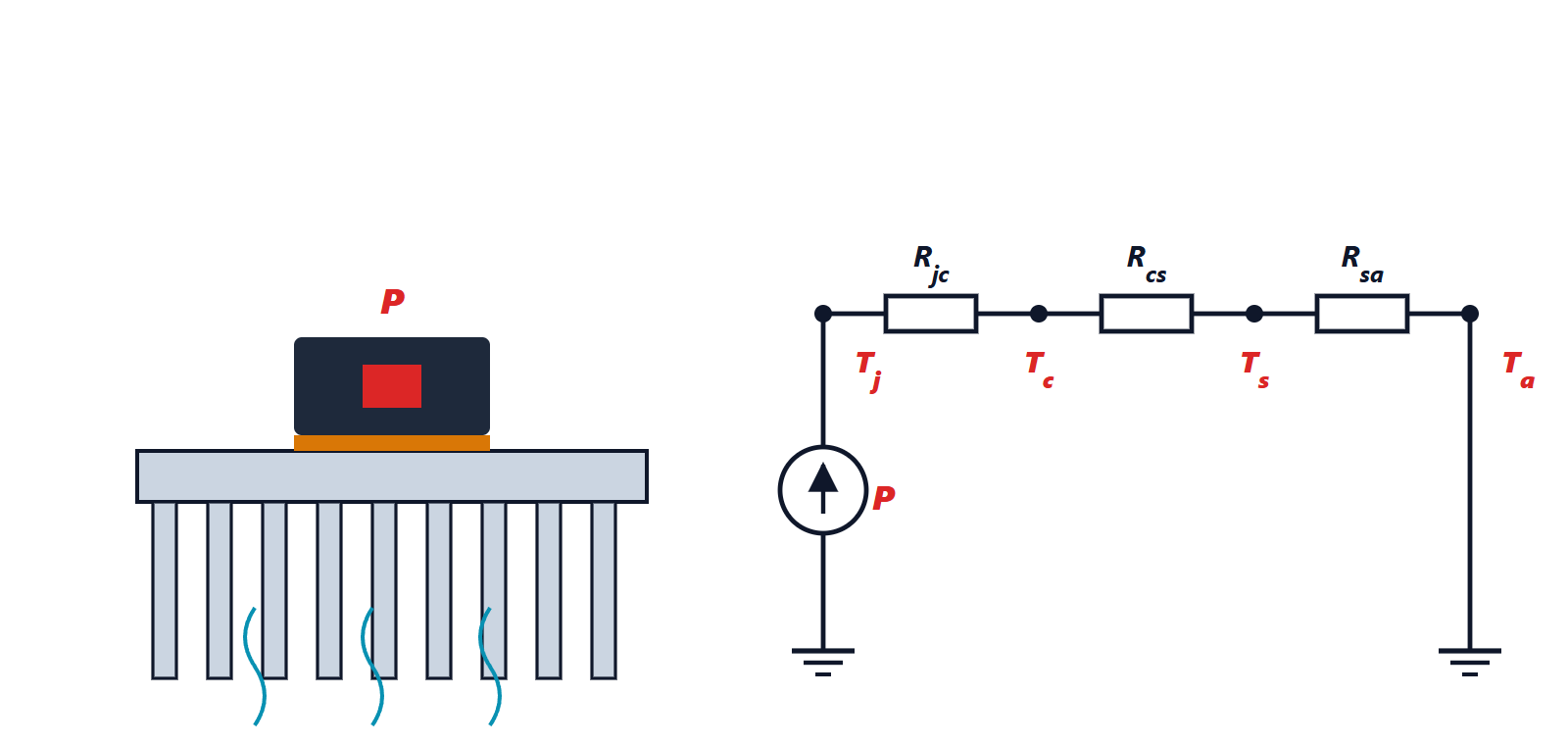
The heat produced in the chip must reach the air through a series of thermal resistances:

 (junction to case) is set by the manufacturer and read from the datasheet;
 (case to sink) depends on mounting, paste and any insulating pad;
 (sink to air) depends on the heat sink and ventilation, and is the parameter the heat sink is chosen by.
Example. A voltage regulator dissipates  W, with
 K/W,
 K/W and a heat sink of
 K/W, in an enclosure where the air reaches 40 °C. The junction reaches
 °C. If the datasheet allows at most 125 °C the margin is too small: a 1 K/W heat sink is chosen (junction at 100 °C) or a fan is added.
The calculation in reverse is the most common: given the temperature limit, the maximum heat sink resistance is found. And the rule of thumb that follows holds across electronics: every 10 °C less at the junction roughly doubles component life, especially for electrolytic capacitors.
Heat exchangers
In heat exchangers two fluids exchange heat through a wall. The overall resistance is the series of convection, conduction through the wall and convection on the other side, and the power is computed with a suitable mean temperature difference (the logarithmic mean of the differences at the two ends). Counterflow arrangements, with the fluids flowing in opposite directions, are the most efficient: the cold fluid leaving can approach the temperature of the hot fluid entering.