Radar: the radar equation, resolution and Doppler
Range measurement, unambiguous range, resolution and pulse compression, the radar equation with proof and example, radar cross-section, the Doppler effect, FMCW, arrays and SAR.
Radar (RAdio Detection And Ranging) transmits radio waves and listens to their echo to detect objects and measure their distance and speed. Born during the Second World War, today it controls air traffic, forecasts rain, measures car speeds, guides automatic braking and parking, and maps the Earth from space. In this lesson we derive the radar equation and see how range, resolution and velocity are measured.
Measuring range
A pulse radar transmits short pulses and measures the delay  of the echo. The wave travels there and back at the speed of light:

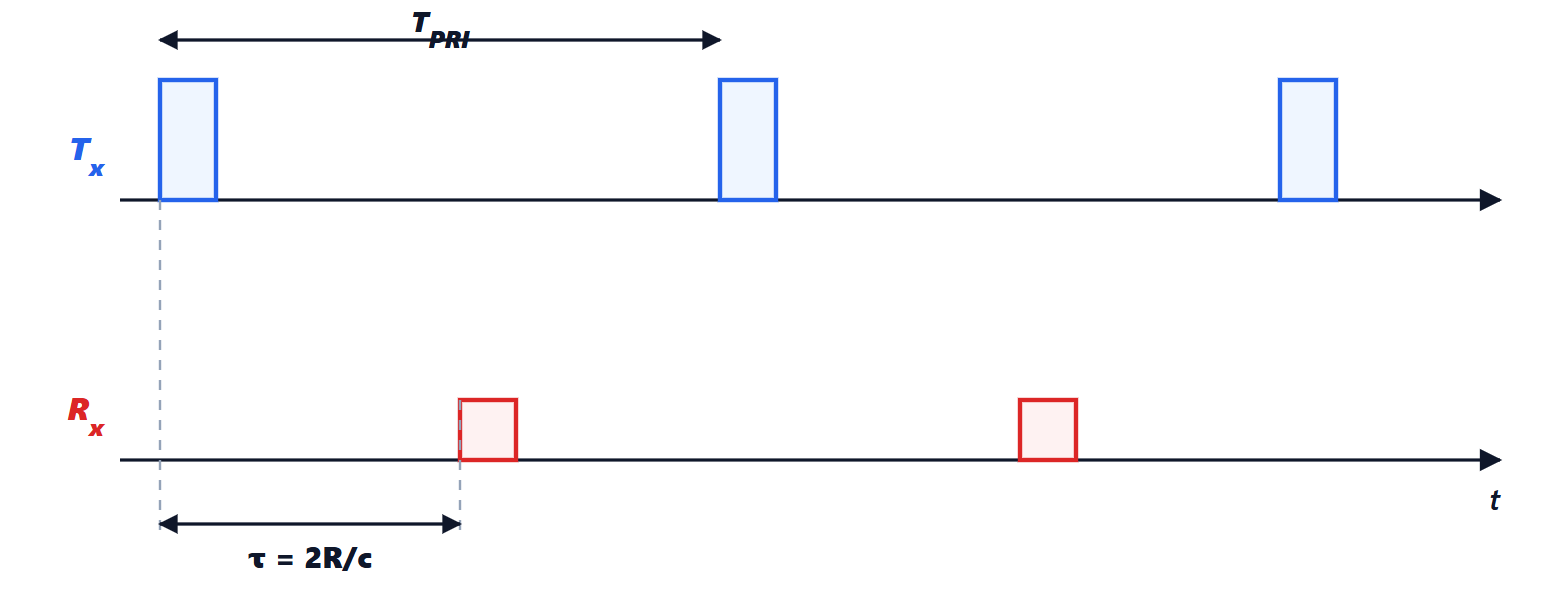
Unambiguous range. Pulses repeat with period  (pulse repetition frequency PRF). An echo arriving after the next pulse would be attributed to it, and the target would appear close. The maximum unambiguous range is

with a 1 kHz PRF, 150 km.
Resolution. Two targets are distinguished if their echoes do not overlap: for a pulse of duration  , the range resolution is
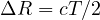 , 150 m with 1 µs. Shorter pulses give better resolution but, for the same peak power, less energy and hence less range. Pulse compression (Signal Theory lesson on correlation) resolves the conflict: a long, modulated pulse (in frequency or with a code) is transmitted and correlated on reception, giving the energy of a long pulse and the resolution of a short one, tied to the bandwidth:
 .
The radar equation
Theorem. The power received from the echo of a target at range  is
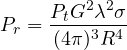
where  is the antenna gain (the same for transmission and reception) and
 the target’s radar cross-section, in m².
Proof. As in the Friis formula (Electromagnetic Fields lesson on antennas), at range the power density is 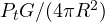 . The target intercepts and re-radiates in all directions an amount equal to what a surface would receive:
 . On the way back this power spreads again over a sphere of radius , and the receiving antenna, of effective area
 , collects
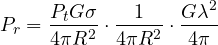
which is the formula. ∎
The  dependence (instead of the
 of a link) is radar’s great difficulty: doubling the range needs sixteen times the power.
Example. A 10 GHz radar ( cm), 1 kW peak power, 30 dBi antenna, target with
 m² (roughly a small aircraft seen head-on) at 10 km:
 W, about −103 dBm. A very faint echo, detected thanks to the integration of many pulses and to compression.
Radar cross-section depends on shape more than size: a corner reflector (three perpendicular planes) a few decimetres across has a huge cross-section, used on buoys and boats; a “stealth” aircraft is designed with slanted surfaces and absorbing materials to reflect energy away from the radar, reducing by many orders of magnitude.
Velocity: the Doppler effect
A target approaching with radial velocity  returns an echo shifted in frequency by

(the factor 2 comes from the round trip). At 10 GHz, a car at 30 m/s (108 km/h) produces a 2 kHz shift, easy to measure precisely. It is the principle of radar speed cameras and of weather radars, which also measure wind speed through the motion of raindrops.
The Doppler shift is also used to separate moving targets from stationary clutter (ground, buildings, sea): filtering out the zero-frequency component leaves only the moving objects.
Modern radars
- Frequency-modulated continuous-wave (FMCW) radars: they transmit continuously a frequency rising linearly; the difference between the transmitted and received frequencies is proportional to the delay, hence to the range. They are simple and low-power: the 77 GHz radars in cars, for adaptive cruise control and emergency braking, are of this type, on a single chip.
- Phased-array radars: the beam is steered electronically in microseconds (lesson on antennas), tracking many targets at once.
- Synthetic aperture radar (SAR): mounted on a moving satellite or aircraft, it combines the echoes collected along the path as if they came from an antenna kilometres long, and produces images of the ground with metre resolution, by day and night and through clouds.