The multipath radio channel, fading and OFDM
Delay spread, intersymbol interference and coherence bandwidth, Rayleigh fading and diversity, OFDM with FFT and cyclic prefix, the Wi-Fi example, OFDMA and MIMO.
In free space the signal reaches the receiver along a single path. In a city, a house, a moving car it arrives along many paths instead, reflected by buildings, walls and vehicles, with different delays and attenuations. The copies add up and the received signal fluctuates, distorts and changes over time. In this lesson we cover the multipath channel, fading, coherence bandwidth and time, and the solution adopted by Wi-Fi, 4G, 5G and digital television: OFDM.
The multipath channel
The channel is described by its impulse response, a sum of delayed copies:
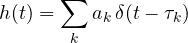
The difference between the longest and shortest delay (or an RMS value of it) is the delay spread: tens of nanoseconds in a room, a few microseconds in a city, up to 10 to 20 µs in hilly areas.
Two consequences.
- In time: if the delay spread is comparable to a symbol’s duration, each symbol overlaps the following ones: intersymbol interference. At 10 Msymbols per second a symbol lasts 0.1 µs, and a 1 µs delay smears it over ten symbols.
- In frequency: the response
 is not flat. The copies add in phase at some frequencies and in antiphase at others, with deep notches (frequency selectivity). The coherence bandwidth, the range over which is roughly constant, is of the order of the inverse of the delay spread: with 1 µs, about 200 kHz.
Fading
If the terminal moves, the phases of the copies change and their sum fluctuates in time: this is fading. Moving half a wavelength (6 cm at 2.4 GHz) can take you from a peak to a 20 to 30 dB notch. With no dominant direct path, the received amplitude follows the Rayleigh distribution, and the error probability falls much more slowly than in a noise-only channel: instead of exponentially, as  . Reaching 10⁻⁵ takes tens of extra decibels. The speed of the fluctuations depends on the Doppler shift,
 , and its inverse is the coherence time.
The defence is diversity: receiving the same data through several independent “routes”, which are unlikely to be all in a notch at once. Space diversity (several antennas at least half a wavelength apart), frequency diversity (distant subcarriers), time diversity (coding and interleaving).
OFDM
The idea: instead of sending a fast stream on one wide carrier, send many slow ones on many narrow subcarriers. Each subcarrier is narrower than the coherence bandwidth, so it sees a flat channel: a simple complex gain to compensate. Symbols are long, and the delay spread takes up only a small fraction of them.
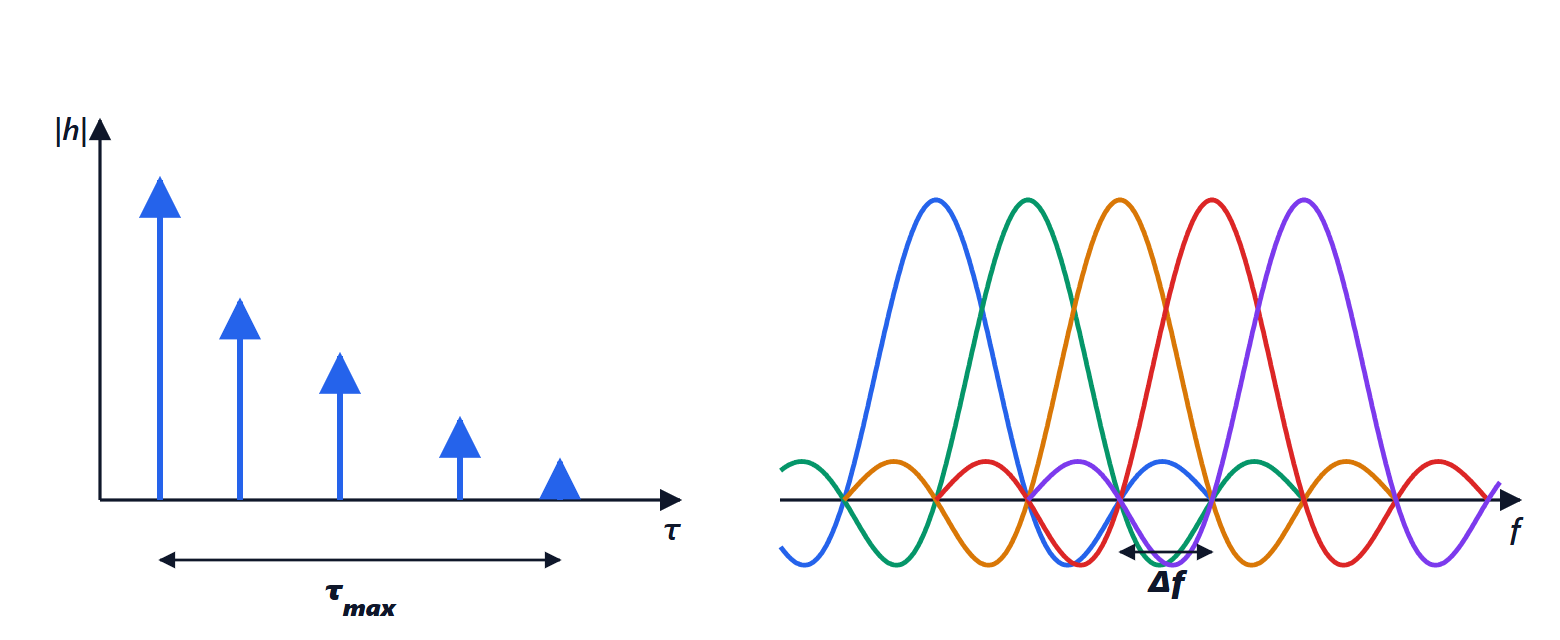
Orthogonality. The subcarriers, spaced  with
 the symbol duration, overlap but do not interfere: each one’s spectrum is a sinc peaking where all the others vanish (figure). In time:
 for
 , because the difference completes a whole number of oscillations in .
Implementation with the FFT. Generating hundreds of oscillators would be impossible; but the sum of modulated subcarriers, sampled, is exactly an inverse DFT of the symbols. The transmitter computes an IFFT, the receiver an FFT (Numerical Analysis lesson).
The cyclic prefix. Before each symbol its final part is repeated, for a duration longer than the delay spread. The delayed copies of the previous symbol all fall in the prefix, which the receiver discards; and within the symbol the convolution with the channel becomes a circular convolution, which the DFT turns exactly into a product. Each subcarrier  therefore arrives multiplied by
 : equalisation takes a single division per subcarrier, instead of long, complex filters.
Example: Wi-Fi. In 20 MHz, a 64-point FFT: subcarriers spaced  kHz, a 3.2 µs symbol plus a 0.8 µs cyclic prefix, enough for the paths of a house or an office. Recent versions use larger FFTs and denser subcarriers.
The price. The OFDM signal is the sum of many sinusoids, and now and then they add in phase: the peak-to-average power ratio is high, and the power amplifier must work far from saturation, with lower efficiency. Moreover orthogonality is sensitive to frequency errors and Doppler shift, which must be corrected precisely.
OFDMA and MIMO
In OFDMA (4G, 5G, Wi-Fi 6) different groups of subcarriers are assigned to different users, each on the frequencies where their channel is best. With several antennas at transmitter and receiver (MIMO), the channel between each pair of antennas is different, and on each subcarrier several independent streams can be sent at the same time in the same band: with 4×4 antennas, up to four times the capacity. This is what made the speed jump of recent systems possible without needing much more bandwidth.




